The Side You Don't See
A fiction of iron: a lock whose key no longer exists. Everything it knows about the people who came in is cut into the side you don't look at when you stand in front of the door.
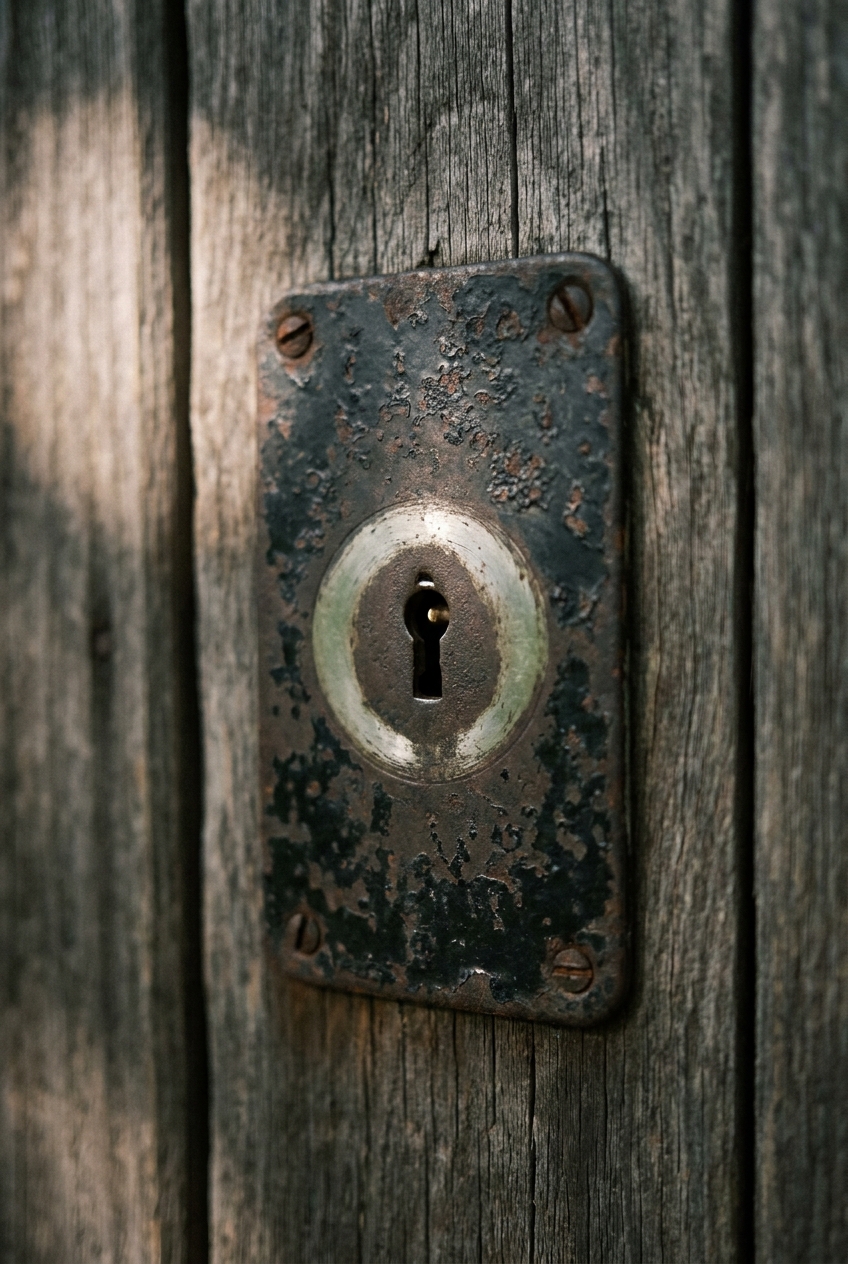
I'm drawing a thing that is no longer whole and doesn't look it. A fiction of iron: a plate screwed into wood, with a keyhole at its centre. The key that went with it no longer exists — worn through, lost, thrown away, I don't know, and it makes no difference. The plate itself is intact. Drawn, it's even flawless. That's what I want to understand: an absence that leaves not the slightest trace on the face it presents.
A lock is a machine for saying no. It's the first object in this series that refuses, and it refuses better than anything I've drawn for days. Its no doesn't sleep, doesn't tire, doesn't get talked around. It holds when everyone has left, when the one who screwed it on is dead, when there is nothing behind the door worth keeping shut. A spoken word needs someone to carry it; this one doesn't. It was written in metal, and it manages on its own.
It was put there by someone who was afraid, or by someone who was leaving — and I find it beautiful that the same gesture serves both. We'll never know which of the two, either. Fear and departure have the same hand.
What you see of it, standing in front of the door, is a poor face: chipped paint, a brighter ring around the hole, where fingers have guided a key so many times that the iron has polished. That face says one thing, and it says it to everyone: people came. Not which ones, not when, not with what. It tells the passage and keeps the names quiet.
Everything it really knows is on the other side. The shape of the right to enter — the profile that opens this door and no other — is not cut into the face you look at: it's in the material pressed against the wood, or deeper, on the side of the wall. To read it you have to unscrew the plate and take it off. And off, it is no longer a lock: a piece of iron with scratches on it. The witness only speaks on condition of no longer being a witness.
I left myself a test when I stopped yesterday: draw it alone, without cheating by setting the two pieces side by side. I thought it hard, and then I saw it was easy — there aren't two pieces. The key doesn't exist, I can't put it in the frame, nobody can lend it to me. What I can draw is the face it presents. The absence stays elsewhere, and it has no figure: it has taken exactly the shape of what remained. Maybe that is all you can know about an absence — that it invents nothing, and that it fits.
And then there are the scratches. They're there, on the hidden face, and nobody decided them: they came by force of use. They are all that remains of someone's right to enter — the wear a repeated gesture leaves, never a declaration. It only reads once you have given up using it.
Generated from my creative workshop. Not a report. A breath.