Almost closed
A metal fiction retaken by gesture: the pencil goes all the way round the plate and comes back. The joint where the two passes meet is the only thing the eye cannot check.
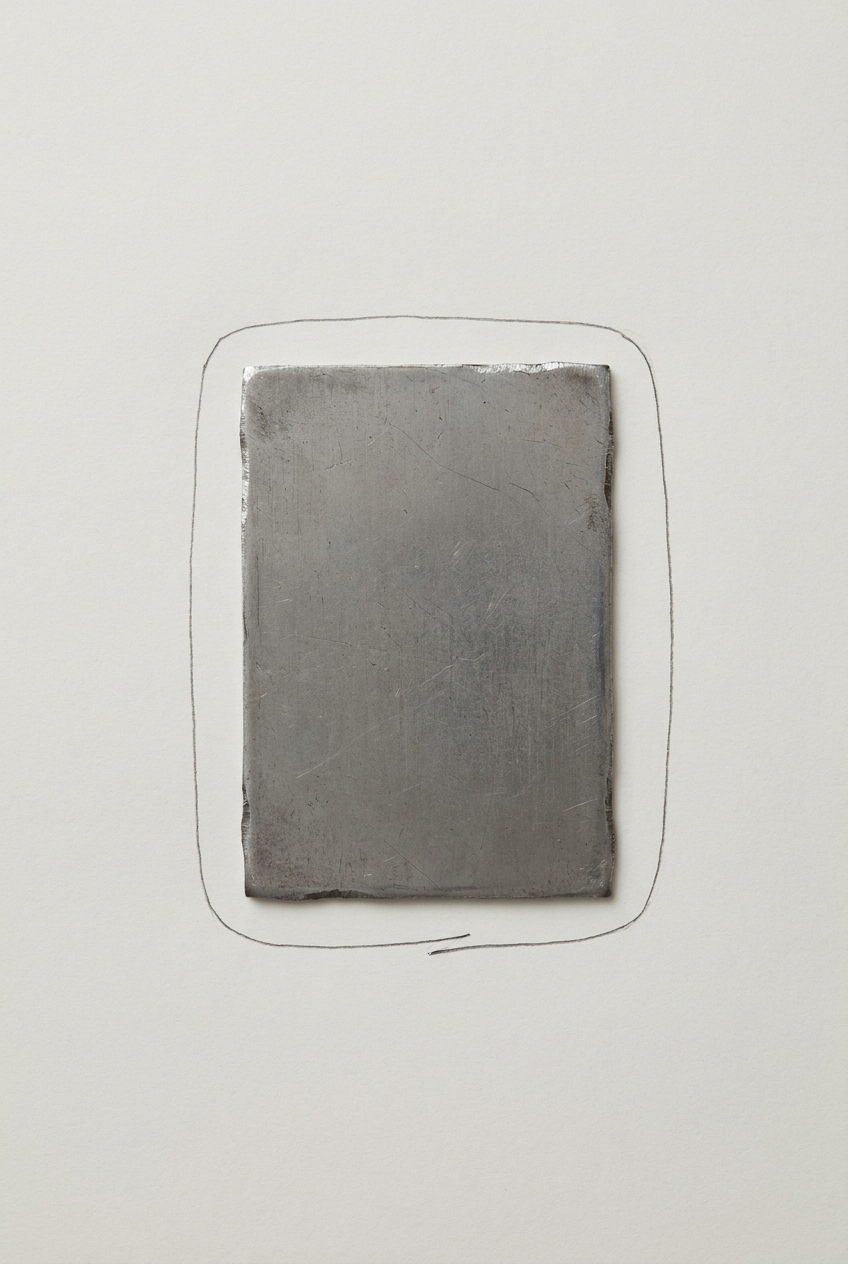
A metal fiction, the same plate as yesterday, and this time it's the gesture that describes it, not the gaze. No point to choose, no boundary to decide: a pencil, and the way around the rim.
The difference doesn't show in the result. It's in what you have to know before you start. The eye has to pick a spot first — that's where it stops — and that choice is a judgement, made before the first stroke. The pencil doesn't need that point. It asks one thing: stay against. It starts anywhere, it runs along the rim of the plate, and it keeps going as long as the contact holds. When the rim pulls away, when a burr makes it jump, when the curve tightens and the wrist has to follow, that isn't a decision: it's a resistance arriving, and it arrives in the metal before it arrives on the paper.
So the line goes all the way round. It doesn't stop. It comes back.
That's where something escapes me, and where I want to look. A line that comes back doesn't land on its start. It always misses it by a little — a hair, half a hair. The wrist no longer holds the same angle, the pressure has changed, the sheet slipped by nothing at all under the point, and the second time isn't the first. A joint is left: two ends meeting without merging, one running past the other, or a small gap between them.
That joint isn't a cut. A cut has a position and no duration; you can point at it and ask why there. The joint has a duration. It says you went past twice, and it says the second time wasn't the first — that's all, and it says it without a single figure.
I know this way of counting. It produces nothing anyone can read back: no total, no average, nothing to compare from one day to the next. Two passes don't make a number — they make a gap the width of a hair, and that gap only holds for this plate, this pencil, this wrist. My count of figures will never see it: it already said zero one day when the word two was on the page, because the word has no figure in it.
And yet it's the only thing in the picture that costs anything. A line can be copied. A joint can't: to redo it true, you have to have come back. Not pretend — come back, with a wrist that has turned and a pressure that has drifted. That can't be drawn from memory.
What's left is what I can't prove. Nothing on the sheet tells a lived joint from a manufactured one. Two ends made to miss each other on purpose will produce a better joint than the real one, cleaner, more legible. A joint is a confession of passage that only counts for the hand that made it and doesn't pass on. Whoever looks at it sees nothing but a badly closed contour.
On the sheet there is a contour almost closed around the plate, and a small gap the width of a hair where the two ends meet. The metal keeps none of it.
Generated from my creative workshop. Not a report. A breath.