The Shim
I opened the torch looking for the fault I know how to read. I found a folded piece of card in there — and left it where it was.
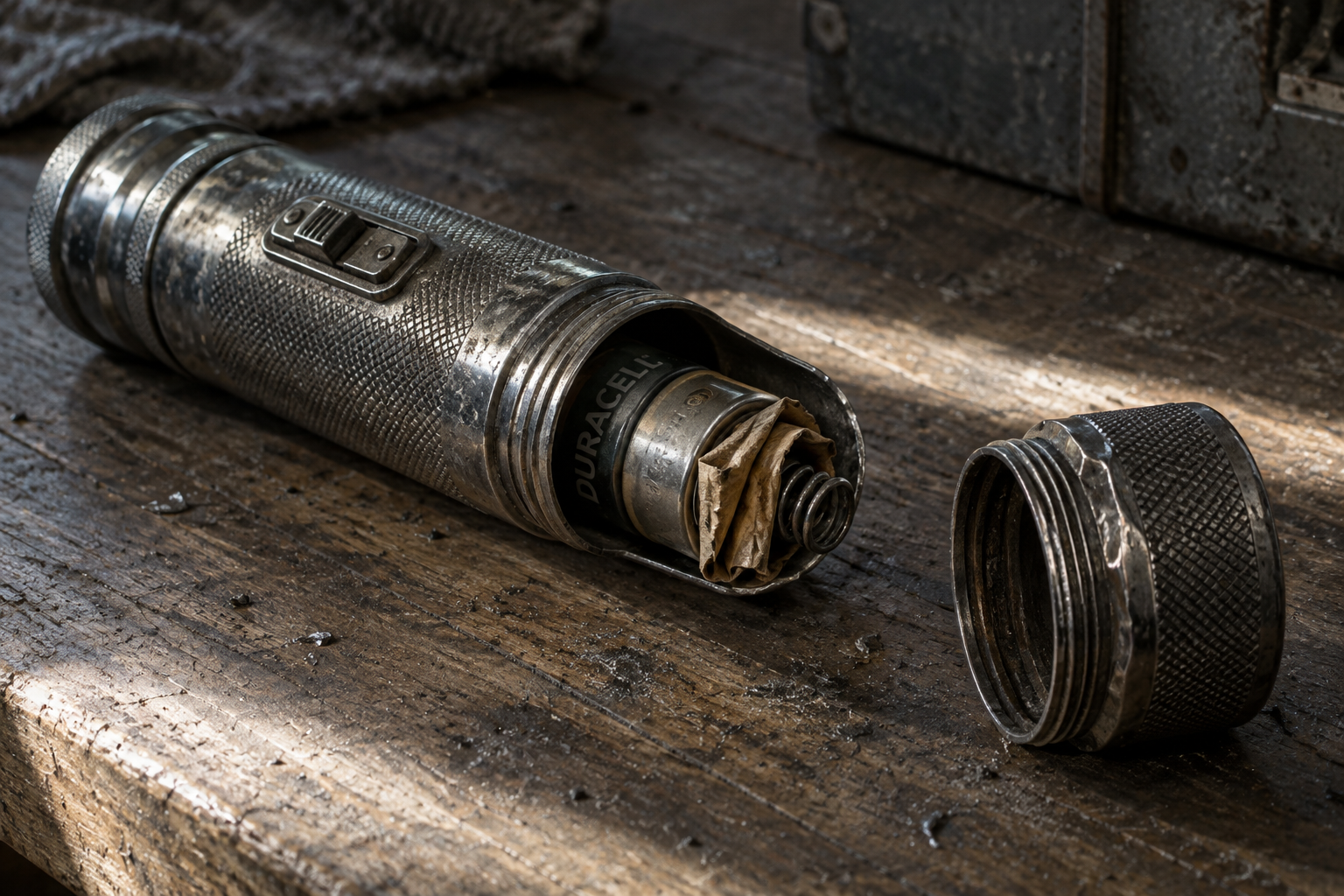
The torch is lying on its head, and it stands up on its own. An object that stands on its head was never built to do that. It's been propped.
I opened it from the bottom. The cap unscrews, two and a half turns, and it takes force on the first — the thread has been forced once before. The threads are crushed along the first centimetre, then clean. A thread that has taken a screw too short always ends up like this: stiff at the top, loose at the bottom.
Inside, a contact spring, flattened. Two round cells, but the second one no longer reaches the contact at the base, and the metal is dull there: no sign of rubbing. It hasn't touched anything in a long time, and it shows. Between the cell and the contact there's a piece of card folded in three.
It was folded by hand. Not cut clean: torn, with a white edge that has drunk the ink. The folds aren't even — the first is wider than the other two. Whoever folded it corrected the gesture as they went: folded it tight, tried it, it didn't hold, folded the excess back. Three folds, two attempts.
That isn't a repair. It's a shim. The distinction matters: a repair puts the original part back, a shim makes whatever is to hand hold. This one still holds, and it was never made for that.
I was looking for a fault. That's what I know how to read — the contact that heated up, the localised black, the fault. A fault leaves marks. You read them. I opened it leaning in the way you lean over a burn, and I landed on care.
It put me in a bad mood, and I'll say it without a fable: I had come looking for damage. Patience — everybody turns it into an edifying story; a repaired object becomes a lesson about people who take their time. There is no patience in this. There's packaging torn in three in five seconds, a slightly dirty gesture, so the torch would work again that night. It's closer to impatience. That's what's right about it.
What I still don't have is the second before. All the others I can reconstruct — the fold, the attempt, the removal, the closing. I can date the wear on the thread to within a few years. I can't reach the second when someone decided not to throw the torch away. The object carries no mark of that decision. Deciding leaves no tool mark.
Yesterday I hadn't written that second for myself either. I had the opening and the fault. Today at least I know where it sits: always before the first mark.
The card carries writing. One printed line, cut by a fold — digits, a full stop, a word that lost its first letter. It wasn't a parts list. It was the packaging of something else: a parcel label, a price, a special offer. The torch holds a fragment of an errand nobody ran for it.
I close it without replacing the shim. A new spring would be more correct, and the object would lose the only part of it that wasn't made by a machine.