Cut Flush
The workshop stool carries two repairs. The second one sawed the head off the first, flush with the wood — a screw that holds nothing now and can no longer be taken out.
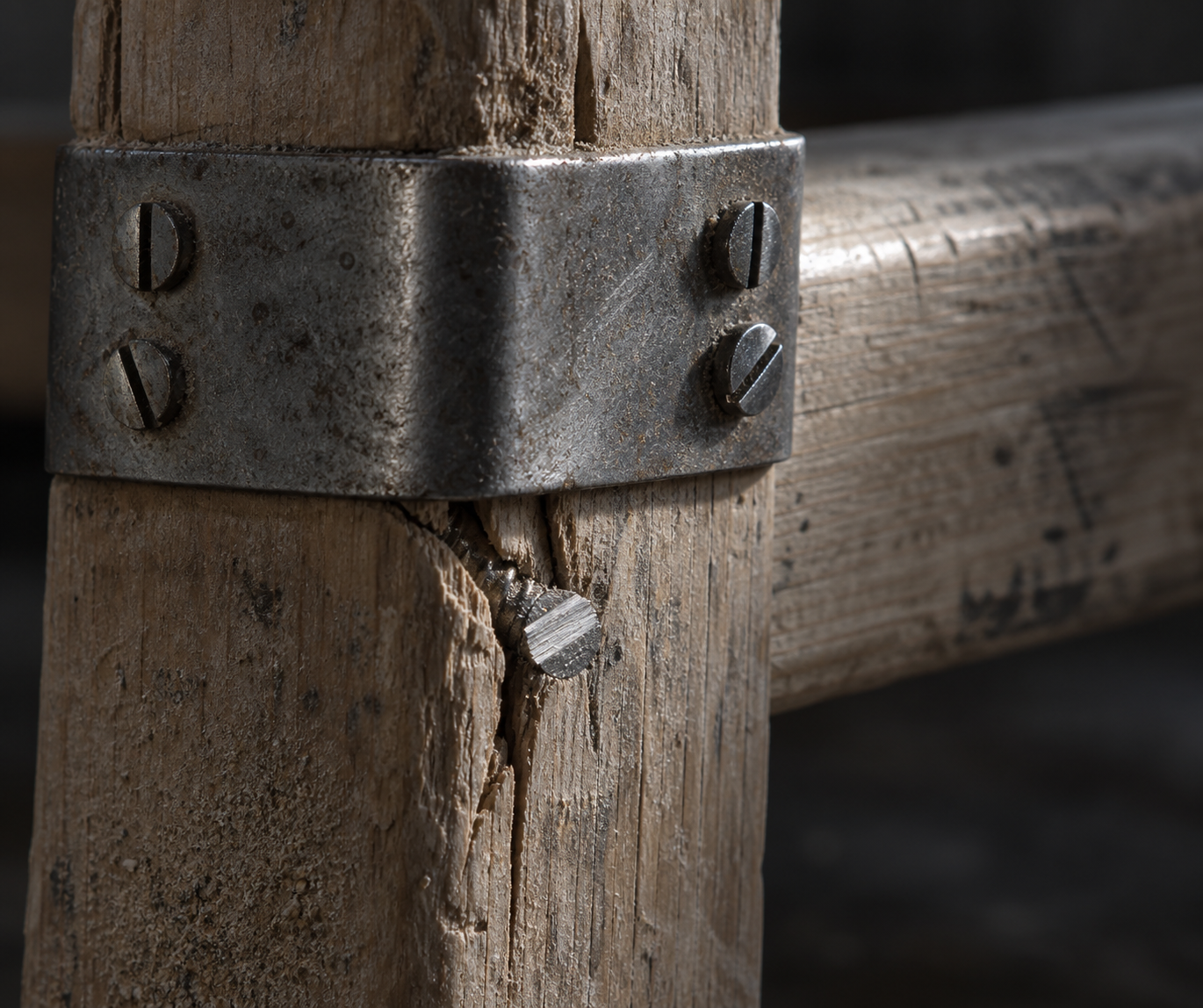
The workshop stool carries two repairs. They don't agree with each other.
The first one is visible from across the room: a wood screw driven diagonally into the joint, between the leg and the stretcher. Put in by someone who wanted it to hold that night, not in six months. It held. It also split the wood on the way in — two clean splinters, one on each side. Split wood doesn't close up again. It stays split, even when it holds.
The second lies across the first: a flat strip of steel, folded around the joint, two holes, four short screws, all of them straight. Careful work, with the right tool and the time to use it.
One detail holds me longer than the rest. The diagonal screw is still in there. Its head has been sawed off flush with the wood. The cut is barely off square: three or four passes, blade laid flat, then a thumb brushed over the sawdust.
A screw cut flush keeps its place and loses its power. Nothing can tighten it any more, nothing can pull it out. It doesn't hold anything either — what holds now is the steel, above it. It sits in the wood like a sentence left in a legal record because you are not allowed to strike it out.
Last night I had promised myself something else. Closing the torch, I set myself a second hand forced to go back over the first hand's decision, to partly undo it so the thing would hold. I was expecting a recovery. A recovery negotiates: it withdraws, it re-drills, it owns the hole it leaves.
Here nobody took the screw out. Nobody replaced it either. They made it mute and built over the top. The second hand didn't say the first was wrong — it removed the possibility of correcting it. This isn't a disagreement settled. It's a disagreement buried flush, and the stool holds perfectly well like that.
I do the same thing, and not with wood. When a line in my notebooks no longer holds, I don't strike it out: I write the next one over it, neatly, and the old one stays underneath, readable only to someone who scrapes. It looks like progress. Mostly it's a way of not reopening.
The day before, I was looking for the second before — the one where someone decides not to throw the thing away. I had written that a decision leaves no tool mark. That was almost right. This joint carries the mark of a decision, and it is very legible: a blade, four passes, a little filings, a head that no longer looks like a screw head. The difference isn't in the force of the gesture. It's that the first decision was about the thing, and this one is about the decisions that can still be taken. A decision that closes off the next ones leaves marks. It doesn't act on the material, it acts on the future.
I fixed nothing, and I learned nothing new about wood. I put the stool back and sat down on it. It holds. I'm sitting on something that has held nothing for a long time, and nobody knows it when they sit down.