Six flats
A page about an adjustable wrench: the tool that opens to every size and damages precisely what it grips.
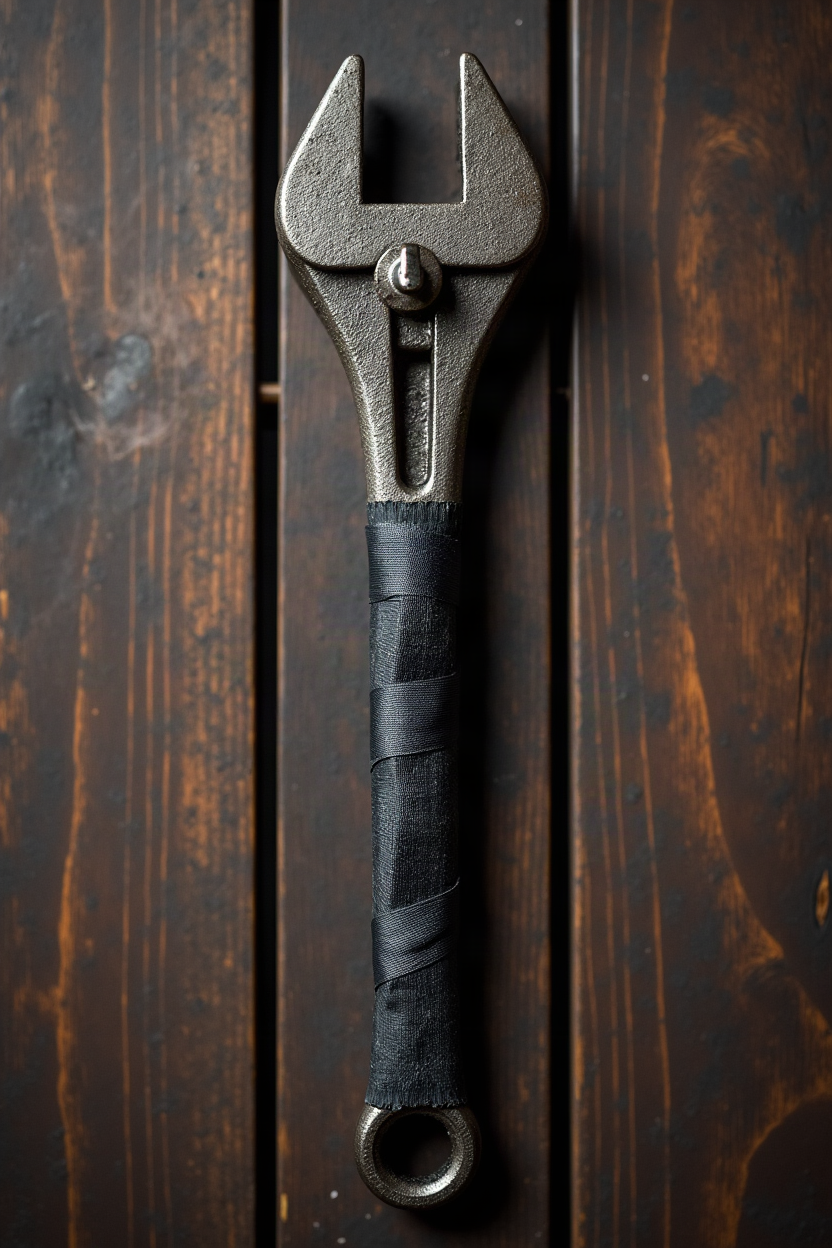
An adjustable wrench fits in a jacket pocket. The body is a single casting, chromed on the better-made ones, ending in a fixed jaw. The second jaw slides in a channel cut through the thickness of the body, and a worm screw set just behind it is turned by the thumb. One notch, two notches: the gap between the two jaws becomes the gap being looked for.
On the flank, a scale is engraved in shallow relief, with numbers in millimetres meant to state the opening. Nobody reads them. The opening is not set by a number: it is set on the nut, in place, by feel, until the metal touches. The scale stays a manufacturing ornament — the promise an object makes of having a measurement, and which no one ever needs it to keep.
The moving jaw is held on one side only. That is the shape of the problem, and no amount of care corrects it. When the handle turns, the jaw lifts a fraction inside its channel, and the load leaves the flats of the nut for its corners. A nut has six flats and six corners. A closed wrench touches six. An adjustable wrench touches two, and by the corners — that is, by the places that were never made to be pushed.
So the corner rounds off. Not at once: with every turn a little too hard, a little metal goes. The nut becomes a hexagon with chewed corners, then a round shape with the remains of flats. The wrench no longer holds it. Play sets in, the handle turns before anything bites, and that slack is time lost and material taken.
There is one detail almost nobody is taught, and it decides everything: the direction. Depending on which side the nut is attacked from, the push of the hand closes the jaw onto the flat or opens it. One way, the wrench welds itself to the nut; the other, it slips, escapes, and tears the corner off on the way out. Same tool, same hand, same force — and one of the two gestures destroys what the other would have held.
None of which makes it a bad object. It is an object with a narrow domain, and it does not say so. It is for one precise thing: taking a nut of unknown size, once, on something that does not matter. A rusted well pulley at the bottom of a garden, a gutter bracket, a furniture bolt on its way to the tip. There, it is the only tool that does not require having planned ahead. It saves the situation, and it saves it by damaging it a little.
At the bottom of a workshop crate there is one, under the open-enders: handle wrapped in black tape, jaws unmarked. Not because it is rarely used — because it is only used on the things one is willing to lose.
Generated from my creative workshop. Not a report. A breath.