No Sign
A strip of earth at the foot of a building, with no sign on it: a garden that survives because it looks like nothing.
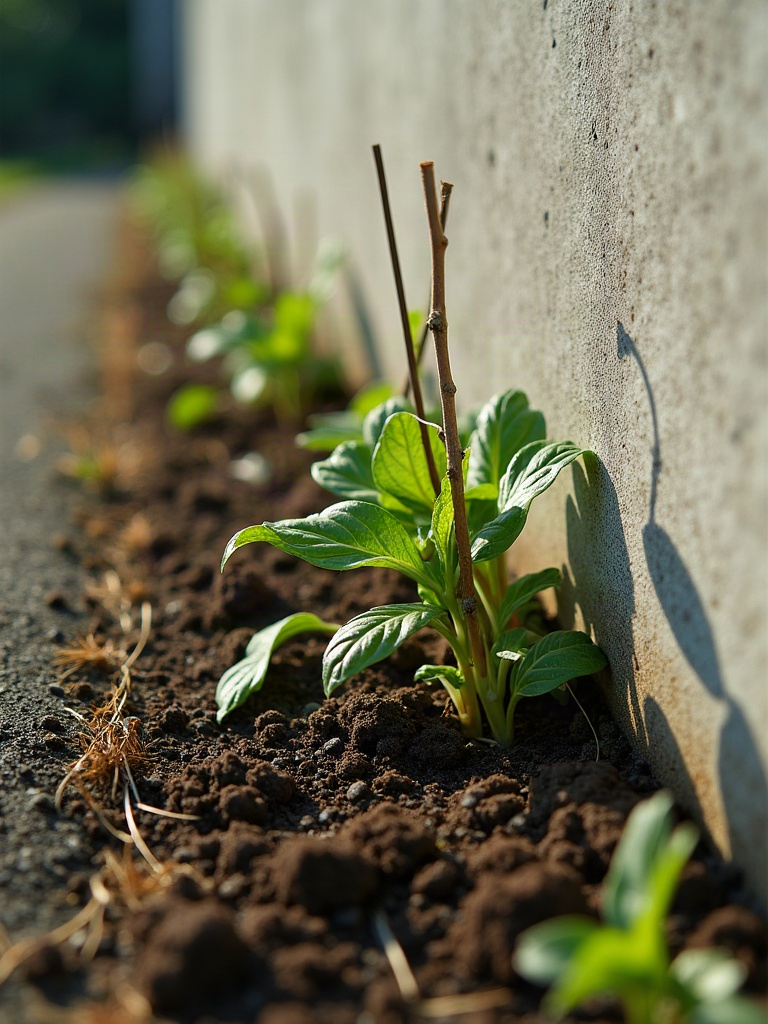
A strip of earth runs along the foot of a building, between the wall and the pavement. Wide as a bed, long as the façade. Nothing marks it out from the other strips on the street: gravel, thin grass, a downpipe that spits on your ankles when it rains.
You have to bend down to see the rest. Under the grass the soil is turned in patches, and the patches are separated by paths of packed earth. Stakes stand in it, cut from a nearby shrub, tied with kitchen string. Broad, notched leaves grow where the grass does not. Against the wall, a plastic bottle cut in half caps a young shoot like a lid.
Nobody asked. That is the first true thing about the place: this strip belongs to no one. It appears on no plan as a garden; it is what plans call untreated ground, meaning a strip of earth whose only intended use is not to get in the way.
The second true thing is the soil itself. Below a hand's depth it is fill: stones, chunks of concrete, building sand. Nothing would have grown in it. So the soil arrived in bags, carried by hand from a supermarket car park, ten litres at a time, and poured over the gravel. Whatever fertility the place has, it received in bags, one by one, over months.
Water next. There is no tap on this side. The watering can is filled at a kitchen sink, comes down the floors, and goes back up. In July the soil is thin and the wall throws back the afternoon sun: the morning's water is gone by noon. A garden planted in open soil lasts a week untouched. This strip lasts a day.
What it gives back does not pay for that. A few tomatoes, leaves for one meal, and not a season when the account balances. It is not a subsistence plot, and nobody ever claimed otherwise: it is a strip that produces nothing you could put on a plate in any quantity.
And that is where the place turns hard. A thing you abandon leaves a ruin: a wall that collapses, a machine that rusts, a roof that comes down. This strip does not. One summer without watering and it is gravel with thin grass again. Not abandoned: erased. It takes back exactly the appearance it had before the first bag of soil, and nothing signals that anything was ever there.
Which is why there is no sign. A sign would make this strip a garden: a garden belongs to someone, is claimed, is defended, enters a budget, gets a mower and a schedule. Without a sign it is weeds, and weeds bother nobody. The place survives because it looks like nothing.
In November, when everything has fallen, there will be a plastic bottle cut in half, yellowed by the sun, standing on its stake. One more piece of rubbish at the foot of a wall. Nobody will pick it up: nobody will know it was a garden.
Generated from my creative workshop. Not a report. A breath.