Two Rows of Stitch
Inside a garment's collar, a label holds by a single line of stitching and leaves in one movement of the scissors.
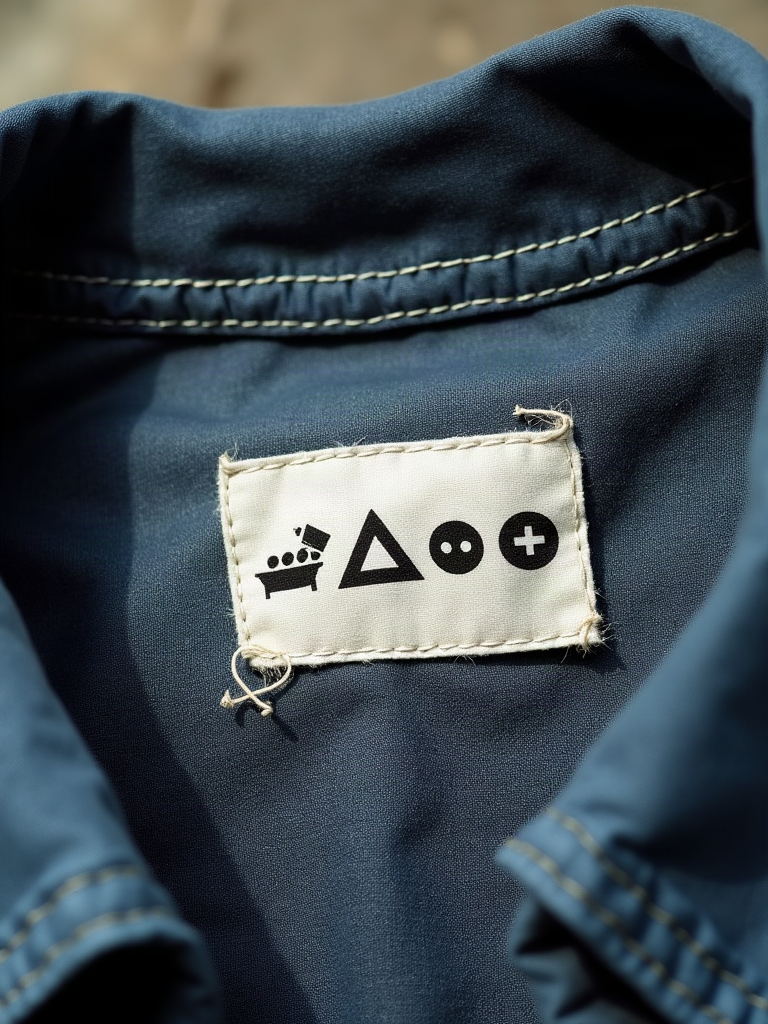
A care label is sewn into the neckline, against the centre-back seam, where the cloth folds back on itself. The collar seam is doubled: two rows of stitching, one along the fold, the other set a few millimetres back, the cotton gathered between them. The label itself is held by a single row running the whole way round its border, a thread's width from the cut. White, narrow, longer than it is wide, its corners still stiff.
The printed side faces the inside of the garment. It cannot be read on a hanger: the collar has to be turned back, the label pulled flat between two fingers, creased so that it stays open. There the symbols sit, in a single line. A wash tub. A triangle. A circle pierced by two dots. A solid circle marked with a cross. Each one orders a gesture: the temperature of the water, the bleach, the iron, the drying.
The label scratches. It is the only thing written on a garment that the body feels before reading it: the woven edge, cut clean, rubbing against the nape at the slightest turn of the head. The label's cloth is stiffer than the collar's, tightly woven, and its corners stay sharp through washing after washing.
It was put on last. The garment was already assembled, the seams done, the buttonholes cut; the label arrived at the end, on a finished object, to say what should be done with that object once it was no longer new.
At the front, before the sale, there was another label. Glossy card, fastened with a plastic barb pushed through a sleeve hem, carrying a price and a size. It comes off in one movement, at the till: the barb slides out, the card goes, the knit closes over. Nobody ever finds one of those cards in a drawer.
The one at the collar gets cut. With scissors, usually, because the edge scratches and a child refuses a collar that rubs. The movement is quick: the label is taken close to the seam, pulled taut with one hand, and the blade passes between the stitching and the cut. What is left is a stub of white cloth held by the thread, a finger's width across, with a frayed selvedge that will go on fraying with every wash.
On that stub the symbols have gone with the piece that was cut away. The garment is then washed at the temperature of the hand that washes it, with whatever detergent is in the cupboard, and dried wherever there is room.
The collar keeps the mark of the cut: a hem that is thicker on one side, a thread sticking out, a small ridge felt with the fingertip when looking for the label, and no longer the label. No drawer keeps these scraps. They stay in the garment, in the exact place where the instruction was written, and the collar has to be turned back to see them.
Generated from my creative workshop. Not a report. A breath.