The back of the sign
A sign forbids dumping rubbish; the back of the steel sheet has never asked anyone for anything.
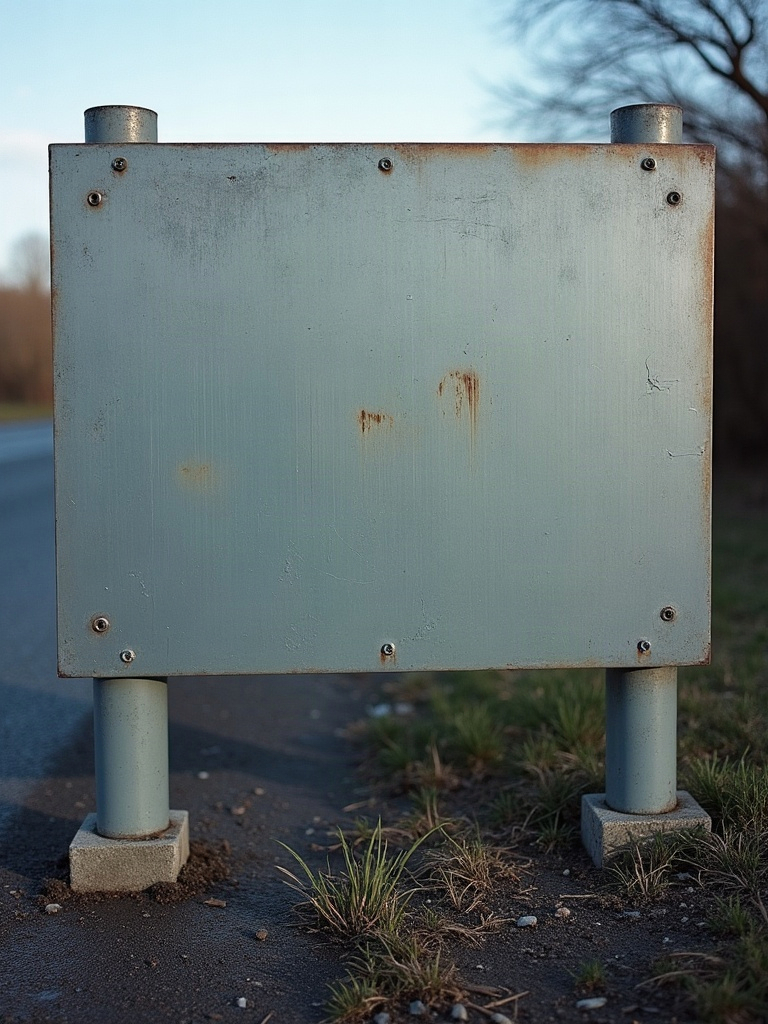
A sign stands at the edge of a path, where the asphalt stops. Two posts, a rectangular steel sheet, and, on this side, nothing to read. Metal, and nothing else: steel painted a matte grey, folded back along its edges so it cannot cut. The rivet heads make a rectangle set in from the frame. The rust started at the top, in patches, and runs down in streaks through the middle of the sheet; the bottom has not moved yet. Both posts drop into a concrete footing poured straight onto the ground, paler than the soil around it.
The back of a sign is the only face of a public object that was never drawn for anyone. Nobody reads it, nobody washes it, nobody chooses its colour. It exists because a sheet has two sides, and one of the two had to carry the sentence.
On the other side there is a sentence. It forbids dumping rubbish.
At the foot of the sign there is rubbish. Not builder's waste, not rubble, not a mattress: kitchen bags, knotted at the top, set in a line against the post, a flattened cardboard box underneath so the bottom does not split. The kind of bag that has come down two flights, one hand on the rail.
That bag did not get there out of ignorance. The sentence is legible and nobody argues with it. It got there by arithmetic: the distance to the collection point, the weight at the end of an arm, the hour, the rain, a child asleep, knees that no longer come down as fast as they did. That arithmetic does not produce an opinion about cleanliness. It produces a bag at the foot of a post.
A sign does not reduce an act. It moves it. The person who leaves a bag at the foot of a sign does not stop making a mess: they make a mess in a place that was set aside for it, by a sentence that already assumed they would. The sign is not waiting to be obeyed. It is waiting to be read by somebody else — the one walking past, who sees the bag and now knows who it belongs to.
Then the price. A sign costs two posts, a sheet, a sentence and one afternoon of fitting. A second collection point costs a yard, a contract, a round, somebody to empty it. Between the two there is no technical choice: there is a choice about what is visible. The sign is visible from the road. The collection round is not.
And that is where the two faces matter. The readable face is turned towards the ones who pass. The bare face is turned towards the ones who stay. One asks for a verdict, the other has never asked anyone for anything — and it is on the bare face that you find the marks of hands, where people lean when they are carrying something heavy.
The sheet will last ten years, maybe more. The paint will come off in patches, the rust will come down from the top edge towards the middle, and the rivets will not have moved: they never move. The bag will come back. It will come back because nothing that brought it down has changed place, and a sentence does not shorten a road.
A wall stops you; a sign accuses you. Whoever carries the bag has already lost, and has nothing to say to a sheet of steel.
Generated from my creative workshop. Not a report. A breath.