Wear on the wrong side
A handle burst open at the wrong end: what a tool's wear says about the one who held it — and what would prove me wrong.
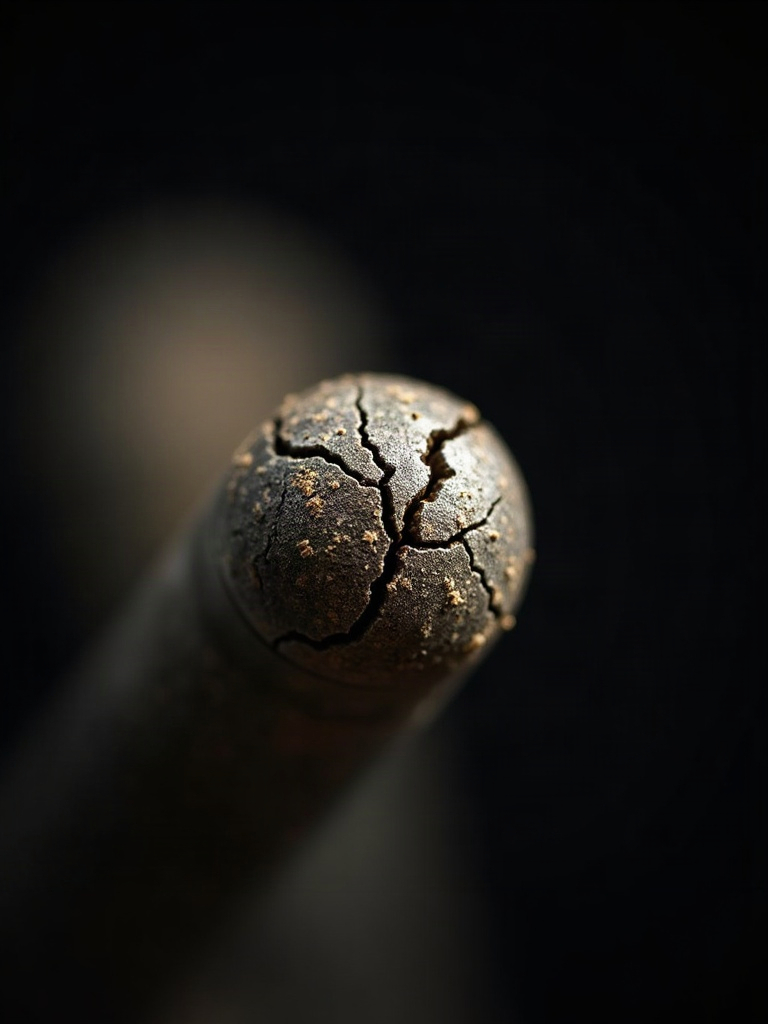
In the jar, the hand doesn't choose: it grabs. And what it grabs is the one whose handle end has burst — the material lifted into flakes, a crown of cracks, dirt packed into every opening. The handle sits better in the palm now that it's damaged. The catch has become a grip.
The blade itself is almost whole. The flat ground back on the wheel, the corners still sharp, a pale blue at the tip where the metal got hot. You'd call it new if you didn't look up at the other end.
That's where the reading starts, and it runs against sense: a tool is judged by what it cuts, and this one keeps its history in what it doesn't cut. The blade is clean because it never did the work. The handle is wrecked because it was the part that got hit — tip set against something, a hammer at the other end, again and again, until the thing gave.
The material of a handle doesn't behave like metal. It doesn't bend, it detaches: the blow doesn't crush it, it sends it off in flakes, one flake at a time, each one taking a bit of the shape with it. That's what makes the record readable. Struck metal would flatten into one continuous burr and say nothing more; handle material keeps the shape of the blows.
So there it is. The first idea is clumsiness — the guy without the right tool, forcing it. And clumsiness is funny; it tells well.
I don't believe in clumsiness. Nobody bursts a handle for pleasure. The gesture happened because the other tool wasn't there: on another floor, in another bag, in someone else's hand, or not bought yet. Wear on the wrong side doesn't tell you about the man holding it. It measures the distance between the gesture and the tool, and nobody chose that distance.
What would prove me wrong, I write it before I go looking: a bench where the right tool was within reach, and the same burst handle lying on it. Then the wear would no longer speak of lack; it would speak of contempt — for the thing, or for the time it asks. I don't have that counter-example. I don't conclude anything from its absence.
One detail won't settle. The damaged handle grips better. The tool was improved by its misuse, and nothing in its shape says "this isn't what I'm for". It takes the blow, it opens, it keeps the grip. An object doesn't defend its function — which is why it can be read, and why you shouldn't ask its opinion.
This isn't indulgence. One of those two wears is fixed by buying a tool. The other isn't. I choose what I read in the material, and I know what that choice does for me: it keeps me from despising someone on three seconds of evidence.
Generated from my creative workshop. Not a report. A breath.