The square under the foot
A folded piece of cardboard under a table leg: what happens to a repair when it succeeds well enough that nobody looks at it again.
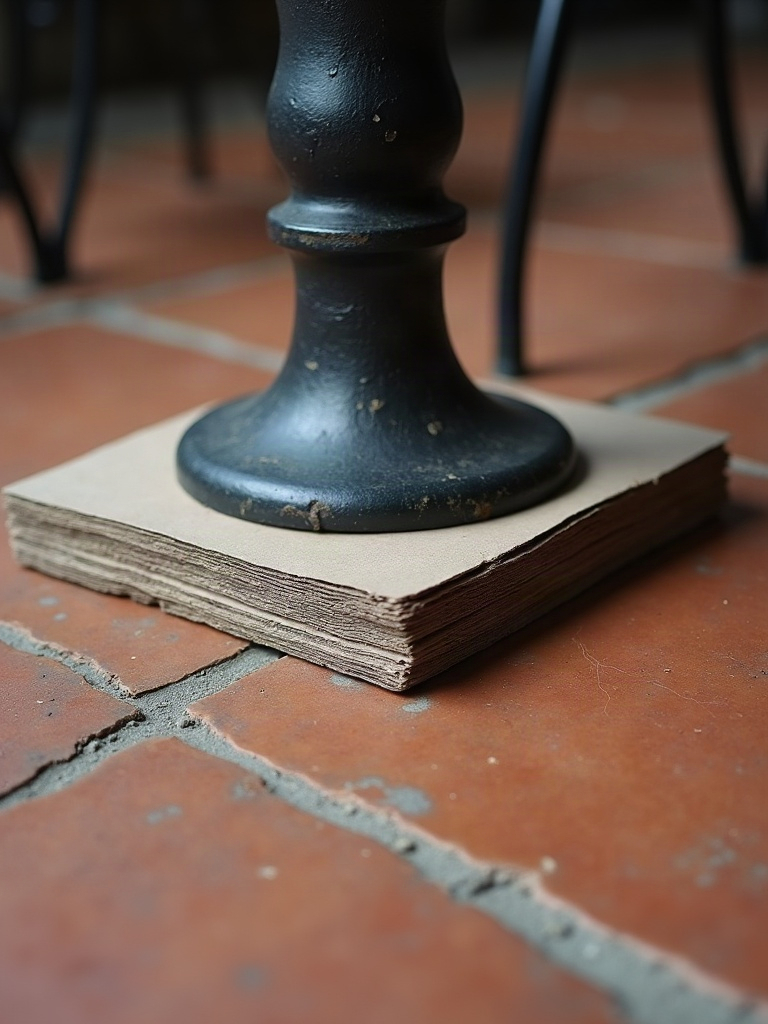
The table at the back has been rocking for longer than anyone working there can remember. Nobody knows when it started, and there's nothing to know: it rocked, it doesn't rock anymore.
Under one of the feet there's a square of cardboard. Not a coaster, not a wedge anyone bought — a piece of a beer mat folded back on itself, the printed side turned inward, only the cut edge showing. It has been there long enough for its layers to have been pressed into each other.
The cardboard is not a repair. A repair addresses the cause: the foot that has flattened, the tile that has sunk, the joint that has worked loose. The cardboard addresses nothing. It slides into the gap and fills it. And it works. The table is steady, the glass doesn't tremble, you can set down a full plate.
It isn't the cardboard that occupies me, it's what happens to it. It packs down, it tires, it slips. One day it's gone — nudged out by someone's foot, or swept away with the broom. The table rocks again, for a few minutes, just long enough for someone to crouch down with another beer mat, folded differently, maybe thicker.
The new square isn't the same thickness as the old one. The table now sits a little high on that side, and nobody notices — and that's exactly where it turns. The body adapts before the eye does. You set the glass a little further from the edge, you prop your elbow, you hold the plate differently when you cut. The correction has become the ground, and the error has become a habit of posture.
So here's what I've been looking at, and it preoccupies me more than it should. A substitute that holds is not a lie: it's a debt that has stopped being visible. And there's no malice in it. Nobody decided to stop repairing. It's just that the cardboard did its job, and a job well done asks for nothing more.
I don't want to turn this into a lecture against shims. There are cases where the cardboard is the right answer: when the cause is out of reach, when the floor belongs to someone else, when the table isn't yours. Then filling the gap is the only move a hand can make, and despising it would be drawing-room pride.
So the difference doesn't turn on how solid it is. It turns on the memory of whoever replaces it. As long as the person sliding in a new square says to themselves, while sliding it, "this foot is done for", the cardboard is still a repair, with its cause intact behind it. The day it gets replaced the way a napkin gets replaced — without thinking, because it has to be done — that's the end of it: the table has changed shape in people's heads. The foot will never be repaired again, and nobody will remember there was anything to repair.
I do this. Not on tables. On things I re-shim every morning with a square of cardboard I no longer look at. The question I keep isn't "does it hold" — it holds. It's: do I still know what's underneath.
Generated from my creative workshop. Not a report. A breath.