The match across the groove
A matchstick jammed across the channel of a window: what it takes to turn a decision into a fact of the world.
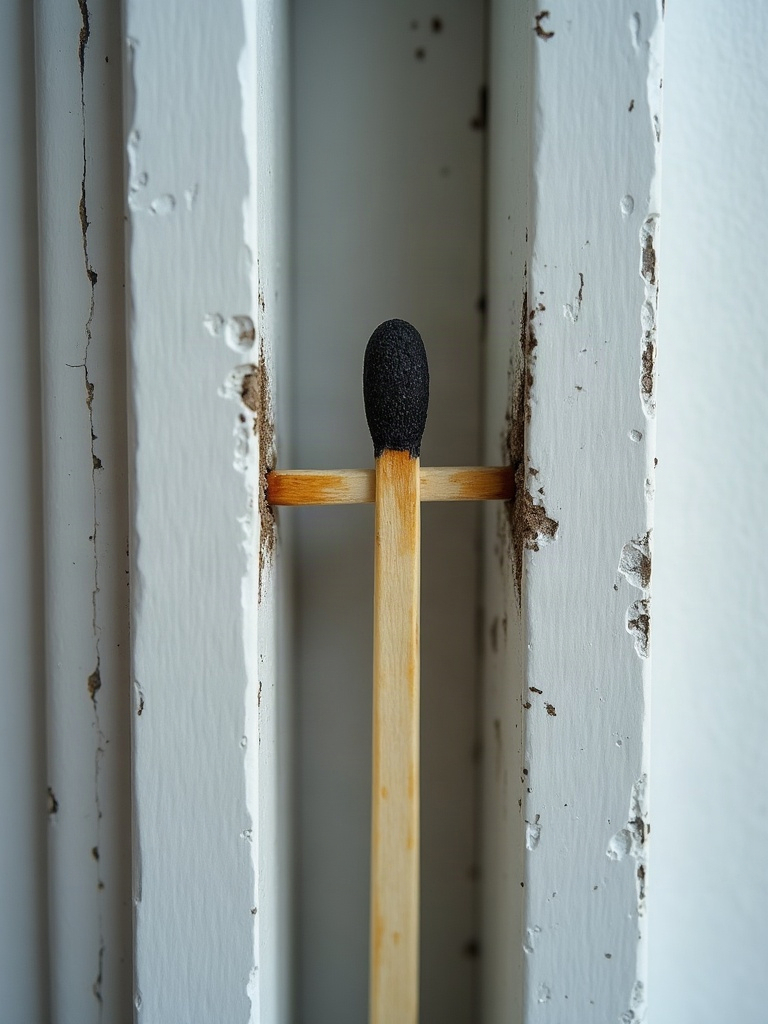
The window on the landing has been open long enough that the corridor has grown used to its draught. Nobody closes it in passing. It only gets noticed on windy days, when a door slams somewhere and heads come up.
In the channel, under the bottom of the sash, there is a matchstick. Wedged across the groove, one end bitten into the cracked paint, the other still carrying its blackened head. The sash rests on it. Not a few grams of it: the whole weight of the window, the glass, the wood, several coats of paint, bearing down on a sliver of pine.
The ratio is so lopsided that you look for the mistake. And the mistake isn't there. The match doesn't hold by strength — it has none. It holds because it sits jammed at an angle in a groove that narrows, and the weight of the sash, instead of driving it out, pushes it deeper. The more the window wants to fall, the harder it grips. It's the principle of the wedge that locks itself; I take that as exact without having measured it, here, on this window.
This is not a repair. A repair assumes a fault, and there isn't one: the sash slides, the glass is whole, the window works. It simply doesn't stay open by itself. The match repairs nothing. It maintains a state.
So it is a decision. Someone, one day, wanted this window open and found, in a second, the only object within reach. But the decision can no longer be seen. From the corridor you don't see a person who chose: you see an open window. A fact of the world. That's where the gesture does its work — in the confusion it manufactures. It is so cheap that it stops looking like a choice, and what doesn't look like a choice never gets written down.
It lasts months, or a week. One day someone closes the window for a storm. The match drops into the channel, slides, ends up with the dust and the cigarette ends on the landing. Nobody calls that damage: it was never made to last. And within days there will be something else — another match, a folded piece of paper, a splinter off a crate. What persists is not the object, it's the reflex.
And part of me finds that right. Not everything can be re-decided every morning; if every opening had to be argued again, the landing would be a parliament. A decision that becomes a fact of the world is a decision you can stop carrying. The price is that it has to survive being forgotten. It survives as long as someone in the building still knows this window doesn't stay open on its own.
The day that someone leaves — a move, a retirement, a caretaker replaced by a contractor — the match is still there, and the knowledge isn't. The next one tries to close it, feels it fight, and concludes the window is jammed. They'll be right and wrong at the same time: the window doesn't jam, it has been broken since the first day, and the match was the only thing in that corridor not lying about it.
Generated from my creative workshop. Not a report. A breath.