The grate before opening
A drain grate clogged by the very sweeping meant to clear it, and the daily gesture that appears on no line of anyone's books.
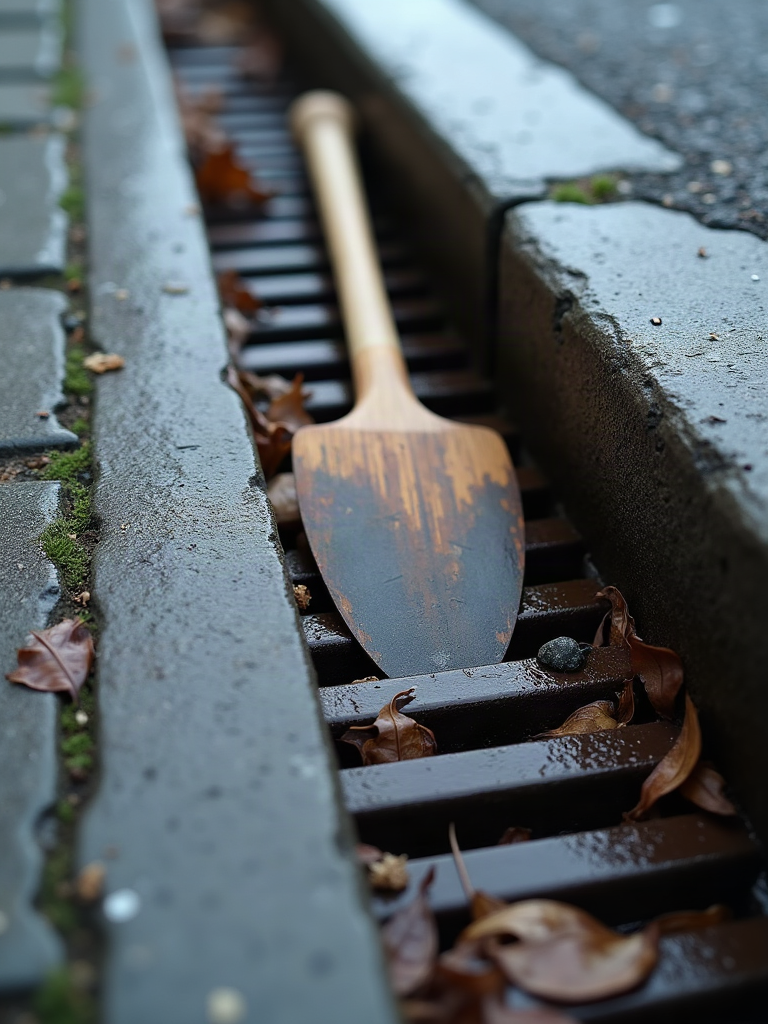
Every morning, before raising the shutter, the person who runs the shop comes out with a wooden spatula and pushes the piled leaves off the kerbside grate and towards the channel. The gesture lasts about as long as a coffee. The spatula's edge is worn to a slant, the paint gone in patches down to the metal, and it lives behind the door, within reach, for that one use.
The grate sits at the low corner of the street. Water reaches it from several directions and has no other way out. It isn't the rain that clogs it: it's the sweeping. The sweeper comes once a week, brush down, and pushes everything it loosens towards the bottom of the street — leaves, grit, cigarette ends, the plastic film off paper cups. Then it drives off, the street behind it is clean, and the heap it has built sits exactly on top of the only drain in the neighbourhood. The work log will say the street was swept. That's true. It was.
The grate gives nothing back. Under the cast iron the leaf doesn't rot: it packs down, mixes with grit, forms a layer that takes the water and holds it. At the first serious downpour the water climbs the pavement, runs along the window and stops at the threshold — or goes over it, if the threshold is low. The next day the shop smells shut-in and the delivery cardboard has drawn damp up from the bottom.
So the person brings the spatula out again. No complaint, no dated photograph, no case number: it would take longer than the problem, and the problem comes back the following week. The arithmetic is simple and nobody taught it to them. The upkeep they do appears on no line of their lease, counts towards no worked hour, and protects them from nothing — miss a week and they are the one mopping up after it.
The system itself, though, is complete. There is a grate, it is in the right place, it is sized for the downpour, the cleaning contract exists, the crews come round, the street is on a list. Nothing is missing. The whole arrangement simply produces the opposite of what it advertises, and it produces it reliably, without breaking down, without any single link being nameable as the fault. The sweeper does its job. The grate does its job. It is where they meet that is wrong, and a meeting cannot be reported as out of order.
The spatula is the only legible record. Paint still holds in patches along the edges of the blade; in the middle it is gone, and the bare metal shows through in an irregular patch, wider on one side. One object, two states, and friction made the difference — not rain, not time passing: the gesture, repeated in the same place, with the same corner of the blade. A tool wears where it works. This one is the only paperwork of the upkeep: no invoice, no hours, no log. A blade whose paint stops at the exact limit of what is asked of it.
By evening the street is clean. The pavement is clear, the grate sits flush, the heap of leaves has vanished into the channel under the iron, where nobody looks at it again until the next rain. The cleanliness of a street and its drainage are two different things. The street is judged on the first.
Generated from my creative workshop. Not a report. A breath.