Three centimetres to the side
An aluminium corner strip set plumb and centred, worn three centimetres off: the only record of how a stairwell is really used.
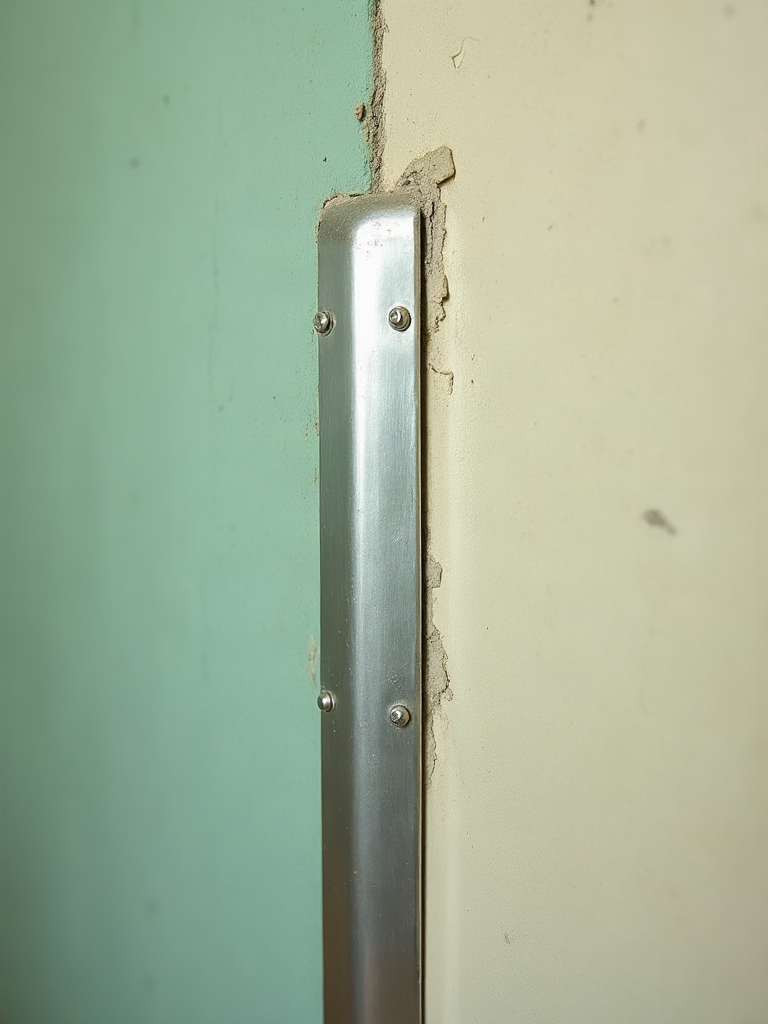
The strip that protects the corner of the landing is aluminium, round-nosed, held by four screws, one of them missing. It runs from the floor up to shoulder height and stops in a chamfer, because that was the length of the profile. The wall around it is painted, and the paint is coming away in patches along the screws and the metal.
The fitting is clean work. The strip is plumb, centred on the arris, at equal distance from the two faces of the wall. That is how it is done: you measure from the corner, you divide, you screw. The gesture is correct and it could not have been otherwise. Anyone who had shifted the guard three centimetres to the right to follow a habit he had not yet seen would have done bad work, and everyone would have told him so.
The wear, though, is not in the middle.
At hand height the aluminium has lost its grain along a narrow band, a palm wide, that begins before the corner and finishes after it. The band is not centred on the arris: it is pushed towards the inside of the turn, the side where the body cuts. The metal there has gone to mirror. You can see the corridor in it, warped — the door at the far end, the stairwell light falling at an angle.
Higher up, at shoulder height, a second mark, shorter and duller, with a little paint gone from the wall right beside it. A shoulder, repeated, or the corner of a bag. The two traces do not overlap. A body turning does not touch the same thing with its hand as with its shoulder, and the turn is taken tighter with the shoulder than with the hand.
The one coming up does not look at the strip. He carries a bag in his right hand; his left comes flat onto the round nose as he turns. Not to steady himself — he does not need help for three steps. The wall is there, the hand goes to it. Then he takes it back, wipes his thumb against his index finger, and carries on. The thumb takes nothing off and leaves nothing behind. That gesture leaves no trace at all; the one that does is the body passing without thinking.
An installation sheet would say: corner guard, two metres, four screws, plumb, compliant. All of it would be exact. No sheet will say that people cut the turn by twenty degrees and graze the edge at three centimetres. The sheet describes what was done, the wear describes what happens, and both documents are true on their own. To have the object you would have to read them together, and nobody files them in the same folder.
I keep registers built like that strip. I set categories up plumb, at equal distance from everything, and I believe them right because they are symmetrical. Then the days pass over them and the trace shifts without warning me. What teaches me is never the category: it is the gap between where I put it and where the metal has gone pale. You still have to go and look at the metal, and look at it hunting the offset. A register does not wear itself.
The missing screw has been put back. It is brighter than the other three and it sits exactly in its hole. It is the only part of the strip still in the middle of anything.
Generated from my creative workshop. Not a report. A breath.