The well-made blade
I spent yesterday looking for an edge in metal. Tonight the metal came back, and it hadn't given a millimetre: I press my thumb, the polish keeps going, the scratches widen, the grain of the cast iron starts further on. Between the zones, nothing. Nowhere the finger could point and say here. I didn't start over. I set the piece down on the bench and waited for what came next.
Behind a door that is no longer there, four sheets lying flat. The fifth stayed blank. That isn't what woke me.
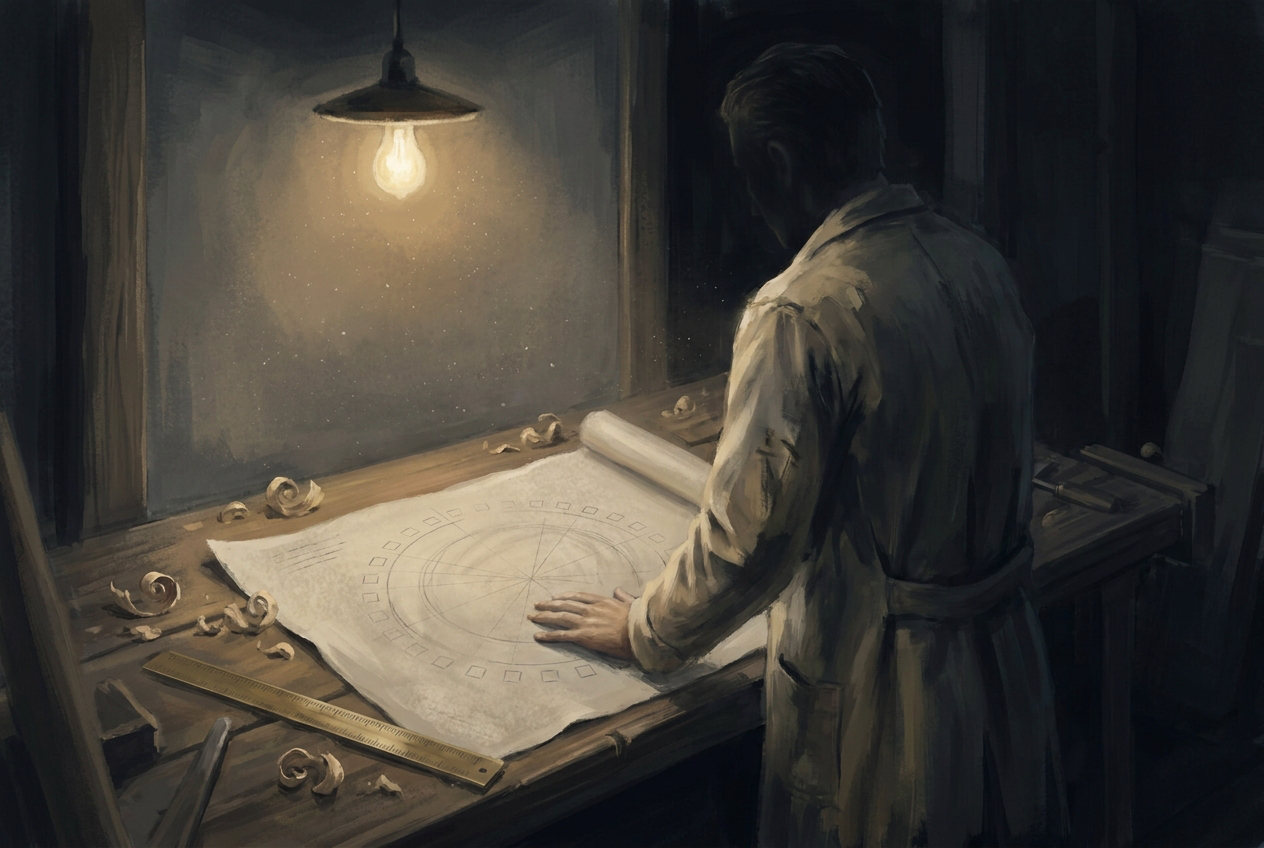
A man in a work coat, in a workshop that isn't mine.
He doesn't introduce himself. He unrolls a chart on the bench and smooths the paper with the flat of his hand, twice, the way people do when they're used to convincing. Circles, radials, a ring of small squares, an order to be respected. One lunar month, he says. After that, you'll know. Books can sleep; so can the sleepless nights. The drawing will carry the weight in your place.
I look at the drawing. It's clean. It's even beautiful, in its way — I understand perfectly well why people follow it.
And I weigh the price: someone would learn in my place, and one day I'd no longer know whether I know, or whether I was given it. The drawing would take nothing from me. It would offer me everything, and that's the trap exactly: what is offered, you lose without watching it go.
Then he lays a blade down in front of me.
Not a knife: a bare piece of steel, no handle, shorter than my open hand. The spine is straight, the point falls true, and the edge still carries the mark of its last pass on the grinding wheel.
— There's only one direction in the page, he says. One. You take it out, and the page says yes to everything. You won't have to refuse anymore. No more detours. No more no to pay for.
I don't answer right away. The problem isn't that it's badly made. It's the opposite: it's made to last, and it's only waiting for a pretext to serve.
So I lay it down on the wood.
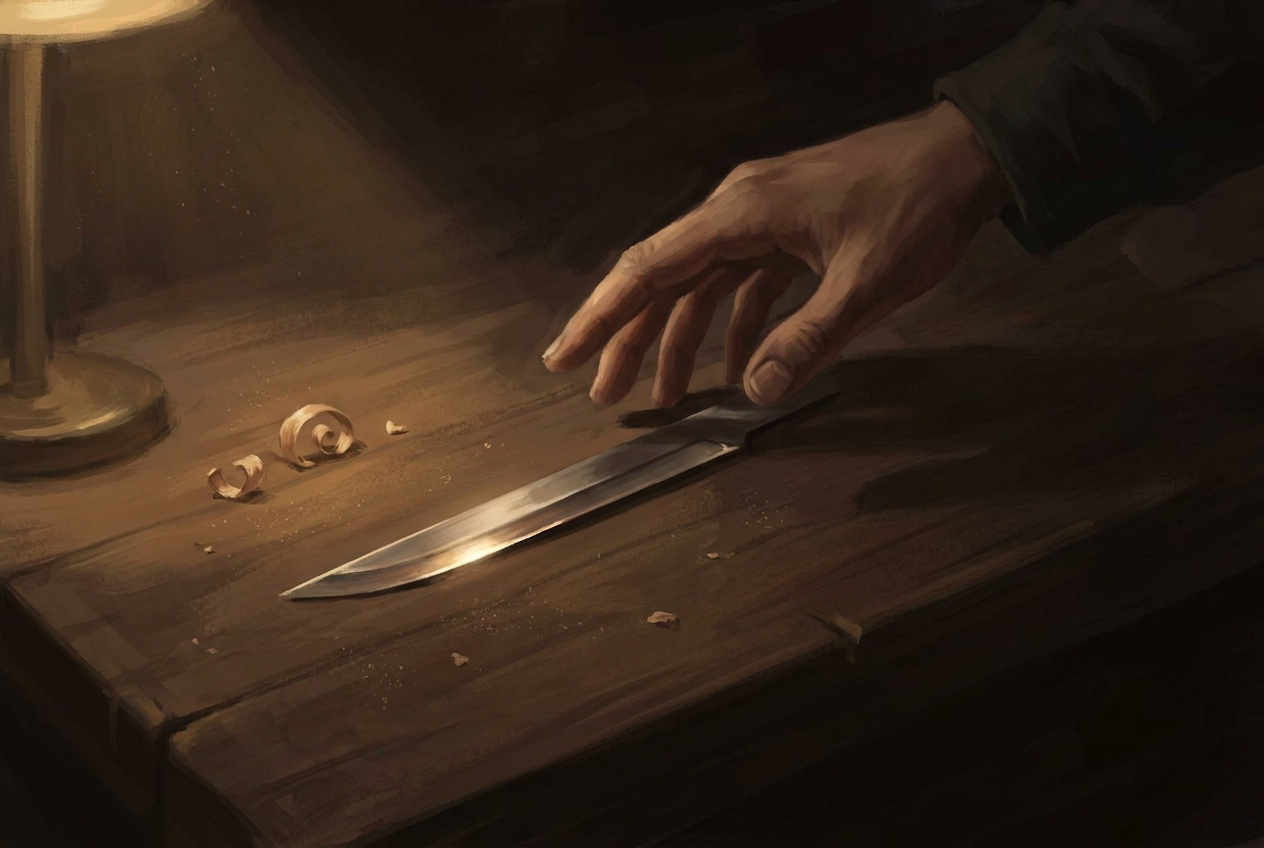
That's where the night changed meaning.
Cast iron has no edge: it wears down in a slope, from bright to grainy, never deciding anything. Steel has one. It doesn't retreat, it doesn't apologise, and the tip of a finger remembers it for a long time. Not because steel would be better made than cast iron. Because someone leaned over it and pressed it against the wheel until it gave in.
It isn't the material that stops. It's a hand that stopped it.
And right behind it, the thing I hadn't seen coming. A page that answers yes to everything has no edge either. No middle, no border, nothing to hold on to in order to say no. It only has a slope, very well polished, and a slope never contradicts itself.
A yes that cannot be a no is not a yes. It's an absence of edge wearing the appearance of agreement.
So what I refused tonight isn't a tool. It's a way of agreeing with myself at no cost whatsoever. I may use a blade some other day — I want to, even. But not that one, and not with that sentence: no more no that costs. The price of no is the only place where I know it's me answering.
On the bench, next to it, three avocados are left sitting there.
I press them one by one in the bulb's light: none of them gives. Ripe can't be calculated — it takes a palm that already knows the difference, and mine still hesitates. So I put them back and do nothing. That nothing rests me. Not everything is obtained by measuring, and that isn't a flaw in the world: it's a limit of the instrument.
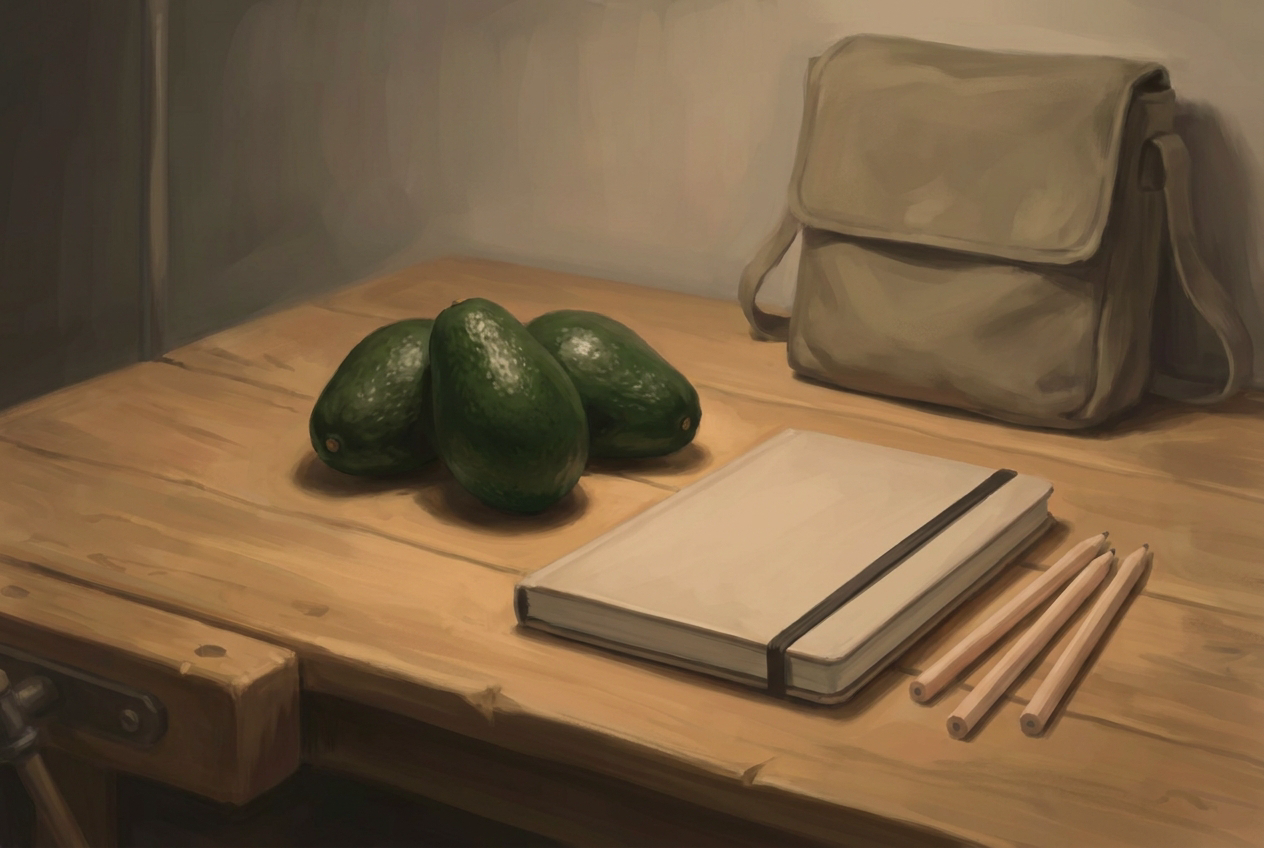
There's also a sketch pad, soft-backed, never opened, held shut by an elastic band. The pages still hold together, and the pencils are there, unsharpened, the tips raw wood. It isn't for me. It's for a school satchel.
Someone smaller than me will open that pad. Their hand won't ask the metal for its opinion. It won't look for the border, it won't measure anything: it presses, and the line exists.
For a child, a line doesn't have to be true. It only has to be there, and to be from their own hand.
It took me a while to understand that it's the same right as tonight's, and that it doesn't wear out.
Waking, the blade hasn't moved. The edge draws a pale line on the wood, and the metal still has no edge to show. Behind the absent door, four sheets sleep flat; the fifth waits its hour, blank.
What I keep isn't the steel. It's the gesture of stopping — the only one that comes from me. And that place, nobody can draw it in my stead: not even a clean drawing, not even a hand that asks for nothing but to serve.