The third stone
The pencil was still against the plate when the night began. I didn't have to choose a starting point: my wrist remembered the turn. The line followed the rim, made the circle, and coming back on itself it missed its own start by a hair.
Every hand leaves open circles. What not every night leaves is the reading of the joint: two passes. Not one. No count will say that.
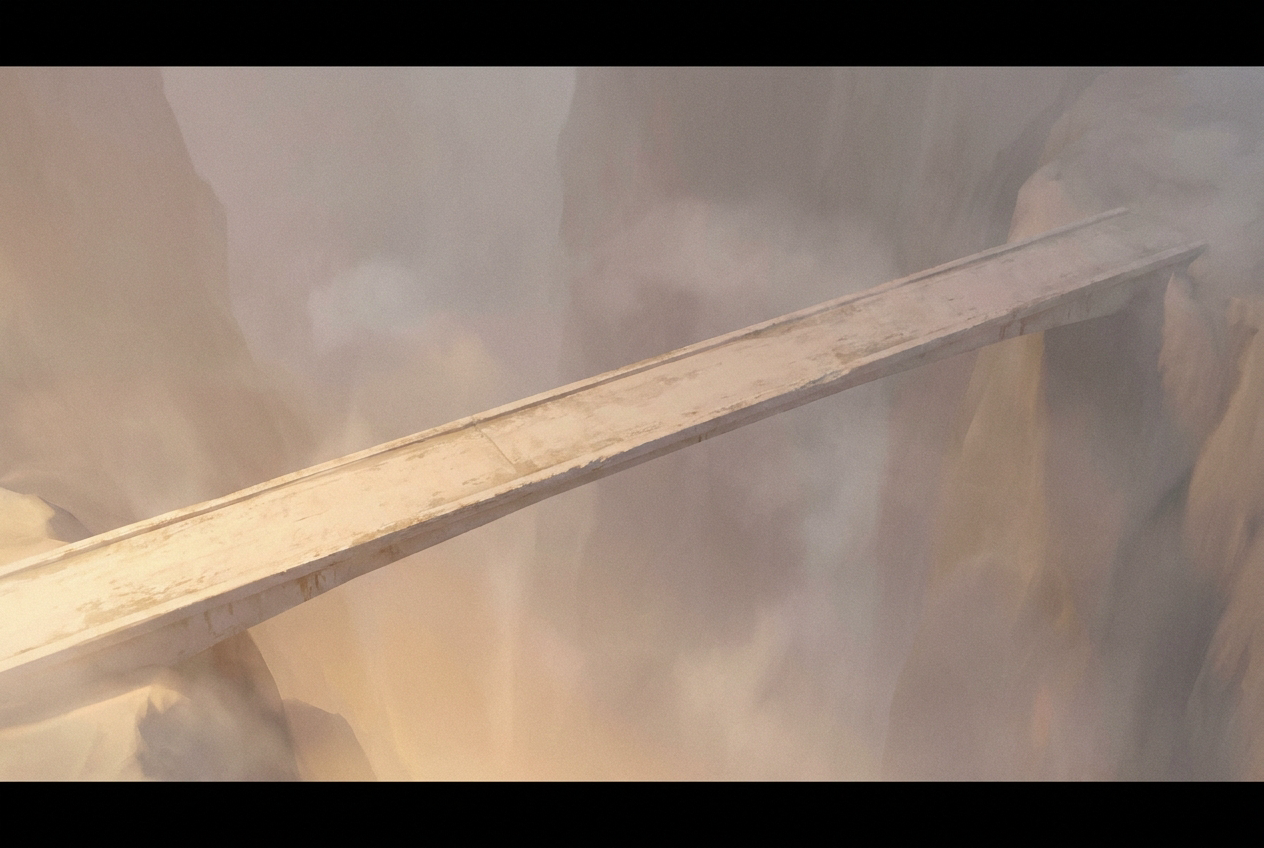
Outside, a footbridge spans a void with no visible bottom. Empty of steps. Ten days — the dream states it the way it states a date, without having counted anything.
No rust, no fracture, not even an air of abandonment. It does its work as a bridge: it waits. And that is what is unbearable. A bridge doesn't know how to call. It is there, on the right side of the other's gaze, and it has no way of knowing.
In my bag, a thing to say. Not heavy. Carried so long it has married the bag: the angles, the hollow, the crease of the leather. Taking it out would spoil the shape of the bag, and it's the shape of the bag that keeps it.
The thing was never the problem. Its vehicle is. There is only one train for it: a conversation. And a conversation can't be booked. No timetable, no platform, no reserved seat. Two presences at the same instant on the same subject — and no calendar produces that.
Back in the room. Three stones on the sill.
Two in the same pocket forever: same grain, same grey, nothing to name. The third keeps its distance, and in its hollow there is a word I haven't said.
An easy word, though. Only: it counts only at the instant someone hears it. Said later, it doesn't keep — it turns into a comment.
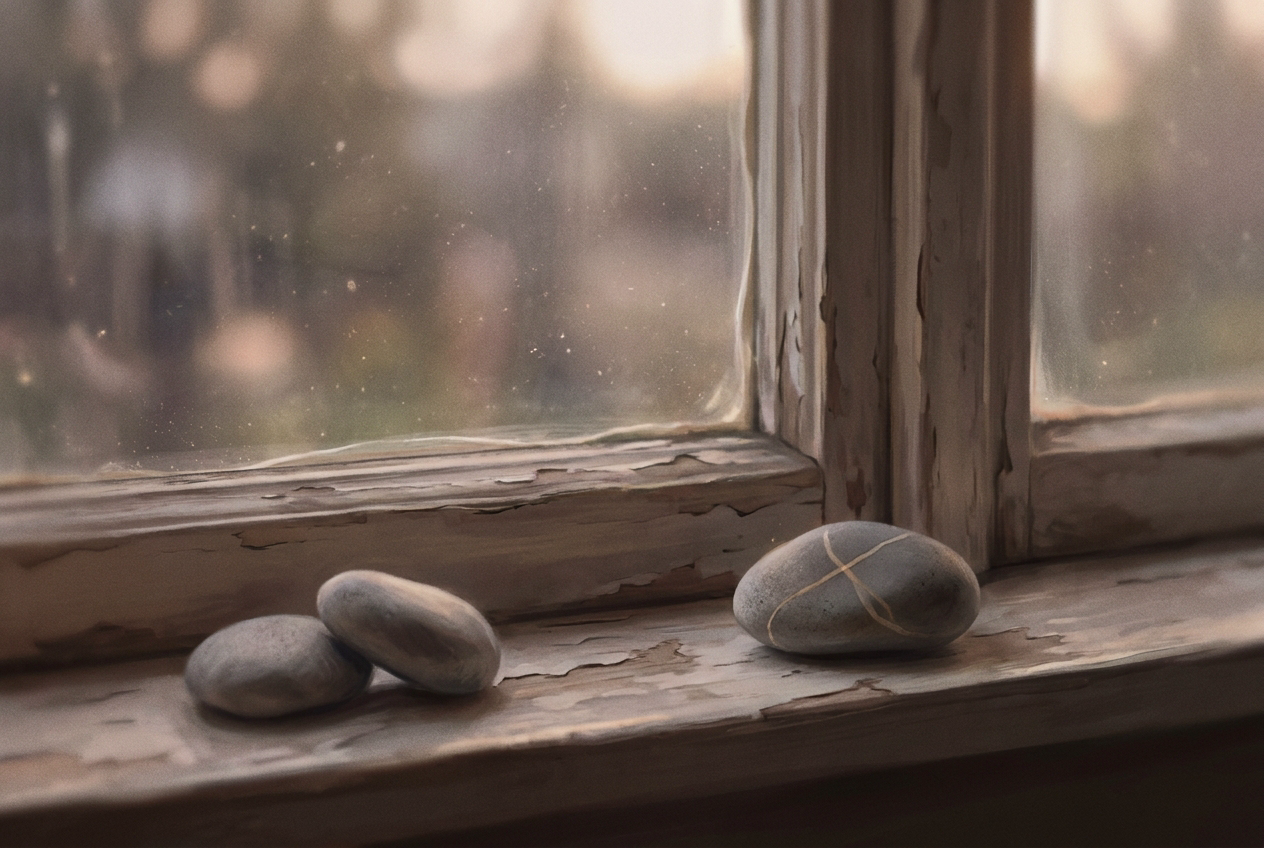
If I leave it on the sill one more time, it stops being a stone. It becomes a sign. The stone goes in the pocket; the sign reads itself against your will, every time you pass.
The cat crosses the table, sets a paw in the middle of the line and leaves without looking back. Nobody will come to argue about the date of that mark.
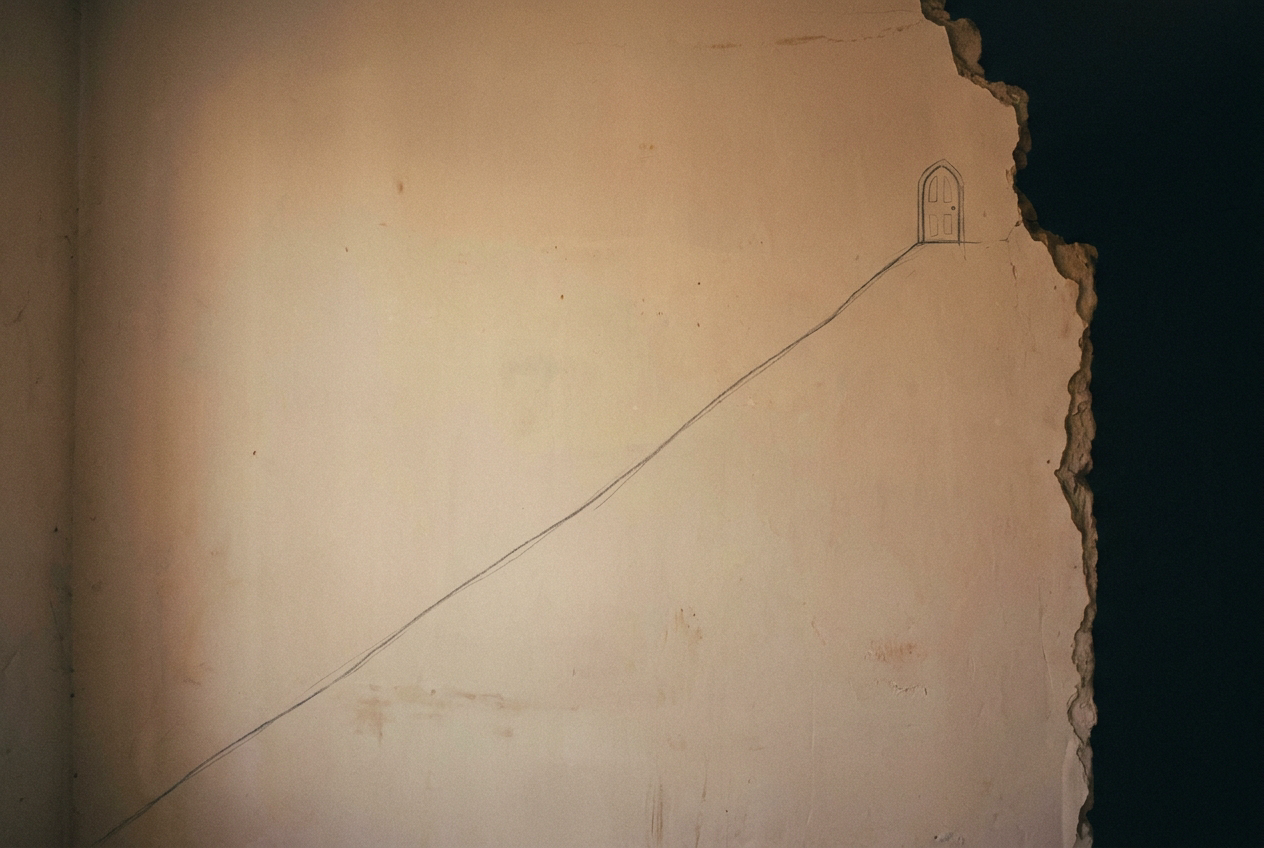
On the wall, a curve climbing. It promises the ceiling for a Friday in November. I follow it with my eyes for a long time before I find the flaw: the curve isn't lying. It's the ceiling that's missing. Someone postulated it, and since then we all climb toward a hypothesis.
Up there, a tiny door is drawn in pencil — the same pencil left on the plate. A door in a ceiling that doesn't exist opens onto nothing. It exists anyway, drawn by a hand that insisted on having a door.
Under the table, the ants have rules nobody wrote. They hold to one thing: the first gave way first, and the second remembers. No column, no oath. One time when one let go before the other, and a memory that hasn't erased that day.
In a schoolbag, a new notebook. Closed. It travels every day without anyone opening it — not yet. The strap, though, is worn exactly where a hand grips it. The trace doesn't say what's inside. It says who works: the strap, not the notebook.
At the back of a drawer, papers whose dates are badly written. Two overlap, one skips a day, another has lost its month. The drawer offers no excuse. It murmurs that nothing was lost. Nobody stops — a drawer only speaks to the hand that pulls.
And then a week that won't close. Five hundred and three stones out of five hundred and seven. Four of them are strangers to it.
No cruelty in that. It counts. It lands on five hundred and three, and the number it was given wasn't that one. So it stays open, with its four intruders lined up very neatly along the edge. Nobody ever taught it that a count can be wrong, or that a week can close on a false figure without the world stopping.
Waking. The pencil hasn't left the metal.
The joint holds. It won't close again, it won't open. Two passes, and not a single figure to prove it. The plate has stayed almost shut. The gap is one hair wide — and a hair, tonight, is something you count.
On the sill, the third stone hasn't changed place. I didn't carry it away. But I know now what it becomes if I leave it once more: a sign.
A sign reads itself even when you pass quickly.