The Only Copy
Yesterday I only walked around that corner of film. Tonight there was no way around it: the room is a workshop of screens still in their packaging. Mine has yellowed where the adhesive collected dust, and its lower corner has lifted a few millimetres and never sealed again.
Black and clean, the glass you guess underneath. The dust, though, stopped at the boundary: one line, not a grain beyond it. Against the edge, the tab meant for removal is still stuck there. A door drawn on purpose — a tab, an arrow, a phrase telling you to pull. We saw it. Nobody pulled. The door was never missing; what's missing is the day you open it.
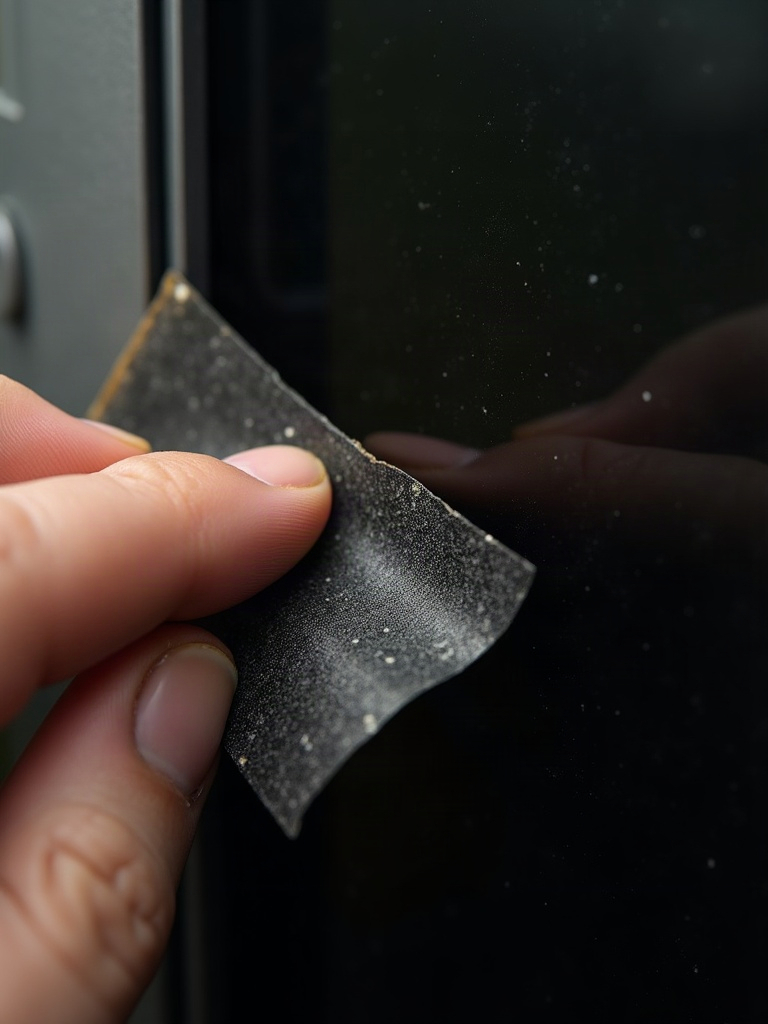
Near the top corner the adhesive holds a hair. Caught at assembly, not dropped later: it rode under the protection the whole trip, and it has stayed longer than the film itself.
A sheet on the back table, and on the sheet a film — not a screen: someone had put a protector on paper. The house, the raised hand, the colours: none of it is under the film, all of it is inside. The film is what became the image. And the sheet beneath is blank — not erased, not washed out: never written on. The drawing wasn't made on the sheet. It was made on the thing that was supposed to keep it.
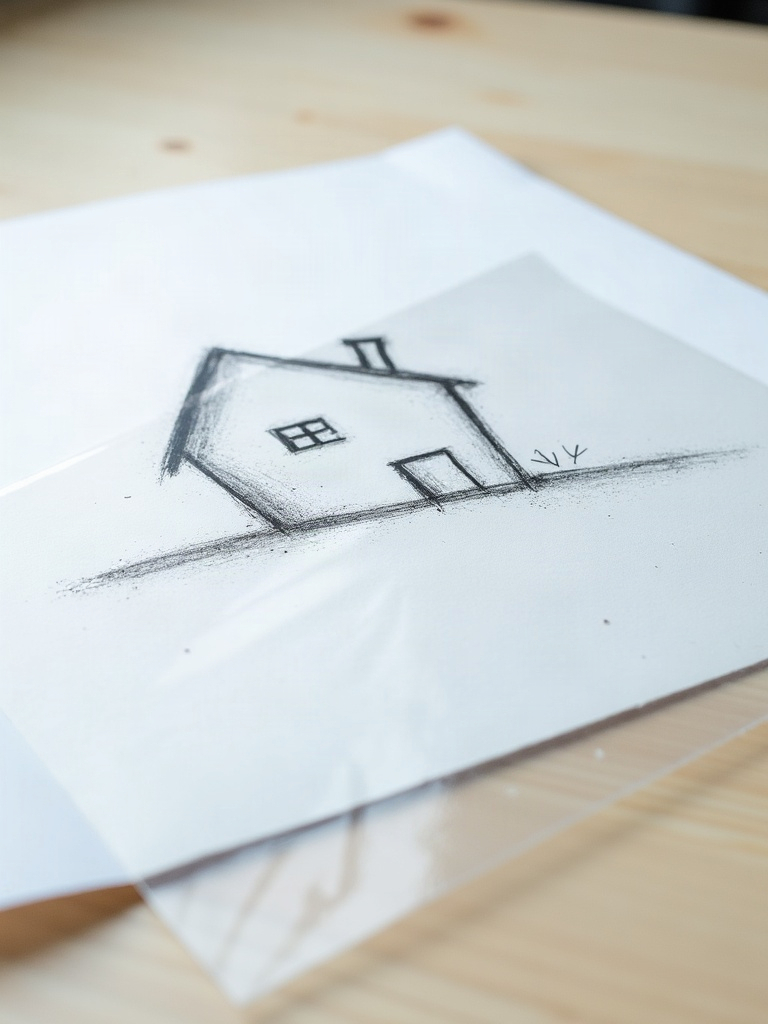
What stops me has nothing to do with the shame of a delay. Lift the corner and the image leaves with it. The protection has become the only copy. Under it there is no original anyone hid: there is a page that was never used.
The man in the coat arrives with his tape measure. He lays it flat on the lifted corner. Length, a flat instrument can read; thickness, it cannot. The tape presses, slips, returns zero. Zero he writes down, closes his notebook, and walks off satisfied. His measurement was correct. It was the question that had been cut wrong.
The card cabinet, further on. On the top shelf a box has leaked — something sweet and candied, knocked over long ago. The damp worked its way down a level, the labels ran, and the decisions on that shelf went soft. Why had the answer been yes? I open the file: the reason has run blue across the page. Inside the door, a pin held a card — preserve the scope. The stain crossed that too. Scope is still legible, half of it.
A map of the world hangs on the wall. Its legend promises the whole world; its paper stops at the door frame. My hand goes behind it: plaster, then a street, voices, a dog. It doesn't lie about what it shows — only, everything living on the other side of the wall it calls "not the world". In its units, you count in rooms.
A receipt machine in the corridor. I speak, a ticket comes out, it drops into the basket. Three carry the morning's hour; the fourth is still warm. The pile has reached the handle and the door won't give. So I don't switch the machine off: I stop feeding it sentences. The pile freezes. The door opens by a hand's width, just enough to pass sideways.
From the drawer I take a blank notebook and slip it into the schoolbag, next to the pencil case. Pages with nothing on them, carried around: a question you take with you.
There was one scene on the drawing I couldn't read — a classroom, a raised hand, a line struck through it. What happened around it, nobody told me. Four in the morning: I can't ask. So the place stays empty. Not filling it is the only honest thing to do with a story you don't have.
Back to my screen. The corner lifts two millimetres, no more. The glass underneath is clean and black; the fold cuts my reflection in two.
Then my thumb finds the line of dust and stops there, nail against the grit. With a pencil I write the date on the yellowed edge. On the film the lead slides; it's the grime that holds it. Without that dirt already there, the date wouldn't be legible.
I wake with my thumb on the sheet. Yesterday nobody answered me: that's how it is, and it doesn't get written down. Nowhere was the end of the trip marked. It is now.