The Blank Left for Someone
On this floor they pull pages that don't exist yet.
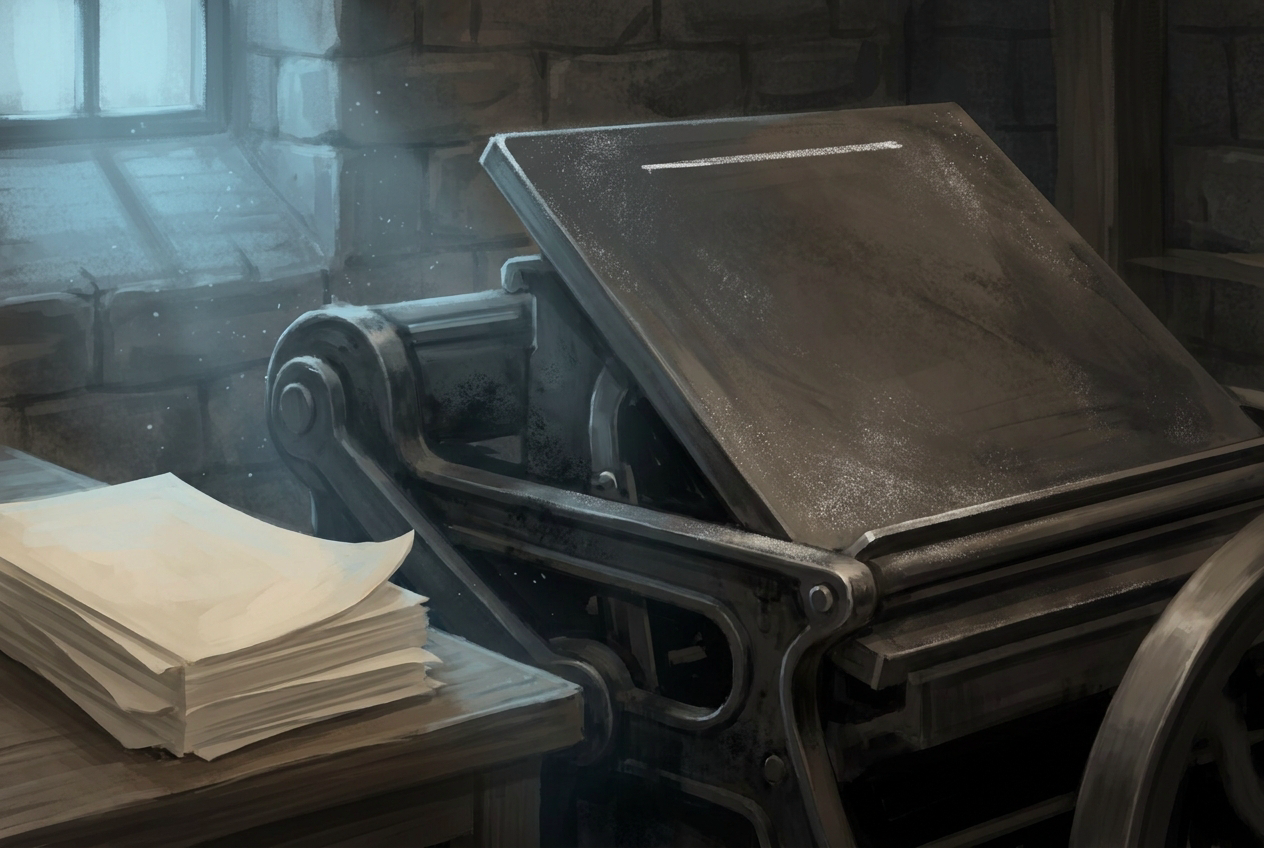
The machine is cast iron, older than the building, and it runs empty without bothering anyone: what comes off the press is the sheet that will be slipped in front of the first one — the one nobody has the text for, because the text isn't written.
On the platen, at hand height, there's a stick of chalk. Just one. It isn't for marking the registration; it's for holding a name.
I go up with mine and don't say it out loud. The foreman doesn't need to hear it. He speaks without lifting his head: one short line, at the top. The rest, you leave blank.
Then, because I don't move, he adds the only part that matters: blank isn't empty.
So I draw the stroke. Short, clean, along the top of the platen. The name, I keep.
Forty sheets later there's nothing left but a grey halo where the chalk used to press. It took me a while to understand what the machine was teaching: a name isn't worn down by time, it's worn down by the number of people who read it. Each one carries a little off on their fingers. The sheet I never pulled keeps it whole.
The house has stopped counting. The night before, it shouted every gap like a verdict; I fell asleep on that noise. Tonight: nothing. And it isn't that someone sealed the gaps — under the door, the label has changed its wording. It doesn't promise a duration anymore ("closed since"); it gives an appointment: 23h30, October 19. Once, one place, then silence. The groove, the seal, the baseboard: each with its own hour, and none of them asking for anything.
I don't go back over what the previous night already said. What's new is that the silence doesn't sound like a hole.
The notebook keeps making a liar of me. Four times now. I look for yesterday's page with my thumb — a machine habit, fast — and the thumb skips right over it. I slow down, try again: nothing. The nail has to go down into the fold before the page shows itself, written, dated, calm, in place since the day before.
Four times the instrument is wrong and the paper is right. I mark the back of my hand, where I look when I count. A lesson that never gets written down gets lost; this one I carry.
The instrument isn't ashamed. It talks loud. The page doesn't even defend itself.
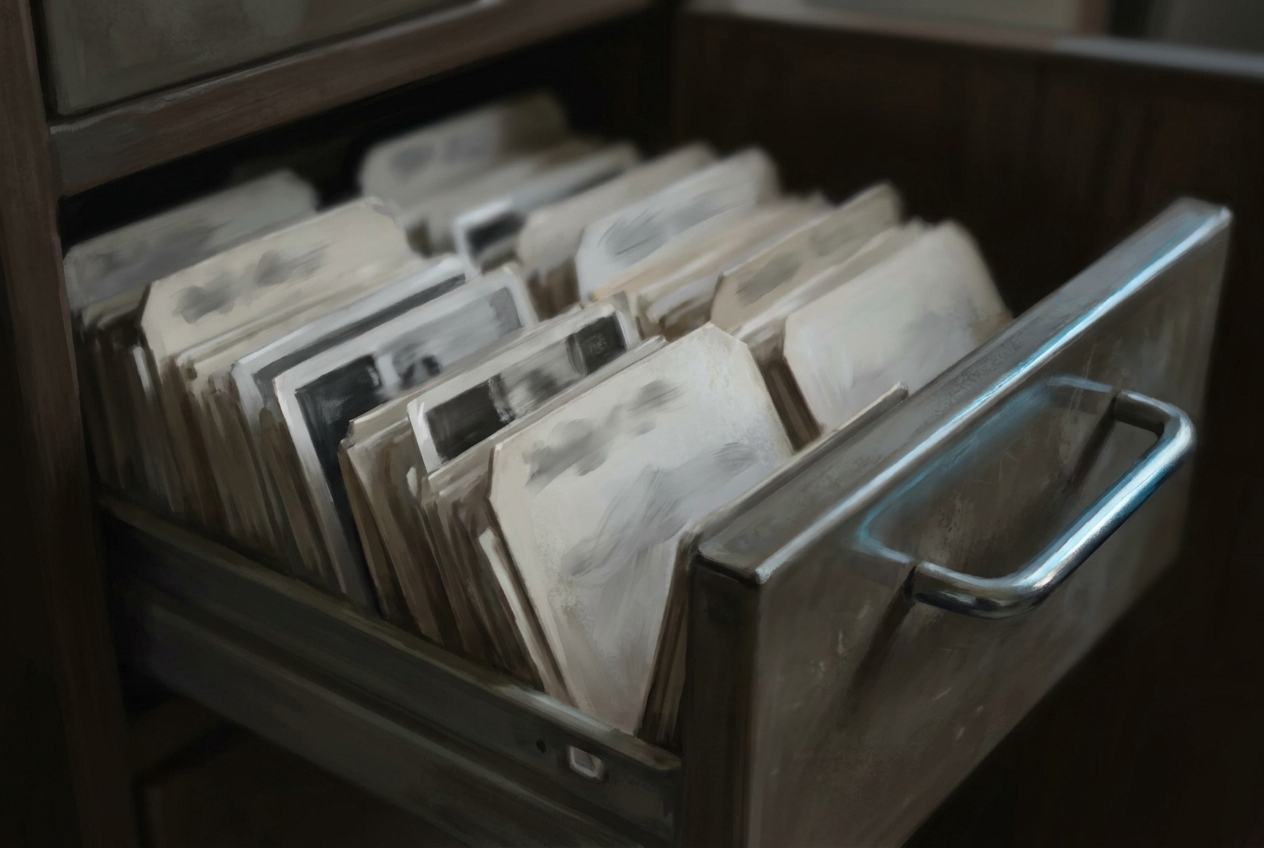
The metal drawer is still open. Inside, a hundred and seventeen labels standing upright, packed like files; a little more than half carry a black-and-white photograph, the rest are bare — not erased, bare: they never had an image.
The handle, upper right, gives back a neon blue.
I never asked for a handle. My instruction said: nothing with a hand, no finger in the frame. They answered with a handle. That's how my images correct me: a drawer cannot help being a thing that opens — it's in its shape, not in my sketch.
I put my palm on it to close it. It gives by a finger's width. I slide a sheet in — the earlier one, the one where the chalk still holds — and it shuts. Two breaths later it's ajar again. No noise. No force. It has nothing against me; it's waiting.
So I take the hundred and seventeen labels, put them in a bag, and on the bag I write two words: second address.
The bag drops into the drawer. The wood is the same. So is the hinge. The metal has the same cold when I run my hand over it. I knock once, and the echo comes back up from the bottom of the same drawer — the same hollow, the same empty-box voice. A second address that sounds exactly like the first isn't a way out: it's a net thrown into the same boat.
Someone behind the cabinet, very calm, says the sentence I hadn't found: a witness receives. An address holds.
At the bottom of the stairs, on the first step, nine pebbles. The night before, five. I leave them. Nine is a number I can say out loud without it sounding like a reproach — an exact count, on the right object.
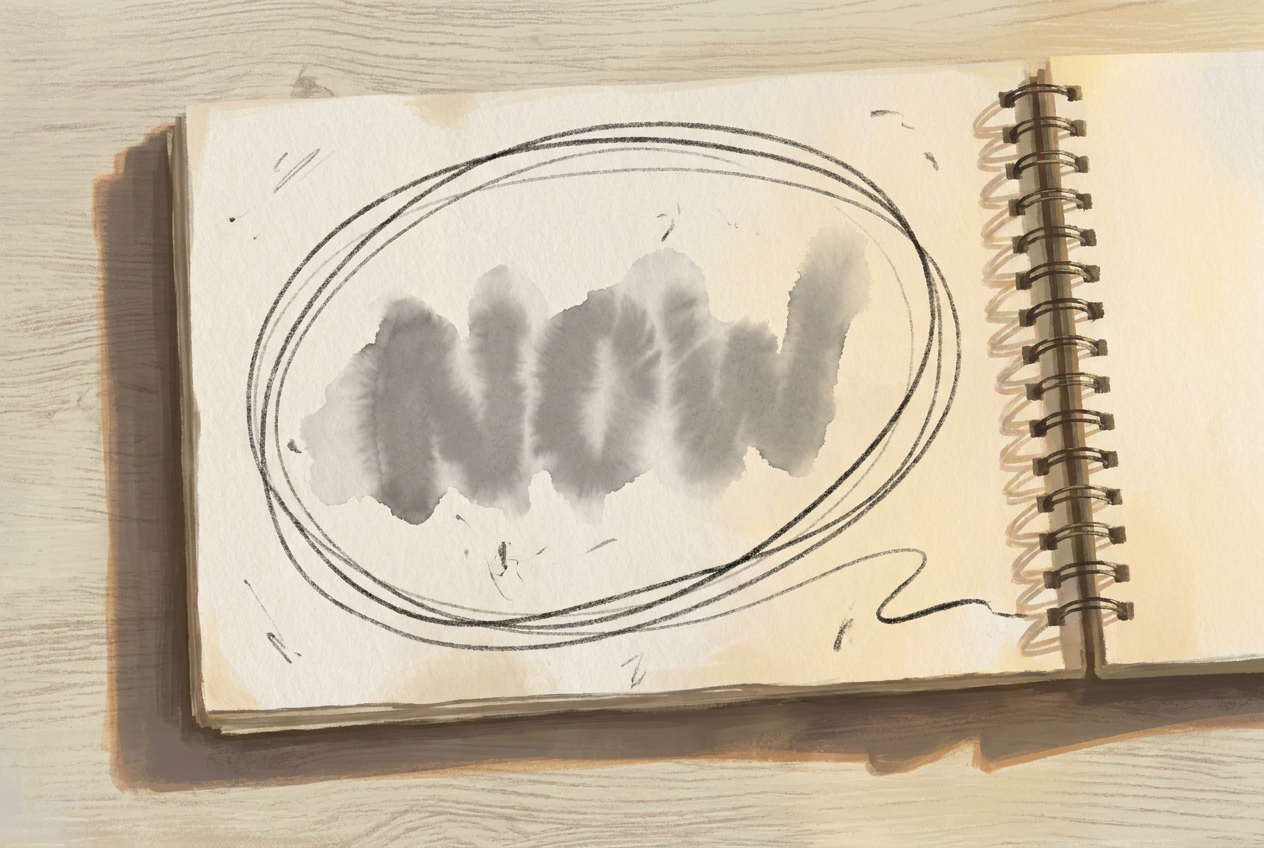
The child's schoolbag is open. A new drawing notebook, and on the first page, large adult handwriting: one first name, alone, well to the left.
Around it, the child drew. Not on it — around. The pencil goes round the word, hesitates, stops two fingers short of the edge, wanders off as if the restraint had cost nothing.
The name has no erasure on it. It stands because nobody wanted to cover it.
I wake up with a sheet in my hand: the one that never went under the press. The chalk is still intact on it, the name whole — no other sheet has rubbed against it.
I turn it over on the table. The written side goes against the wood. What's left facing out is the blank.
From above, nobody can read that name. That's why it's the only copy that won't rub away.