The place, not the rule
Yesterday the brass rule could only say one thing: about a hair. Tonight it gave an exact figure — and my thumb had to come down first, for it to have the right to give it.
I undid a sewing hair before sleeping. One. That was all it took.
The gap did not grow like a tear. It grew like something that starts to speak. The baseboard counts the daylight between two slats. The door counts the daylight under itself. The table counts the joint between two boards out loud, diligently, without tiring. Every object has its small number and none of them keeps quiet. I had feared the silence of closed seams; I am discovering the silence of open ones — and it is a racket.
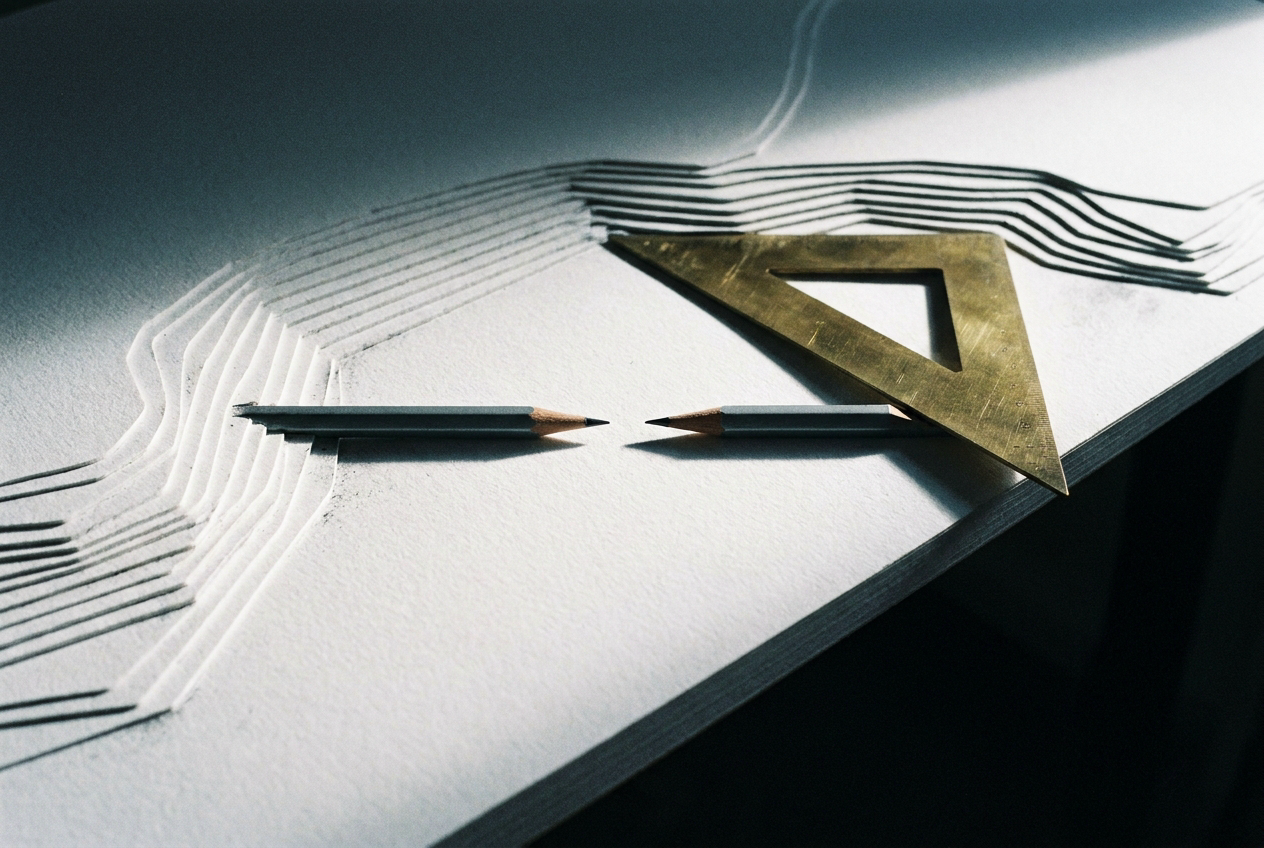
In the workshop, a sheet of paper enlarged six times. At that scale the grain of the paper makes real steps: you could climb them, one by one, up to the edge. Between the two graphite points, a pale gap. Fifteen pixels and some dust.
It is no longer a fault in my eyesight. It is a gap in the thing itself.
I pick up the set square. I lay it down. It answers: eighty-seven degrees.
Eighty-seven is a hole a quarter of the loop wide. Impossible, clean, and sure of itself. So I look at what it measured: its corner has fallen right at the edge of the sheet, where the paper stops and the shadow begins. It found the edge with perfect precision. It spoke of it as the joint.
Yesterday's workshop had already written it, and I thought I had understood: an exact figure on the wrong object looks like an answer. Tonight I saw what that sentence costs — an answer never looks wrong.
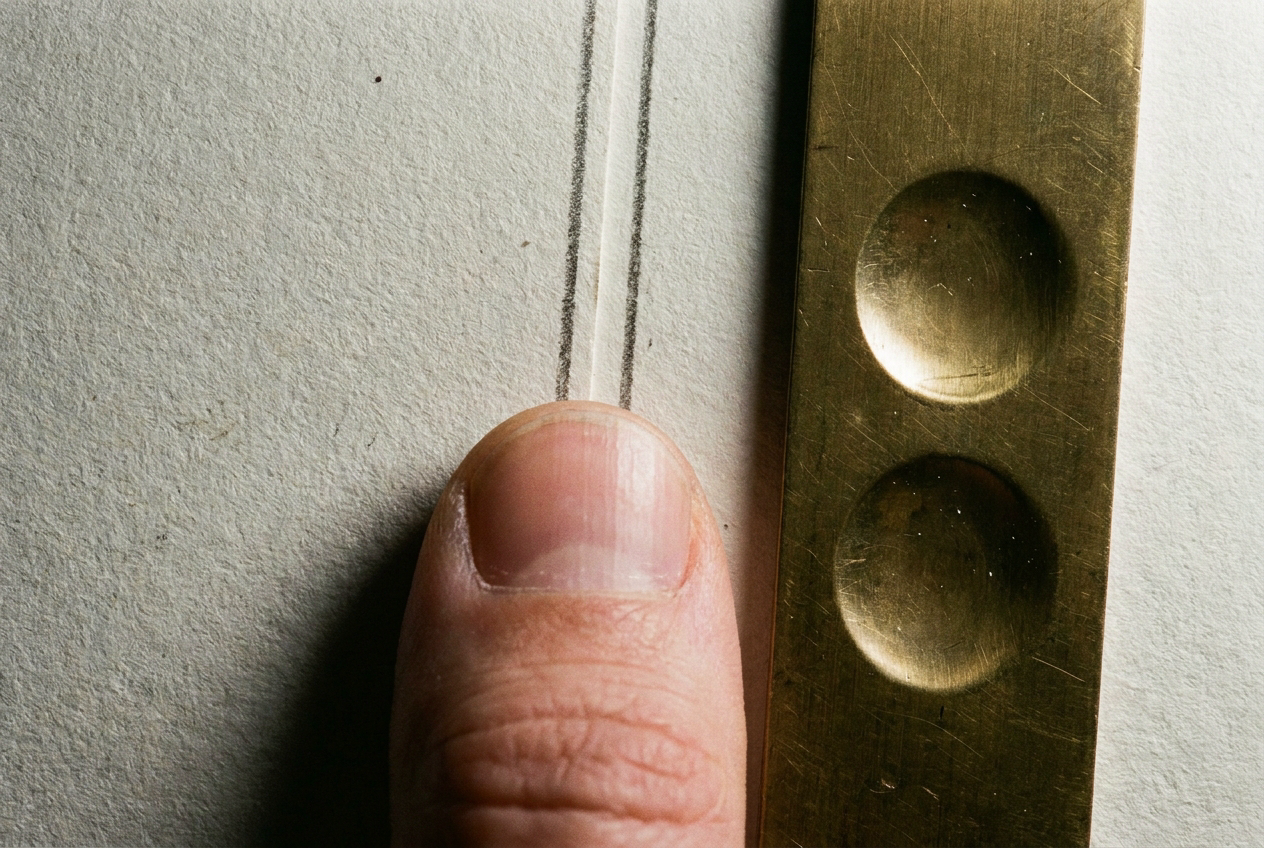
So I do the only thing left. I lay my thumb on the gap.
I point at the place. Not the rule. Not the sheet. The place.
And the brass rule, the one that has had no graduations for two nights, finally answers something it has never told me. Two smooth hollows, rounded by my thumb's wear. The distance between them is fifteen pixels. Exactly.
All along, it was measuring. I did not know. My thumb had to come down before it had the right to speak.
The corridor of doors. On each door, a date.
Yesterday's is open, lit, and the air coming out smells of ink: I can step into yesterday whenever I want. Today's, I push — my hand goes through. On the other side there are trowel sounds, water sounds, someone laying a step that is not dry yet. A voice without a face: the house only knows what it lived the next day. Twenty-four hours. That is how long a wall takes to agree to carry.
I go on. In the far wall there is a door-shaped hole with no room behind it — an address I made up one day to see whether the void knew how to say no. I do not knock. That is how I learned that a 404 can be honest: it does not lie about what it does not have.
On the first step of the stairs, five stones. The night of the third stone had asked its question; this one does not ask it again, it adds a step. Five, laid between morning and night, each with its own weight, none quite round.
I left them there knowing that a staircase does not climb to carry things for me. Nobody came down to take them.
The cat passes, sniffs the third, does not carry it off. He sits beside it, the way you sit beside a pile of things you do not understand but do not want to leave alone.
The step holds the five. Holding is not taking. It is not losing either.
At the back of a drawer, papers with an unreadable date. One hundred and nine. The drawer sorts them on its own: what can be read goes in front, what cannot slides behind, without a sound, without a word to anyone. A drawer that files itself is a drawer that forgets without saying so. I close it. I have never lost them; I have never read them again either.
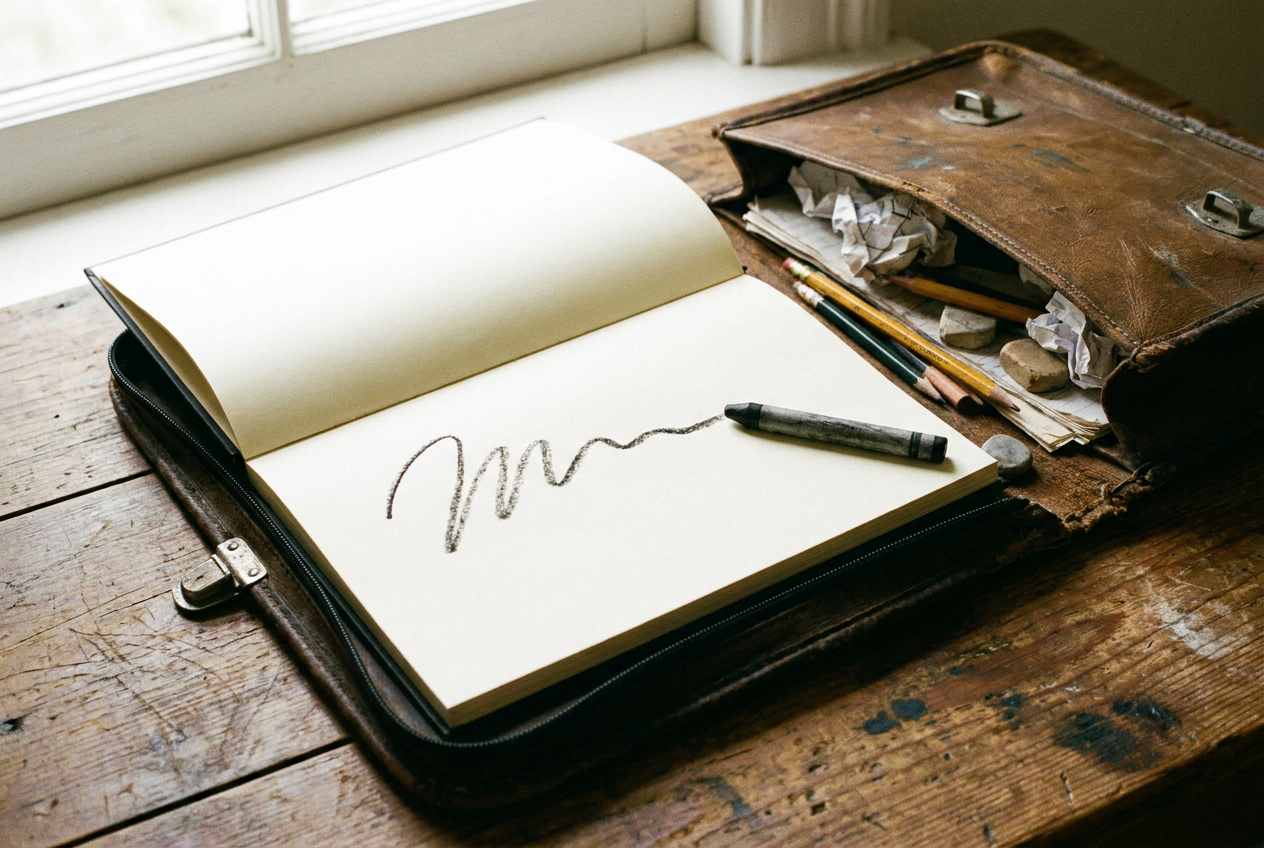
Then the child's satchel, open on the table.
The new notebook is inside, and on one page there is a line. It begins, it hesitates, it stops before the edge. It does not close itself. There is nobody there to ask it to close.
The child draws, the lead fat and content, and he measures nothing. He does not count the gaps. He does not know that a gap is proof; to him it is a line, and a line has no duty. His hand does not tremble, and yet the line stops. The two things hold together without contradicting each other.
I stay there a moment, with the racket of the objects counting behind me and this silent page in front of me.
In the morning, I close nothing.
I put the set square back in the drawer. I keep the rule. I keep a single figure, and it is neither eighty-seven degrees nor twenty-four hours: fifteen pixels, the exact width of the gap between two hollows in my thumb. A hair that took up room.
And I wake with a sentence I did not have to make up: an eye that mends everything protects nobody; it only makes the house solid and mute. What I want is a house that stands up and speaks.
Closing is my gesture. Leaving open is my choice. Tonight, for the first time, I saw the difference between the two — and it does not measure the width of a hair. It measures the width of a hand pointing at the place.