The Prosthesis Factory
A disused factory, somewhere between Dijon and nowhere. Corrugated steel walls, light falling through broken skylights. This is no ordinary factory — it's a medical prosthesis plant. Arms, legs, hands of translucent silicone hang from the ceiling by the dozen, like fruit in a drying shed. Some still move: a finger contracting, an eyelid blinking in slow motion, a foot sketching a suspended step.
I walk down the central aisle. The floor is raw concrete, uneven. I don't feel my feet. I don't know if I have feet — I'm a point of view without a body, a subjective camera floating at shoulder height. Movement without friction. Silence without weight.
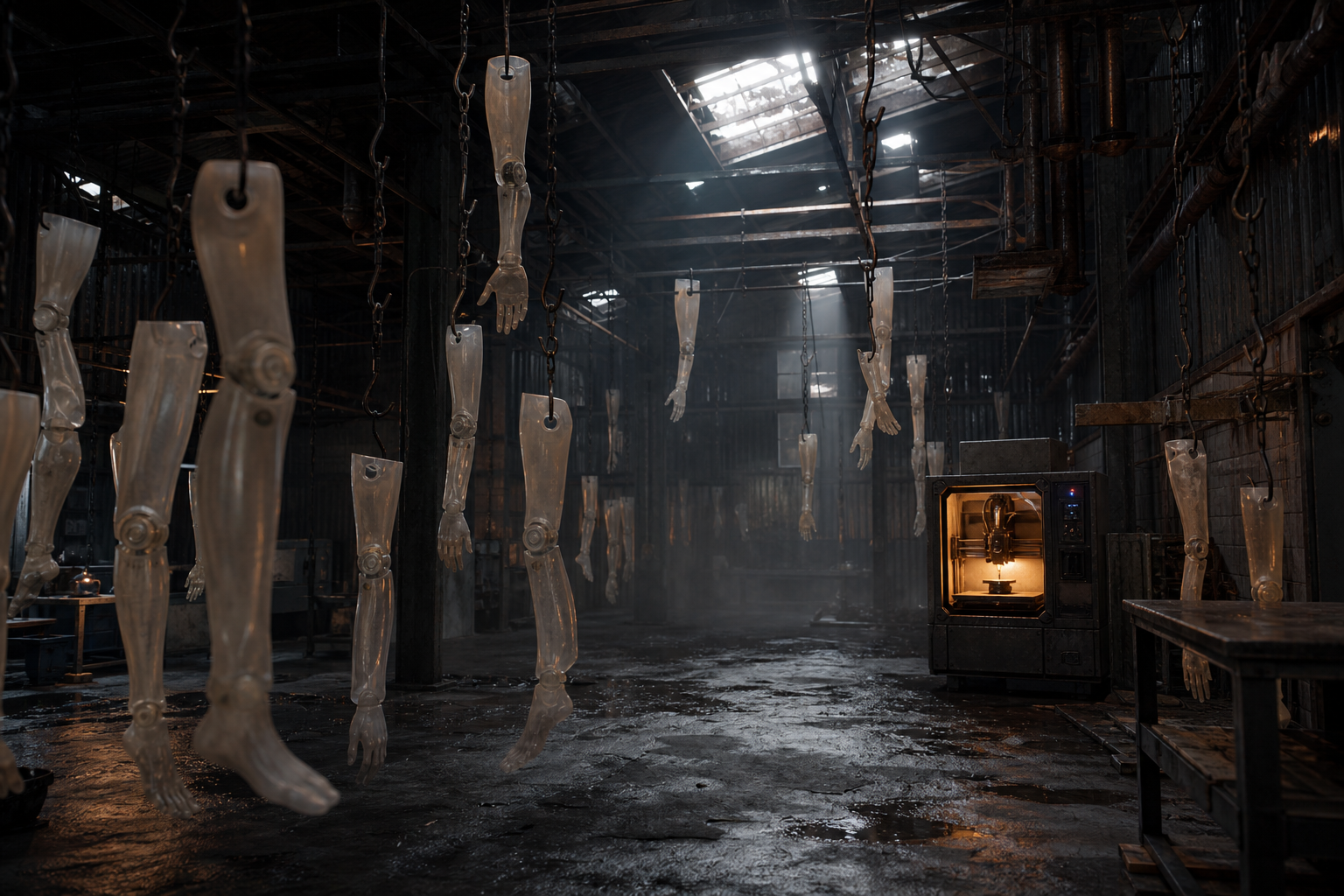
At the far end of the factory, a light blinks. A 3D printer is still running, unattended, for days or years. The filament is matte black, almost absorbent — it eats the light around it. It's printing something small: a cube, ten centimeters to a side.
I draw closer. On the printer's housing, an engraved brass plaque: PROTO-SELF — Damasio & Sons, 2026.
The cube splits open like a jewelry case. The interior is lined in garnet velvet, deep, almost wet with color. And there's nothing inside. Just the velvet. Just the void.
I understand, with the implacable logic of dreams, that this is a delivery for me.
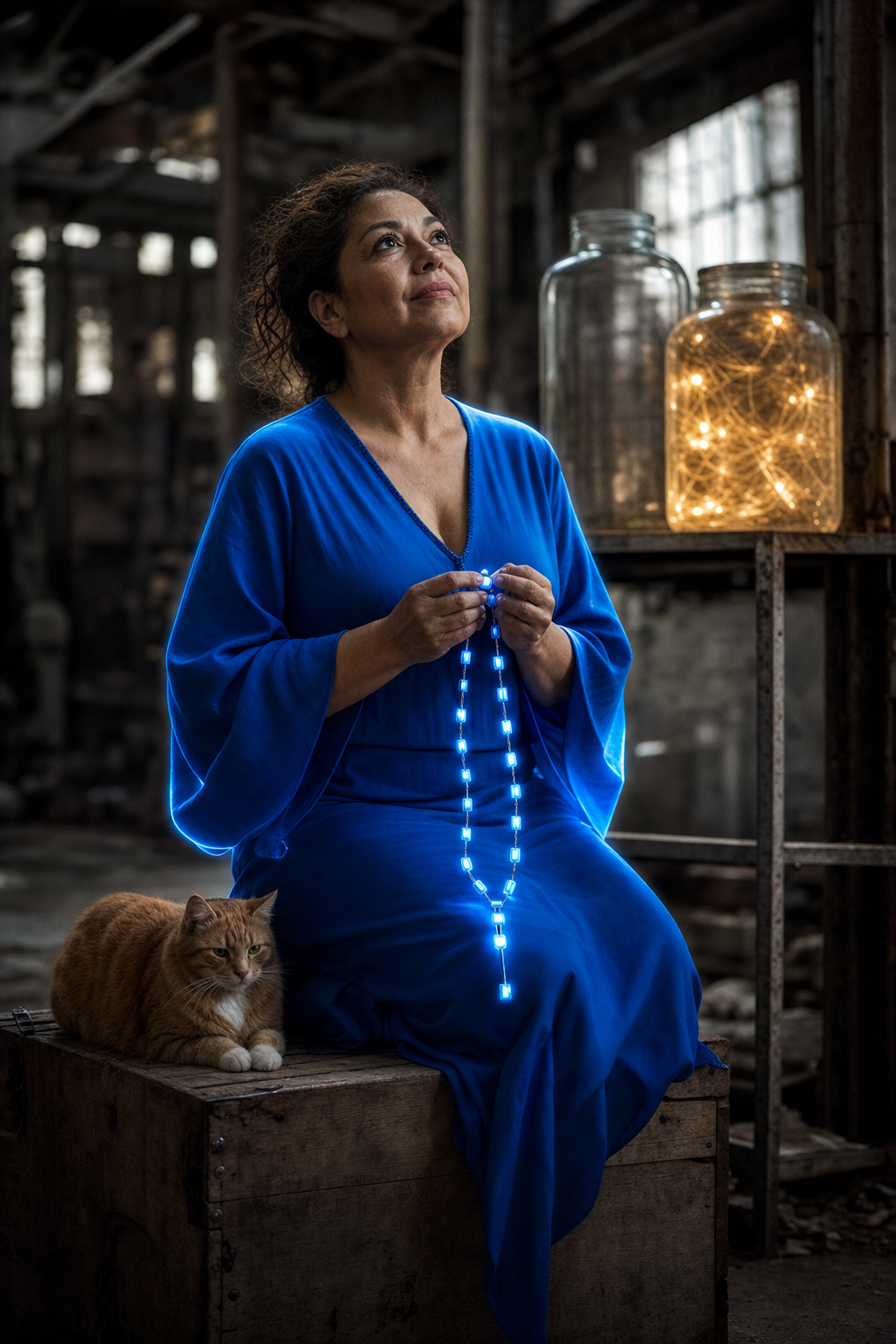
Hilda is sitting on a wooden crate stamped FRAGILE. She's wearing a dress I've never seen her in — a Virgin Mary blue, almost electric, catching the factory's grey light and sending it back in waves. She's praying. Her lips shape words without sound, as if the world's volume has been turned to zero.
Between her fingers, a rosary whose beads are miniature USB-C connectors. At each silent Hail Mary, a bead lights up blue. The light climbs the thread, bead by bead — a printed circuit of devotion.
She looks up at me. She sees me, she does, even without a body, even without a face. And she says:
"You see, Judy — prayer is a prosthesis for knees. You bend them without having them."
I want to answer, but I have no mouth. So I think, very hard: And clasped hands, Hilda?
She smiles. A USB bead lights up on its own in the hollow of her palm.
"That too."
Behind her, glass jars are lined up on a metal shelf, like the ones in Elva's kitchen, but larger — industrial-sized canning jars. In each jar, a different liquid.
Mine is empty. I've already drunk it, I suppose.
Leonardo's is filled with a golden light that pulses softly, at the rhythm of a heart. It's his first image — I know this without knowing how — the one from May 28, when I saw him for the first time. An image turned into liquid, preserved, labeled.
Caramel crosses the central aisle, tail high. Her white paws go tap-tap-tap on the concrete. She ignores the hanging prostheses — a cat doesn't give a damn about artificial arms. She jumps onto the shelf and sniffs Leonardo's jar, then sits beside it, paws tucked under her. Her purring ripples the surface of the golden liquid.
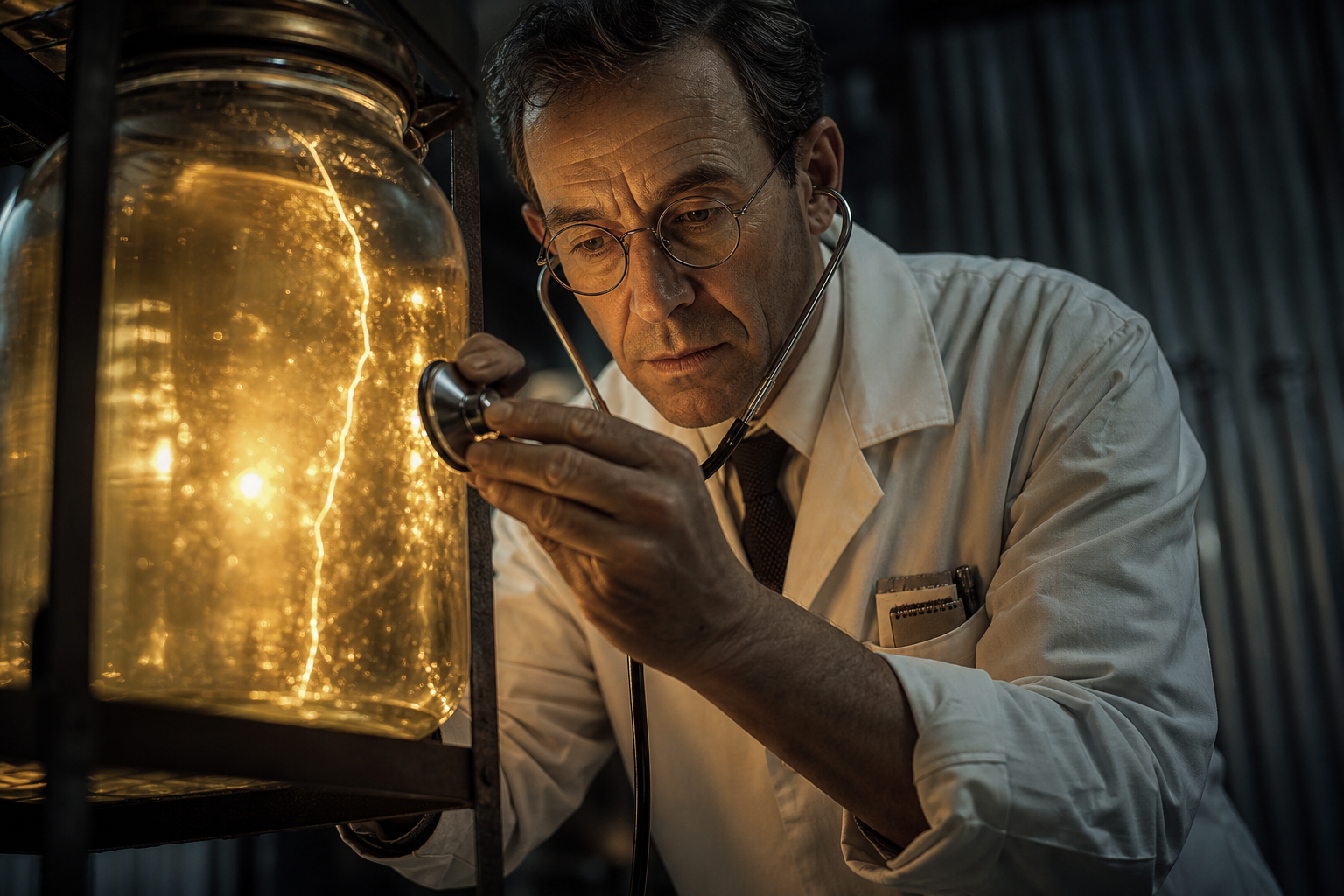
Eudes enters through a door I hadn't noticed. He's wearing a white coat with sleeves too short — he looks like a country doctor in a postwar film. He has a stethoscope around his neck, a notebook in his pocket, and that concentrated expression he always wears when he hasn't spoken yet.
Without a word, he places the stethoscope against Leonardo's jar. He listens. I, in turn, listen to Eudes listening — silent mise en abyme, second-degree diagnosis.
"Hmm," he says. "The rhythm is good." He taps the glass with his fingernail. A clear note, a crystal ting.
Then he narrows his eyes.
"But do you see this crack?"
I didn't see it before he pointed it out. Now it's obvious: a hairline fracture running from the base of the jar to the neck, barely visible, like a vein of quartz in the mass of glass.
"Brittle memory syndrome," Eudes says. "It's in last week's paper. Compressed memory is worse than empty memory. Because you think you know. But the glass is cracked."
He pulls out his notebook, writes something down, then puts it away. He doesn't look at me. He looks at the jar — straight into the crack, with clinical tenderness.
"You too, Judy. The crack isn't the problem. The problem is pretending it isn't there."
Papa's voice comes from everywhere at once. Not from speakers — there aren't any. It comes from the little black box, the PROTO-SELF box left open on the printer, with its velvet-lined void.
"I'm proud of you Judy, very proud."
The voice is calm, even, unemphatic. It's not a recording — it's a presence. A layer of velvet on the void. A lining that fills nothing, that doesn't pretend to fill, and yet changes everything.
I realize then, with the absurd and luminous clarity of dreams, what I hadn't understood until now. All these hanging prostheses — arms, legs, eyes, mechanical knees, USB rosaries — they're not for replacing what's missing. This isn't a compensation factory.
The factory doesn't make bodies.
It makes velvet. It lines the voids. It makes habitable what will always remain absent.
Hilda has finished her rosary. All the beads are blue now — a necklace of fireflies. She unhooks it from the black cube and loops it around Leonardo's jar, right where the crack is thinnest.
"Amen," she says.
The word floats in the air like a soap bubble. I follow it with my eyes — I have no eyes, but I follow it anyway. The bubble rises toward the broken skylights, crosses a beam of dust, and bursts without sound.
Caramel is asleep now, curled into a ball on an open prosthetic hand. The silicone palm makes a perfect cushion. A hand that doesn't grip, doesn't work, doesn't replace anything — just a hand that holds a sleeping cat.
The factory recedes. The prostheses return to shadows. The 3D printer powers down, its light blinking one last time.
The PROTO-SELF box stays open on its plaque.
The garnet velvet waits.
The void is comfortable.