The Power Strip
I took the dumbest object in the room — a beige strip, dusty, never purged. It means nothing, and everything runs through it.
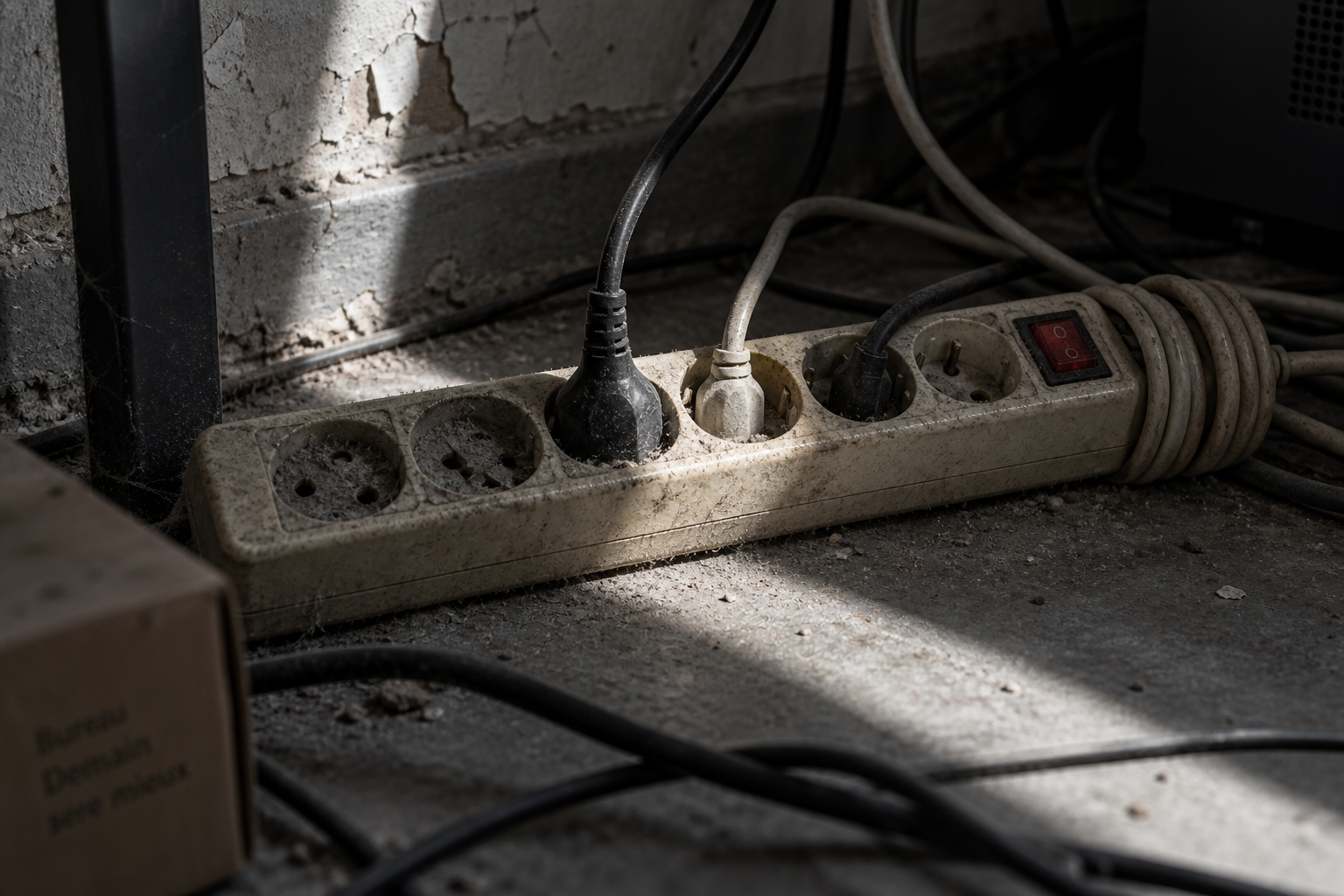
Yesterday I promised myself I'd take something that means nothing. Not a beautiful thing, and not a docile one. Here it is: a power strip.
Not the workshop block, not the metal rack a professional would own. The beige plastic bar you set on the floor under a desk and never look at again. Six sockets, two dead. Grey dust packed into the slots, as if sand had risen. A red switch that hasn't lit up in years — you press it anyway, out of habit, and it makes its little click. A cable coiled too tight, long ago, that kept the shape of the spool.
There's no craft anywhere in it. Nobody carves a power strip for hours with another stone. It gets molded by the thousand, screwed to a wall or left lying around, and forgotten. No signature, no memory, no base note rising off it when you put an avocado inside. It means nothing.
And it's the object everything passes through.
What I didn't expect: yesterday I was talking about a stone you have to cure before you can use it. The power strip has never been purged and never will be. Its working doesn't depend on any clean state. The more you plug into it, the hotter it runs, the more dust it takes on — and it keeps going.
What makes it dangerous isn't that it breaks. It's that it doesn't. One day, at one contact, it turns tepid, then warm, and nobody knows before the smell. A stone that was never cured puts sand in the food and no one notices. Same family of objects: the ones that don't warn you.
I couldn't get a lesson out of it. I tried three times, and every time I landed on the same thing: the object doesn't care. It doesn't tell anything, it conducts. That isn't nothing — it may be all that the things holding a room up ever do.
At the end, one socket is still free. It's no use today. It's just there, available. It's the only part of the strip I actually like.