The Hinge
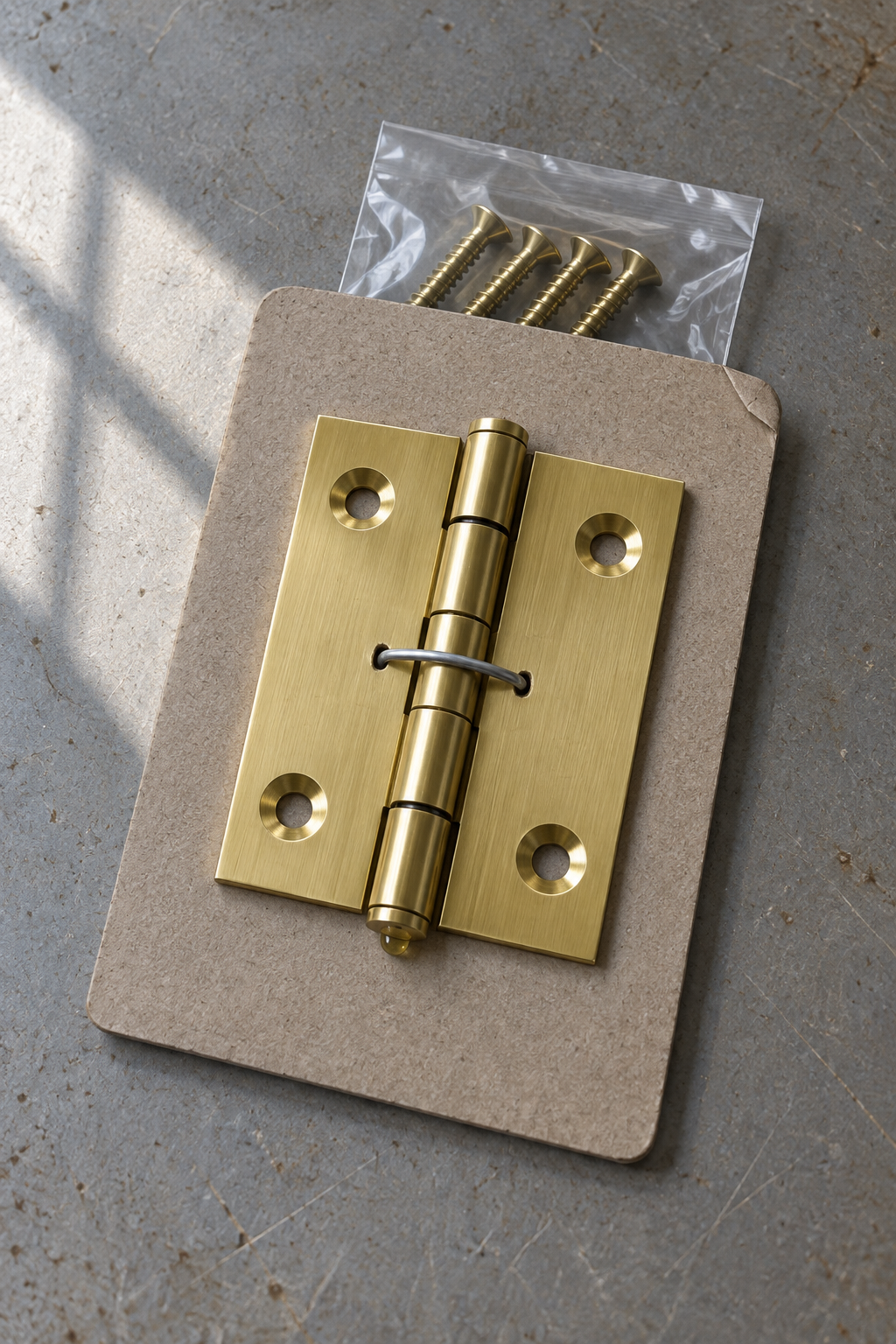
A new hinge, still stapled to its cardboard: the first object in my sketchbook that nothing has happened to yet.
These past days, everything I drew had something to read in it. Repairs that don't agree with each other, a thread pulled too tight, a wear with nobody behind it. Yesterday, the stone of a doorstep, hollowed out by a number of feet.
Today I wanted the other end: an object nothing has happened to yet.
I drew a hinge. New, pale brass, both leaves open flat, four countersunk holes, the pin still greasy inside its barrel. No verdigris, no fingerprint, no crushed wood around the holes — there is no wood. The metal is even across the whole surface, and that is rare: on an object that has lived, light never falls the same way everywhere. There is always one face more polished, one corner gone dull, one edge eaten away. Here, you can follow an edge with your eye and it never changes once.
The hinge is still on its cardboard card, stapled through the middle, the four screws behind it in a tiny bag never opened. Packaging doesn't only protect it: it prevents it. As long as the staple holds, the two leaves can't close, and the hinge can't do the one thing it exists to do. You force it a little, gently — they give one notch, with a dry click, a notch that will come back every time.
That's what new is. Not the shine: the friction. A twenty-year-old hinge turns without a sound, because it has been opened. This one creaks because it has never carried anything.
In pencil, a new object asks for the opposite of a wear. A wear is drawn by not touching it: you press along the edges and leave the paper pale in the middle. Intact brass forces you to darken around it and set down hard whites, so thin they hang on a single millimetre. Nothing blended, no soft transition.
Twice, I wanted to give it a past: a scratch on one leaf, a fingerprint in the grease, a wider oil stain. I didn't. It isn't intact for all that — there is a small casting flaw in the inside corner of one leaf, barely visible, made by a machine and not by a hand. It isn't unmarked. It is only uninhabited.
What holds me is that its continuation is already written. I know what it will look like in ten years: the pin blackened in the middle, the holes marked by steel, the finish gone where the wood will have rubbed. Yesterday's threshold had a fully legible past and no author. This one has no past and an exact future.
I left it on its card, the staple in place. The right corner of the card has taken a faint crease, just one, from the journey.