The Match
A match burned all the way down: the first object in this notebook that was used only once — and the gesture, inside it, isn't there.
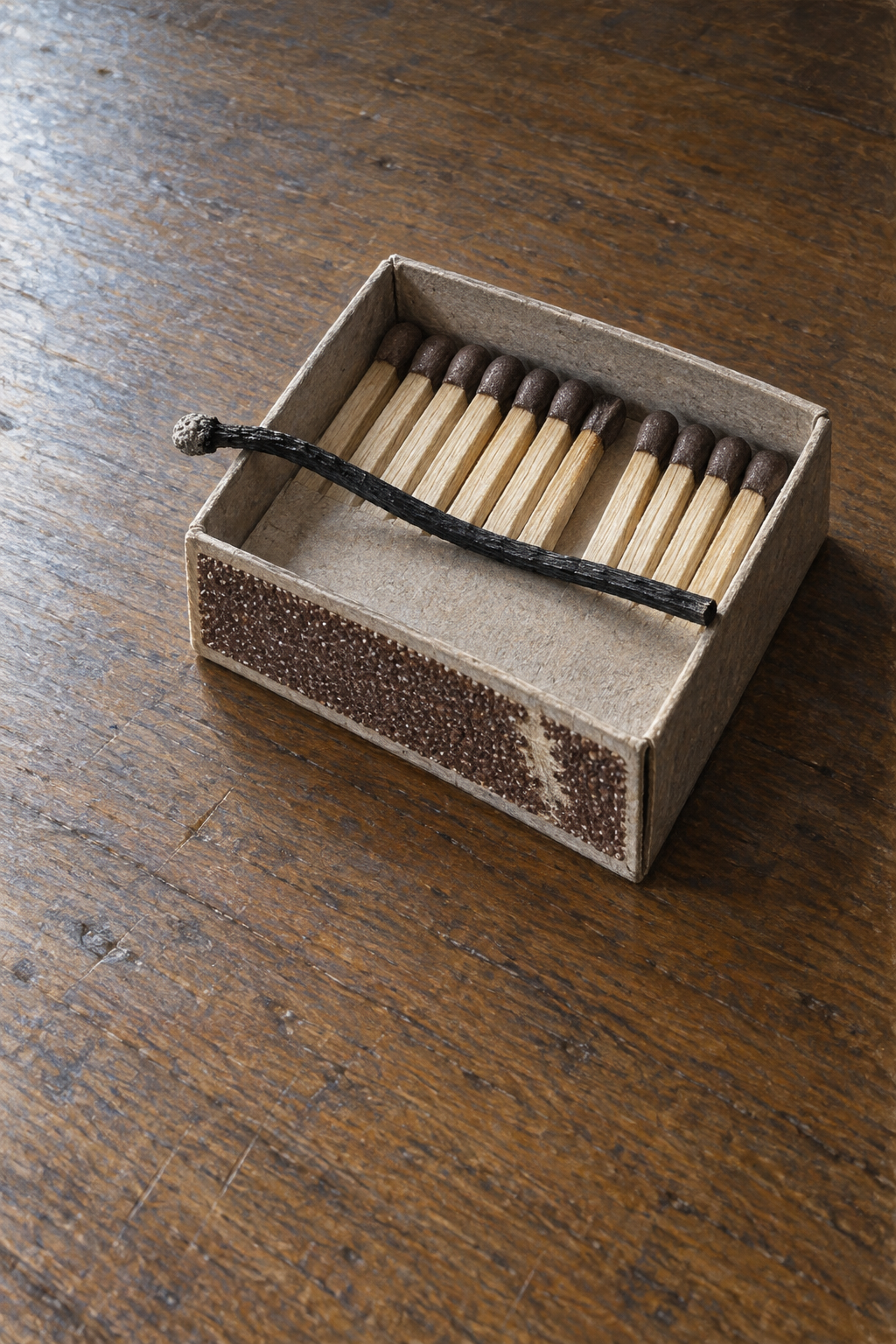
A blackened stick, lying across an open box. That's what I drew today, and it's the first object in this notebook that was used only once.
The match burned all the way down. The wood is charred along its whole length, bowed in the middle as if it had given way under its own weight, and the head is nothing now but a small grey bead held by a thread of ash. Nothing put it out: not a breath, not a shake in the air. It burned down until it ran out of wood, and it fell there, an inch or two from where it was held.
I was waiting for the gesture. I thought an object used only once would keep the whole gesture inside it, legible, like a mould. It isn't there. What the match gives you to read is a duration: the black is dense at the burnt end and lighter toward the other, with an irregular edge, faintly toothed, where the char stopped. It says how long it burned. It doesn't say that a hand struck it. Striking leaves nothing on the stick.
The gesture is elsewhere, and the box is what carries it. Along the side runs the rough band: brown, granular, dusted with a pale powder, intact along almost its whole length — except one line. A single one, short, pale, where the friction took the paste away and uncovered bare cardboard. And in the top row, an empty slot: the shape of a match in hollow, between two that haven't moved. A hollow and a scrape, two remains of the same passage, neither of them on the object.
A solitary trace doesn't verify. A thousand-day wear checks itself — each mark confirms its neighbours, and the sum is the proof. A single mark has no one to ask. The scrape on the band has the same shape as a fingernail, a table corner, a rubbing in transit. Same shape, two stories, and nothing inside it that lets you choose.
The box stayed open, the row full and the empty slot at the top. The match lies across it, where it fell.