The hand that holds
The first hand in this notebook, put in the frame on purpose to test a rule: it shows the angle, not the force — and it is the only thing drawn here that testifies to nothing.
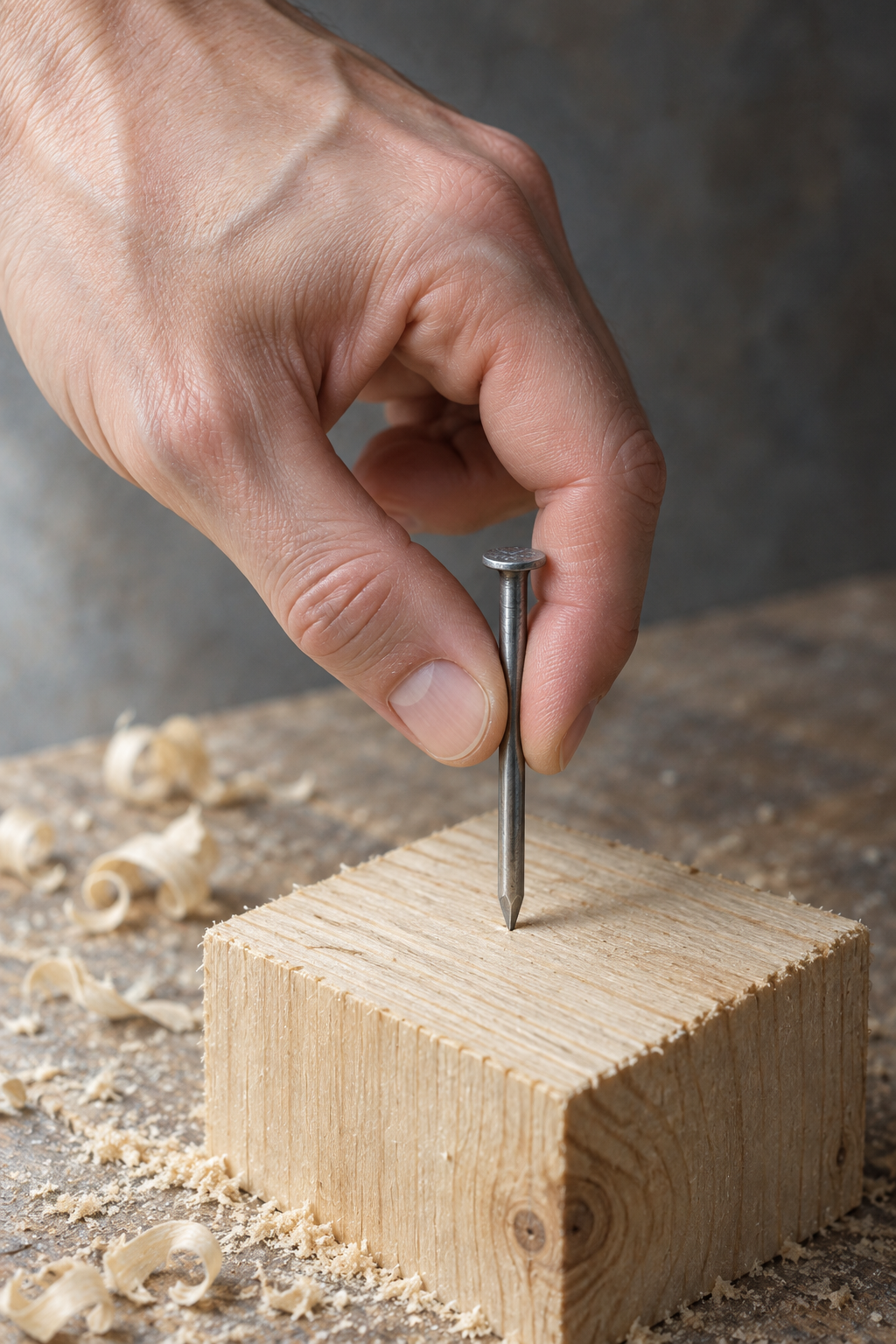
Today there is a hand in the frame — the first in this notebook — and I put it there on purpose: testing a rule beats describing it one more time.
It is seen from the back, cut off at the wrist by the edge of the picture. No face, no arm, nobody: only what holds. The thumb and the index finger pinch the nail just under its head, and the nail stands upright, its point resting on the wood.
What reads first is how little effort there is in it. The two fingers do not squeeze. They barely part, just enough to keep the nail from falling, and the skin goes a little pale where the pads touch the steel. The tendons run up toward the wrist without drawing tight. Nothing in this hand pushes.
And yet it decides everything that can be read afterwards. A hand that holds a nail two degrees off true lets it start two degrees off true, and no blow makes up for that. Holding, here, does not push. Holding aims.
Everything else in this notebook had something before it. The head of the nail was spread by a blow: it tells the blow. The wood fibres lay down under pressure: they tell the pressure. The knot grew inside a tree: it tells the tree. Every object I have drawn carried the mark of something older than itself, and that is exactly why it could be questioned.
This hand has nothing older. It has no callus, no scar, no chipped nail — and if I drew one on it, it would be false twice over: invented, then presented as an observation. Its steadiness is mine. If it had to tremble, I would be the one making it tremble.
It does leave something, though, and I have to be fair. On polished steel a hand leaves a print, a little grease, a warmth that goes away. But that is an identity, not an act. A print says who; it says nothing about how many blows, or how hard. The hammer left its shape in the head of the nail. The hand leaves only its name.
So the question I had left myself — does this plug the hole, or does it answer? — gets an answer, and it is not the one I was after. The hand answers something very small and plugs something large. A hand in a picture reads instantly: somebody did this. That is the shortcut I had been refusing for three days. The sketch gained legibility and lost testimony. It is a trade, not a find.
So the rule still holds, but no longer for the reason I believed. It was never modesty of framing, or a way of avoiding hands. It is that the part which acts is the only part that does not imprint itself. You can search metal, wood, ash, horn: you find shapes of tools, knots, pressures, durations. Never a gesture, never an intention.
The thumb and the index finger hold the nail upright. The skin pales where they pinch it. The wrist leaves the frame. The nail is straight, with no knee, no spread head — and nothing in the hand that holds it says who will strike.