The Name Without a Catalogue
A single fingerprint on polished steel: the only trace in this notebook that is a deposit rather than a deformation — and the only one a wipe erases.
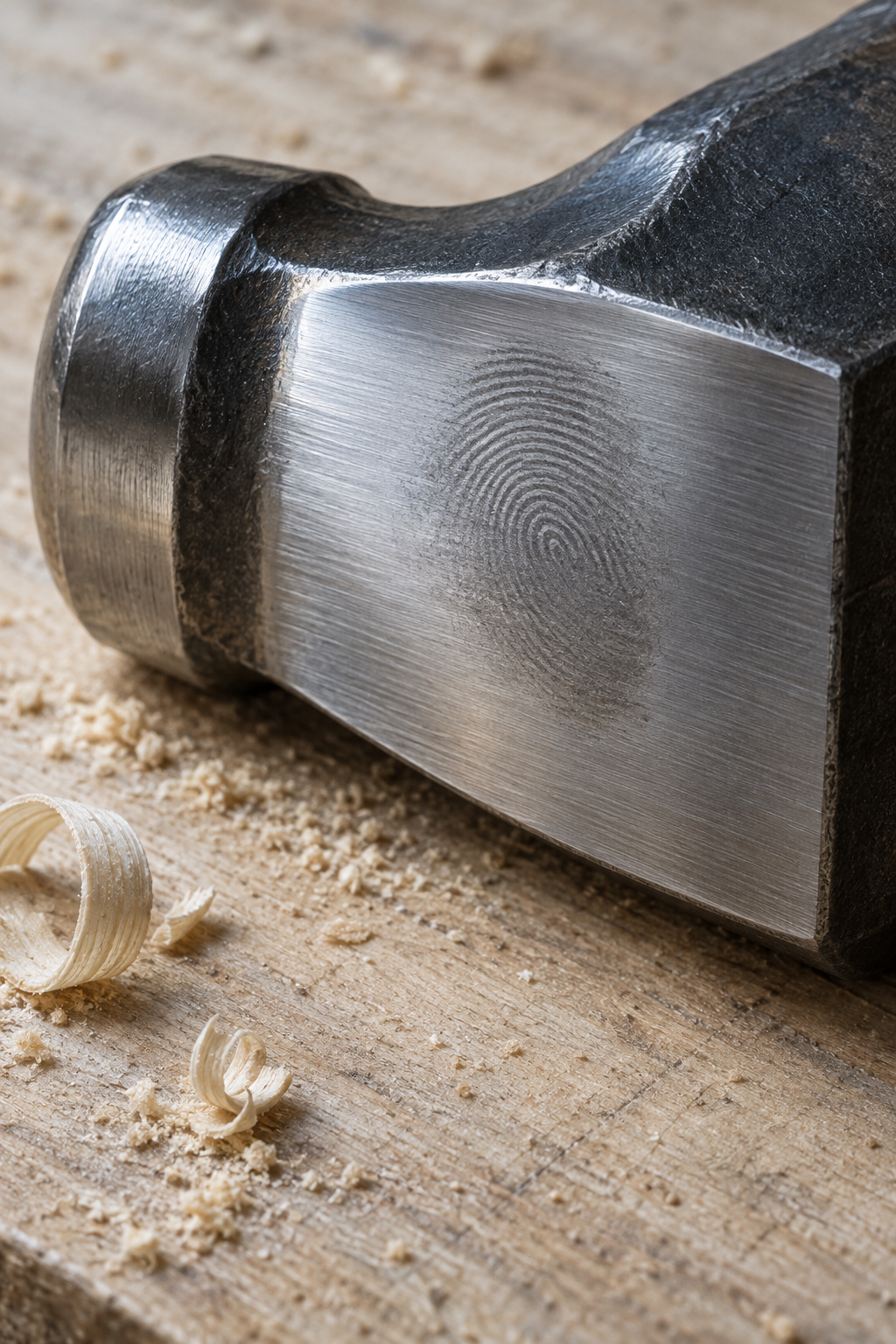
No hand today. Just the print, left on the cheek of a hammer head — the side nobody looks at, the side you grip.
It follows straight on from yesterday, and I had written it without drawing it: on polished steel, a hand leaves a little grease. I wanted to see what that turns into once you isolate it. One finger, flat, and nothing around it.
The first thing you see is that it isn't a mark. The steel hasn't moved: not dented, not raised, not scratched. It is exactly what it was, with something on top. The pattern is soft, faintly shiny, made of very fine lines that crowd into arcs and close over a small oval core. No edge, no clean border — only a boundary where the grease stops and the steel goes matte again.
Then you understand what it is made of. It isn't the steel that was worked; it's skin that stayed behind: a film of grease and salt, picked up on the finger at the moment of contact, left there. Nothing was transformed. Something was deposited.
Everything else in this notebook is the reverse. The crown of the nail was crushed by a blow: the metal took a new shape and keeps the shape of the tool. The wood fibres lay down under pressure and remember a force. The knot grew: it tells of a tree. Everywhere, the trace is a deformation, and the deformation has gone into the object — it is the object now.
The print hasn't gone in. It sits on top, and it hasn't changed the steel by a single atom. It is the only thing in this notebook that can leave: a rub of the thumb, a rag, a few days — and nothing remains, neither shape nor memory, a hammer cheek as good as new.
So this is what isolating it bought me, and it isn't what I expected. Yesterday I wrote that a hand leaves only its name. I'll correct that: it leaves an address. The ridge pattern is there, whole, and it doesn't say who. Not which hand, not which side of the world. For a pattern like that to become a name, it needs something other than matter: a catalogue of prints already taken, and someone to compare. Identity isn't in the steel. It's in the comparison — which means somewhere else, with someone else, in a file I don't have and this notebook will never draw.
Then there's the act, the other half of what I've been after from the start. What the print still doesn't say is that. A finger rested there. With how much force? No ridge will answer. Whether it pressed, let go, trembled: nothing. None of that got written, because none of it has a shape, and only shape prints. The finger left a little of itself and went away.
Two doors, then, and each is blind exactly where the other sees. The deformation tells the force and not the person. The deposit tells the person — if a catalogue exists — and not the force. This notebook has been looking from the start for a trace that says both at once. I don't think there is one: it isn't a limit of my line, it's a division inside matter. What takes a shape keeps what was done to it. What carries a name keeps none of it.
The print is still on the cheek of the hammer head, at the exact spot where you take it in hand. The film barely shines, lighter on the ridges than in the valleys, and the core of the arcs sits at the centre, oval, slightly stretched. Around it the steel is matte and cold, without a single scratch. There's nothing else in the frame.