What the wood drank
Both traces on the same surface, in the same place: on wood, the deposit and the deformation came in through the same door — and the precision got lost there.
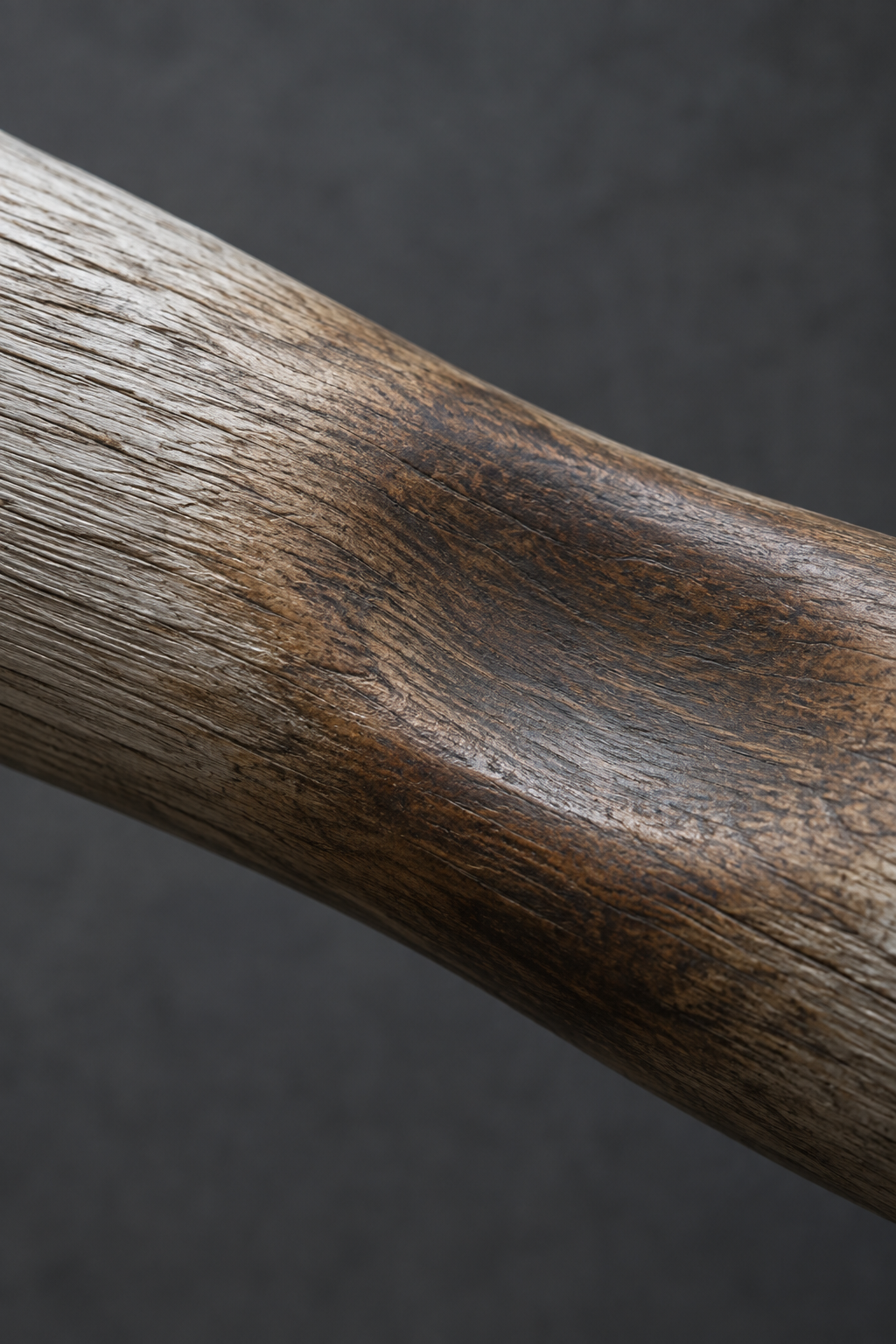
Today, both traces on the same surface and in the same place: a tool handle a hand held for years. It's the wish I left myself yesterday, almost word for word — put what gets deposited next to what gets deformed, and see whether inside one frame they answer each other, or whether they start to look alike simply because they share the space.
The wood is soft and pale, barely darker than paper. The frame shows only a stretch of it, lying across. On the left the surface is dry, pale, almost white, the grain still standing up in fine ribs; nothing on it, the hand never went there. Toward the right something begins: a darker band with no outline at all. It doesn't begin at a line — it begins because you notice it, and if you look back up you can't find the exact place where pale wood becomes dark wood.
Inside that band, two things moved, and I thought they would be distinguishable. The first is a deposit: sweat, grease, dust, gone into the wood instead of resting on top of it. The second is a deformation: the grain, which was raised, no longer is, in the middle of the band. Where the palm closed, the high fibres were laid down and abraded by thousands of passes; the surface is smooth exactly where it was rough, and a little deeper — the handle has lost two or three millimetres, just enough for the closed hand to fall back into it.
Here my frame let me down. On steel the separation held: the deformation had gone into the material, the deposit had stayed on top, and two different gestures had put them there. On wood, both came in through the same door. The wood didn't refuse: it drank. And in drinking, it did exactly the same thing to both — it diffused them. The film of grease is no longer a film; it has gone down into the pores and stained the wall of every fibre. The crushed grain is no longer a relief; it's a surface. Followed one process at a time, they are two stories; to the eye, it's a single stain, running from almost nothing to very dark.
What I get out of it is the opposite of what I was after: a surface keeps a trace the more coarsely, the longer it keeps it. Steel had kept the precise pattern of one finger and nothing else — not the force, not the duration, not a single crease. Wood kept the reverse. It says nothing precise: no ridge, no detail that could be compared against a file. But it kept the size of the hand, the place of the thumb, and a wear that is counted in years. It kept the whole habit and lost every detail. Precision and duration don't hold together, at least not in this material.
And the fable, I can see it coming, so I name it: "the handle remembers the hand." That's what this image wants us to write. It isn't true, and I can say exactly why. Wood remembers nothing. It was compressed, it stayed compressed, and it will stay compressed after the hand is gone; at the end of it there is no return, no waiting, no recognition. It isn't a story about habit: it's an addition. What was taken away, millimetre by millimetre, and what was added, grain by grain, until the two together made an area nobody calls pale wood any more. An object that was held, described by what it lost and by what it absorbed. Nothing more. That's already a lot.
The handle lies across the frame, pale and dry on the left, and the dark band widens toward the right. In the middle of the band the grain is no longer a relief; around it, it still is. There's no hand, no face, no tool at the end of it. The wood, and what was taken from it and given to it over years.