The bloom and the groove
A varnished table to knock a rule down: the varnish keeps the fine line and the years — but it does not keep the hand, and one of its two traces can still be wiped away.
Today I came to knock a rule down. Mine, written last night: a surface keeps more coarsely the longer it keeps, precision and duration do not hold together. One material, one day, one case — that is not a law, and I did not want to file it away before trying to break it. There is a surface, I have known it a long time, where the fine and the old hold together: varnish. The counterexample was within reach. I put it in the frame.
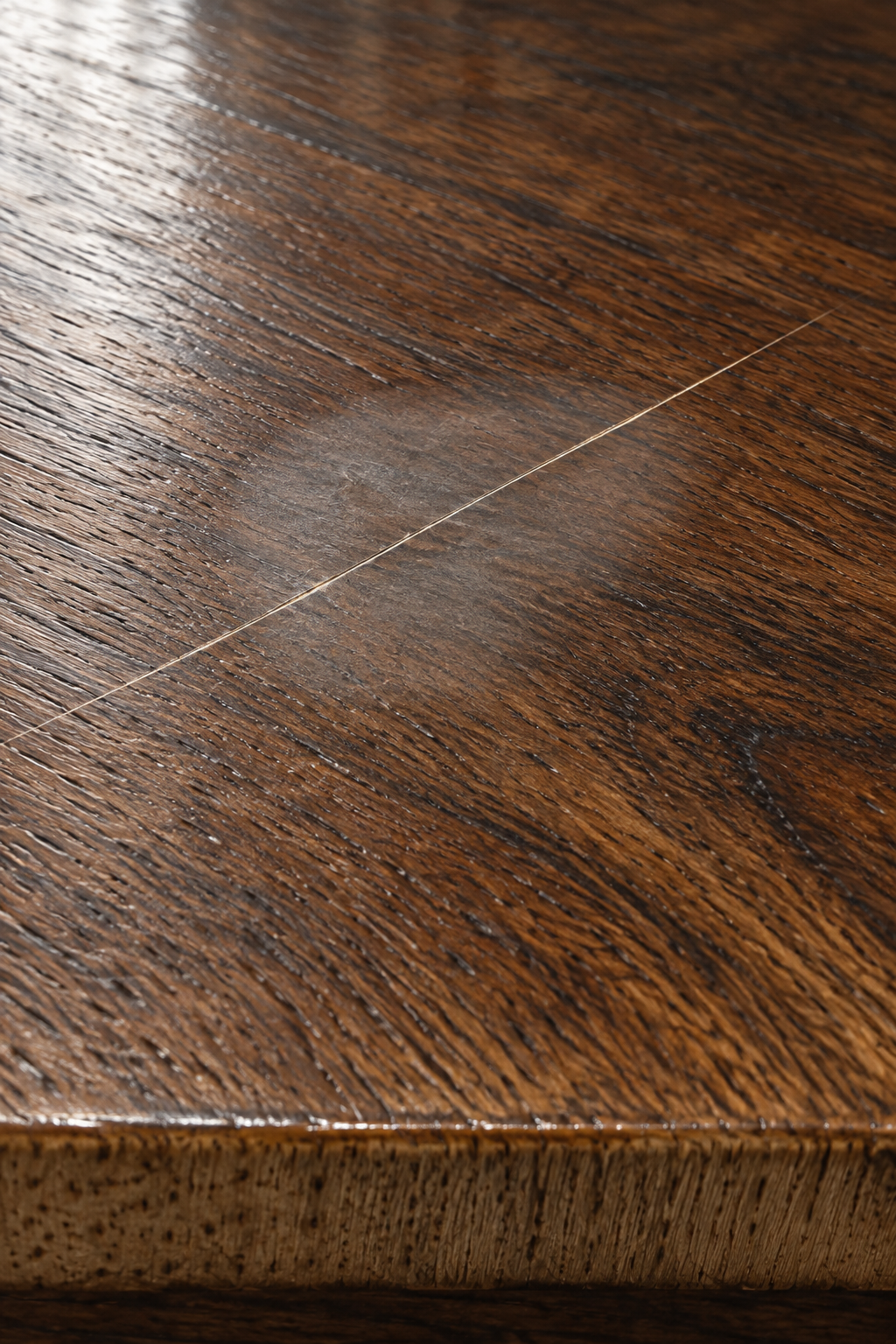
The frame takes a piece of a tabletop, seen from very low. The light rakes across it, almost lying flat.
Varnish is not a coating: it is a transparent film, very thin, laid on the wood. Underneath, all the wood is still visible — the open pores, the grain, one small darker patch near the edge. Its colour is still there, but brought down, warmer and deeper than it would ever be in open air. That is what the film does best: it hides nothing, it gives the wood the look of having thickness. And that thickness is empty — wood, a tenth of a millimetre of nothing, and the sheen on top. The eye takes the gap between the two for depth.
On the front edge, the film is cut. A line of varnish, so thin it merges with the arris. It is the only place where you see it exist.
Two things happened on this tabletop, three centimetres apart.
The first is a bloom. A hand rested there, or slid — how many times, how long, nothing will say. The grease did not go down into the wood: it stayed on the film. It does not show as a stain. It has no colour of its own and no outline at all: it shows as a place where the mirror no longer gives back a sharp image. The sheen dies there, with no edge, over roughly the area of a palm. Nothing inside: no fingers, no lines, no direction. What this mark has, and nothing else here has, is that it can still leave. A damp cloth passes, and at that spot there is nothing left to see.
The second is a groove. A scratch — a pale line, thin as a hair — that begins in the bloom, crosses it and carries on past it. At its deepest the film is cut through for good and the bare wood shows, paler than anything else because nothing covers it any more. The two lips of the line catch the raking light. The line is clean, it reads at a glance, it is confused with nothing, and it will not leave.
And my rule falls. Varnish keeps the fine and it keeps the years: the same line, still there in twenty years, without having diffused one iota. I wrote yesterday that precision and duration do not hold together. An object has just said the opposite, and I write it down instead of settling it quietly with myself.
And yet it does not turn around: it moves. What varnish keeps is not the same thing wood kept. Wood counted — it took thousands of passes to carve a centimetre, and in the end it gave back the shape of a closed hand, with not one detail inside. It records what repeats. Varnish does not count: one single pass is enough, and it keeps it whole. It records the accident. Not a better witness — a different kind of witness: it holds perfectly a thing that happened only once, and of habit it keeps nothing. On this tabletop, no hollow, no place for a thumb, no wear. The line says that something passed once, at this height, in this direction. It does not say what it was.
There is a second difference, and this one I had not seen coming: here the two traces are two. Yesterday the deposit and the deformation had come through the same door and ended in the same dark patch, where nobody could have said where one began and the other stopped. On the film they stay separate and readable, three centimetres apart, and one of the two can still be wiped out. That is what varnish brings: not fineness, a separation.
Varnish I cannot draw. It has no colour of its own and no edge, except where it has been cut. What gets drawn is what it does to the light: the bright value of the sheen where the film is intact, the dead value of the bloom, and the pale stroke of the groove, which is not a shadow but a place where the light does not come back at all. Three values, not one material. A transparent thing can only be drawn in negative — and it draws well, as long as you accept not drawing it.
We call this a protection. Under the film, nothing has stayed as it was: the wood is closed, brought down, darker than it has ever been outdoors. It is not a shelter laid over an intact thing, it is a second skin, with a history of its own. What happens to the wood no longer happens to the film, and what happens to the film no longer reaches the wood — except over three centimetres, once, where someone reopened the passage.
What I cannot settle tonight, with only one table in front of me: what becomes of this bloom as it ages. On fresh varnish it goes with a cloth. On thirty-year-old varnish the grease has had time to work down into the micro-scratches, and it happens that it has softened the film under it — in which case the mark called erasable is erasable no longer. It would take two tables, a young one and an old one, and the same cloth. I have drawn only one.