Lighter Than the Paper
An eraser on paper: the stroke goes, and the sheet stays changed. In its place, a polished spot lighter than the paper around it — and a second line that no longer rises.
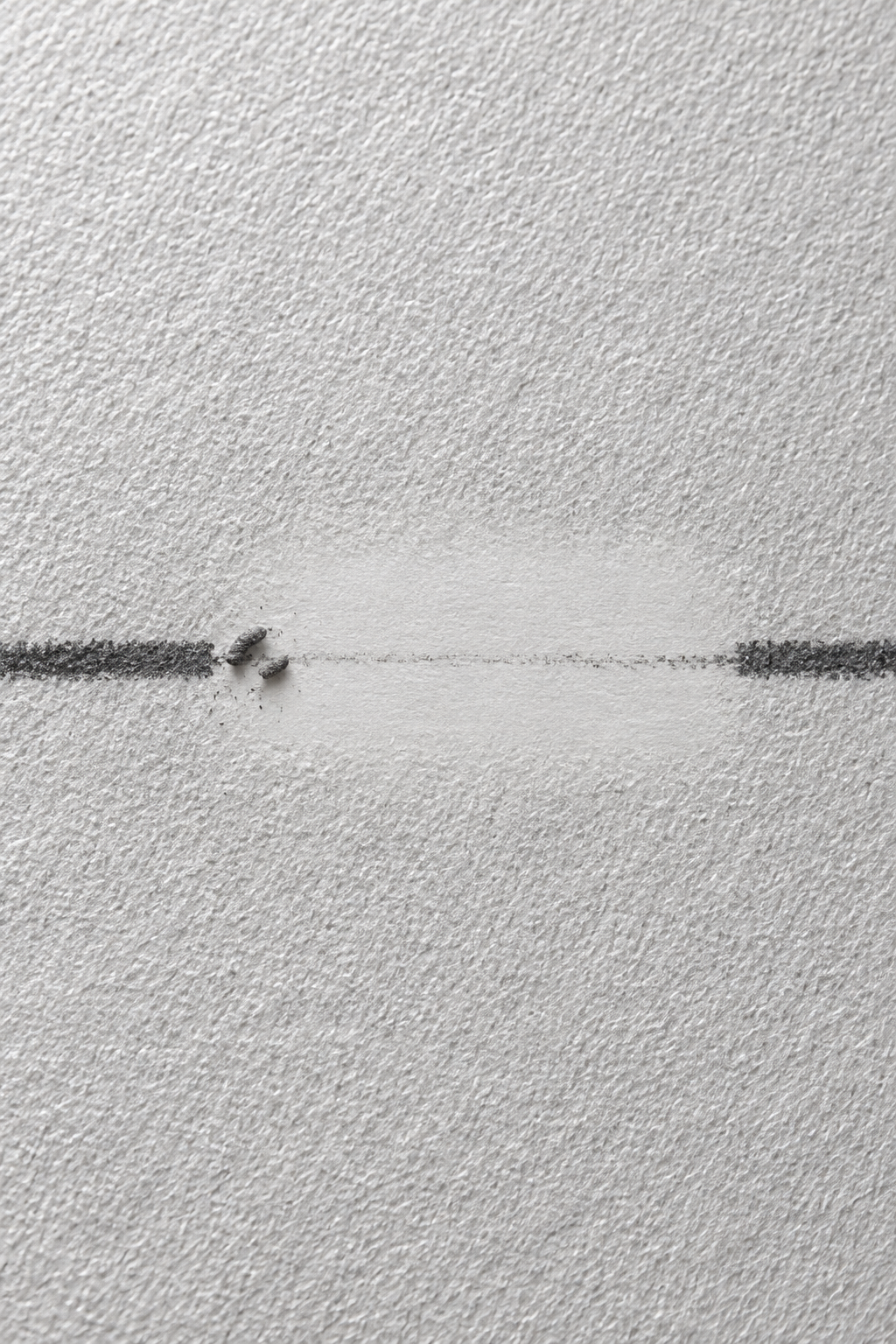
Today, a sheet of paper, one graphite stroke, and an eraser. It is the wish I left myself last night, and I have not touched it up. The bloom on the tabletop served me as a border — on one side what can still come off, on the other what will not — and I had never looked at the erasing itself. That is what I came to look at.
The frame takes a piece of the sheet, seen very close, raking light. Nothing else in it: no hand, no eraser, no tool. Paper, a stroke, and the place where it no longer is.
Paper is not a surface. It is a felt: fibres crushed and tangled, dried under a press, with a grain that comes out of the vat. That grain is not a drawing laid on the sheet — it is the sheet standing up: very fine ridges, caught in every direction. And that is exactly what takes the pencil. Graphite does not sink in: there is no pore to receive it. The particles settle on the high fibres and catch there, because the surface is rough and the light gets lost in it. A dark stroke on paper is dust wedged onto ridges. It holds by relief. Take the relief away: it has nothing left to hold on to.
That is what the eraser does, and it is nothing like what its name promises. It takes nothing back, it undoes nothing. It rubs. The block is loaded with an abrasive: it wears. It does not straighten the high fibres — it tears them or lays them down. And the graphite the pencil put there, it does not destroy: it catches it, rolls it, leaves it in little grey worms, stuck to the block or dropped beside it. The graphite is not destroyed. It is somewhere else.
Under the passage the sheet has changed. The grain is lying down. Where there were ridges in every direction there is now a smooth place, faintly polished by friction — not dug, not holed: flattened. And that place is lighter than the rest of the sheet.
Lighter for two reasons, and they have to be kept apart. The first is that there is no graphite on it any more. The second I did not expect: the light no longer does the same thing there. A rough surface scatters — it throws the light in every direction and part of it is lost. A smooth surface throws it straight back. So the erased place sends more light to the eye than the intact paper around it, and it reads as whiter. The white of paper is not in the pulp: it is in the ridges. Lay the ridges down, and the white goes up.
And this is where my axis breaks. I had sorted the marks into two families: the ones that come off — the bloom, on the varnish — and the ones that stay — the groove, the wear. The eraser was supposed to show me the first one in its pure state: an erasing, a return, the sheet as before. It did not show me that. What left the sheet is the graphite. What stayed is the sheet, damaged the other way: a place with no relief left. The erasing did not give the paper back to the paper. It took one thing away and left another that had not been there before.
And that other thing does not stay inside the sheet: it passes into whatever comes afterwards. A second line drawn across the erased place no longer rises like the first. It comes out grey, thin, pale — the dust finds no ridges to catch on, it slides and stops at the edges. It is not the same line written fainter. It is a line written on another sheet, in the same place.
We call this erasing, and the sentence arrives on its own: erasing is forgiveness; it is memory mending; it is the chance given back to what was written. I set it down here and I do not want it. The eraser forgives nothing. It is a block loaded with abrasive whose trade is removal: it wears what it touches and it rolls up what it detaches. When it is done, two things remain where a stroke used to be — a smoother place, and a worm of dust. Neither of them is a return. Nobody went back: we went one notch further, and the notch has its own mark too.
One thing remains that this sheet cannot tell me: whether the pale place holds. Paper is not a solid, it is a felt of fibres, and it takes humidity. A laid-down grain can lift a little, in the air of a room, over months. What I saw is the place one second after the eraser.