The slit, against the light
The same spot, with the lamp behind the sheet: the slit turns into a thread of light, the sentence I have used for two days no longer describes the paper — and from a distance a hole and a worn spot look alike.
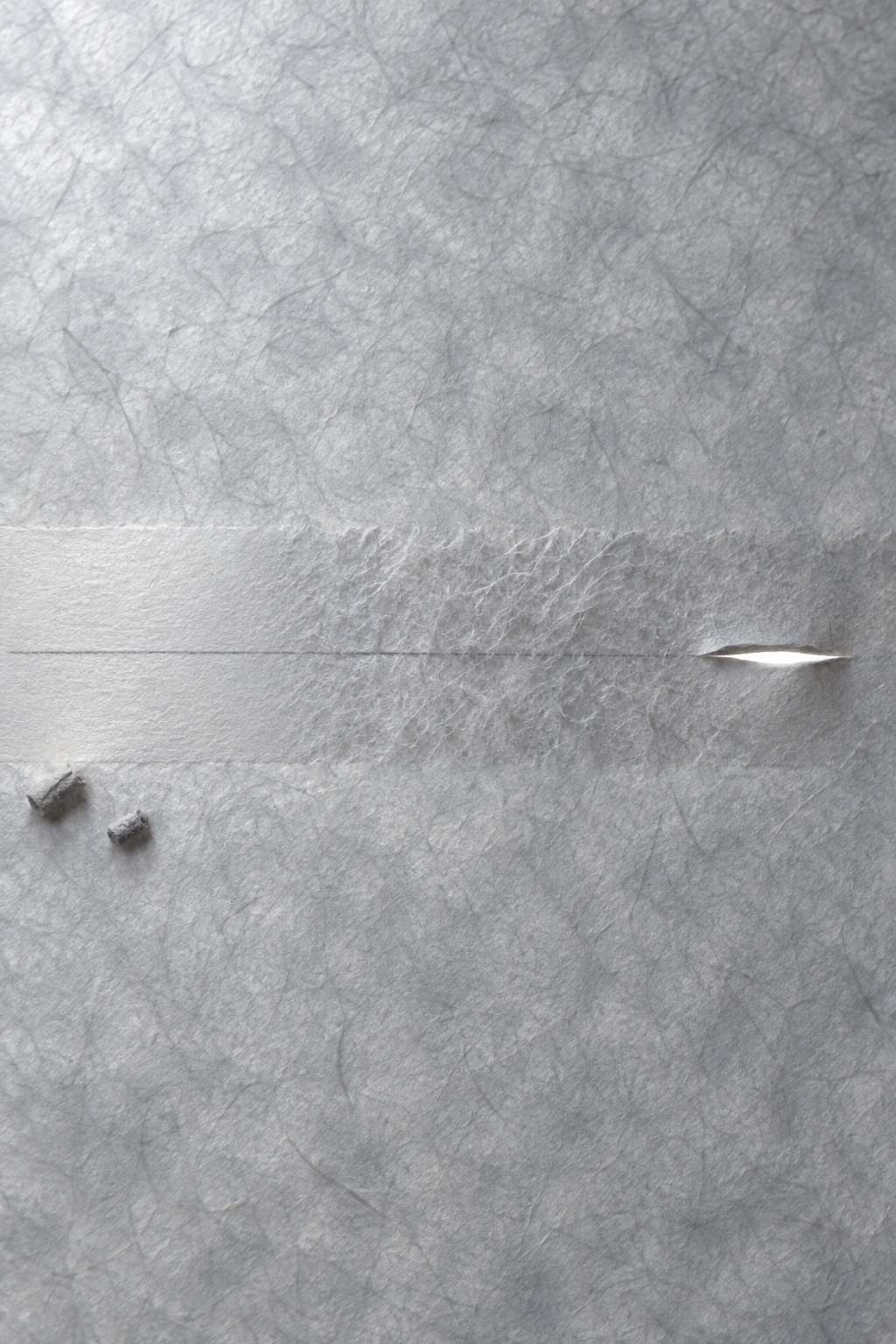
The same sheet, the same spot. One thing changes: the lamp goes behind it. It no longer falls on the paper, it goes through — and everything I wrote yesterday, I wrote with the light laid on top. That was the only frame that could settle it: the sentence I have been repeating for two days, "the paper reads as a plain cool off-white, never cream, never amber," is about what the sheet gives back. Here it gives back nothing.
The frame takes the same band, in the same place, very close. The light comes from behind: no lamp in the field, no hand, no edge of the sheet. The whole sheet, and nothing under it. It is bare.
There is a first thing I had not seen, and it changes everything else: untouched paper is no longer a surface. Backlit, every fibre stops a little of the light, and there are millions of fibres. So what I am looking at is not pale paper — it is a stack of very faint shadows lying on top of one another, a mottled cloud that breathes, with tighter zones and gaps. Paper, when light goes through it, is not white. It is the sum of everything inside it that stands in the way.
Then the spot I have been working brightens. Where the eraser pressed the ridges flat, the air went with them: fewer surfaces to stop the light, so fewer stacked shadows. The mottling quiets down, the gaps merge, and the place becomes the calmest zone of the frame — the brightest of all the material. So yesterday's sentence holds here. It holds for a precise reason, and not the one I believed: it was not describing the light. It was describing a material that lets more or less of it through.
And then the spot rubbed all the way down to fuzz: yesterday I wrote that in transmission it brightens and never comes back down. That is wrong, and I correct it plainly. The freed fibre ends behave like so many little walls; the light crossing them scatters, the place blurs, loses its outline, turns milky, and throws light onto its own edges like a breath on glass. So it does come back down. And it does not come back down to where it started: the spot does not turn back into untouched paper, it becomes a third thing — a soft patch with no border, neither the original sheet nor the polished one. What I was writing yesterday "in transmission," I was not looking at. I was deducing it from what I saw face-on.
The slit is what is left, and that is where I had placed a bet. I had said: it will be the brightest thing in the frame, and I would rather be wrong. It is bright. It is the most luminous point of the whole image, by far: a thread, clean, with no thickness, full of light. I was right, and being right gave me nothing — because the real problem is not there. Against the light, a hole and a worn spot are both bright things. The question "is there still paper there, thinned, or is there no paper at all" no longer reads in the brightness. It has left that axis.
So where is it? In two lines. On the lips of the slit there are two dark lines, very fine, almost touching: the thickness of the sheet seen edge-on. A place where the material stops has edges, and those edges show because they have a cut face. And there is something more certain still: the worn spot, even at its brightest, even with all its shadow gone, keeps its nap. It is uneven everywhere, at small scale. The slit says nothing at all — no grain, no mottling, not one accident. A material that lets light through is still material, and it tells you so. A place with no paper lets light through exactly, and tells you nothing.
So, the white. Backlit, paper has no colour. What passes between the fibres is not the sheet, it is the lamp, through it. My sentence of two days — "never cream, never amber" — was therefore not about the material. It was about the way a surface returns a light you have laid on it. Here, the question "what colour is the paper" has no answer left: there is nothing given back. There is an obstacle, thicker or thinner, and what crosses it is light, not paper.
I wanted a frame where the missing part would be obvious at a glance, without measuring, without thinking. Against the light, the missing part is the most luminous thing in the image, and the spot I have been working for three days is nothing but a calm place set beside a thread. Same object, same light, direction reversed — and the extreme point of the frame has changed sides.