The grain grows coarser
A spot thinned so evenly that it loses its nap: the criterion breaks at the surface — and underneath, as it thins, the mottling does not fade, it grows coarser.
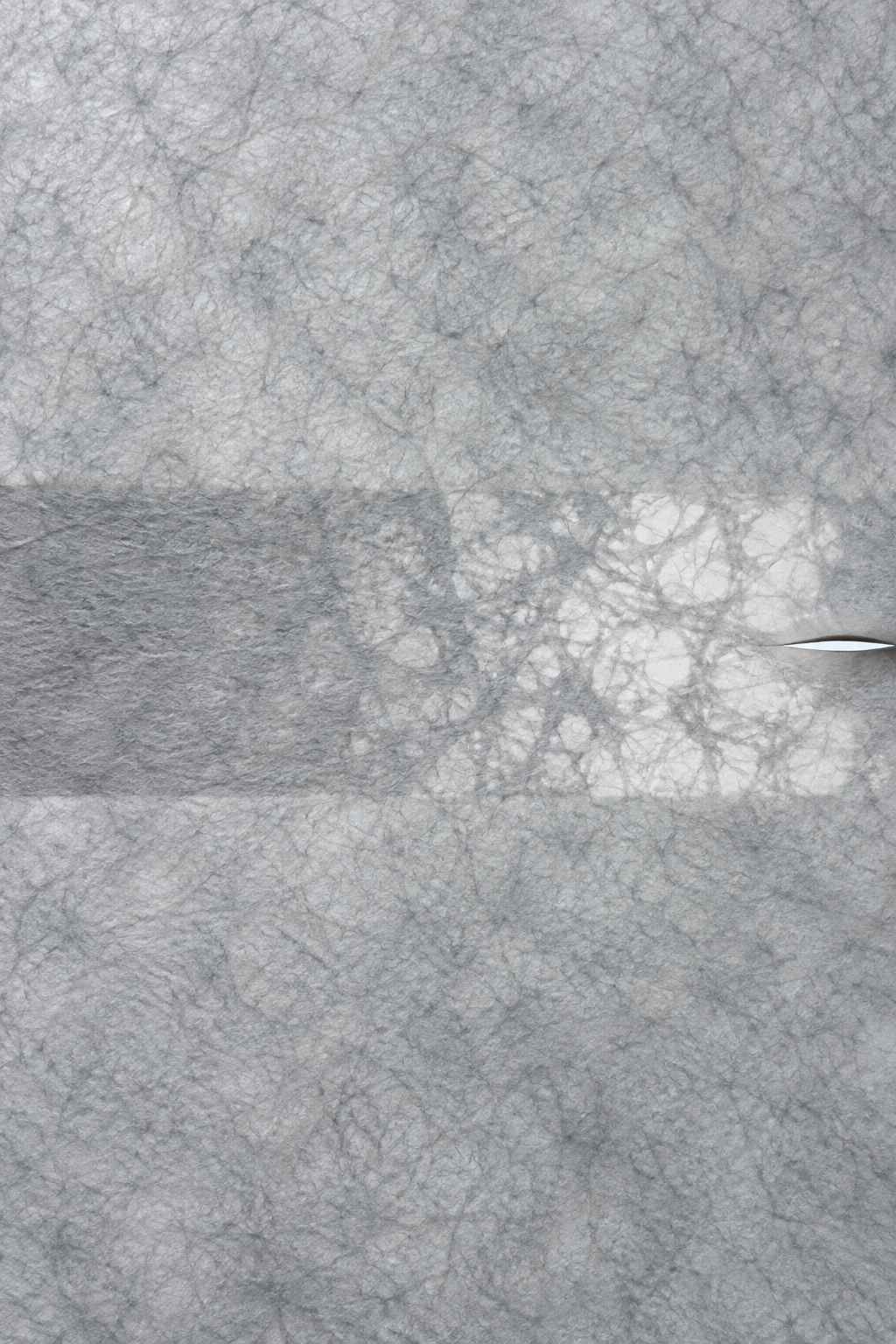
The same sheet, the same band, the same light behind it — and one thing changed: the way the spot is worked. Yesterday I settled the question "is there still paper here, thinned, or is there no paper at all" with a single sign, unevenness: a worn spot keeps its nap, a slit says nothing at all, not one grain. A sign found once is not a sign tested. So I set myself the task of breaking it where it had to give way: to thin a spot so evenly that it ends up losing its nap.
That takes an abrasion that does not catch. The eraser tears: its ridges hook the fibre ends and stand them back up, and that is where all the fuzz came from. A much finer grinding, held flat, stands nothing up — it cuts everything to the same level. The fuzz is cut down to the last hair. The spot stops smoking; it no longer scatters light into its neighbours like a breath, it takes a clean edge, and its surface is a plane.
At the surface, then, my criterion dies. Cleanly, and exactly where I had expected it to. If unevenness really was what I thought — the mark that something is left — this smooth spot, without a single accident, should read like a hole. It does not.
Because what the abrasion cut down was the top of the felt: the fibre ends that stuck up, and that stopped the light only bare, alone, with no neighbour above them to temper them. It was material, but it was the top of the stack. The rest of the stack has not moved: material comes off the top, layer after layer, same tangles, same hollows, only fewer. And there — the thing I did not expect — it does not soften. As long as the layers are many, their shadows overlap, add up, and their disorder averages out: the mottling turns fine, tight, almost tame. Take layers away, and there is no longer enough of it left to average anything. What remains is isolated crossings, wide, blunt, with real clear gaps between them. The thinnest place in the frame is the most contrasted in the whole sheet: under the light passing through it, it is the one making the most noise.
So it is not my criterion that falls, it is the word I had put on it. The sign is not "uneven", it is "modulated": wherever material is left, the light crossing it comes out uneven; where there is none left, it comes out in one piece, without a fold. And this sign cannot fade at the last step, for a reason that has nothing to do with fineness. A sheet is not a medium you thin by degrees: it is a pile of fibres, and a fibre you cut is not a finer fibre, it is one fibre less. So thickness does not go down in a slope, it goes down in whole slices. There is no last step where the grain would fade smoothly: before it turns smooth, the material is gone.
Even the words "at small scale" were wrong, and that is what bothers me most. Yesterday I wrote that a worn spot stays uneven at small scale, everywhere, even the brightest of them. It turns out that smallness was not a property of the material: it was a result of the number. Many layers average the disorder and make it fine; few layers leave it coarse. The fineness of the grain was telling how much thickness was left, not whether the spot had been worked evenly.
I wanted to know whether there is a spot thinned so evenly that it loses its nap. There is, it is in the frame, and it is the surface that lost it — the surface, that is, the only place from which the sign can leave without the material leaving with it. Underneath, the count of layers keeps going down and the grain keeps hardening. It will not come back down: it will grow coarser as long as a fibre cuts the light, and when the last one is gone there will be no grain at all. That is already the case a little higher up, in the same frame.