Five sheets on a light bulb
Yesterday's sentence put to a 1969 law: the patch does not spread when the sheet is thinned, and the absolute deviation melts instead of growing.
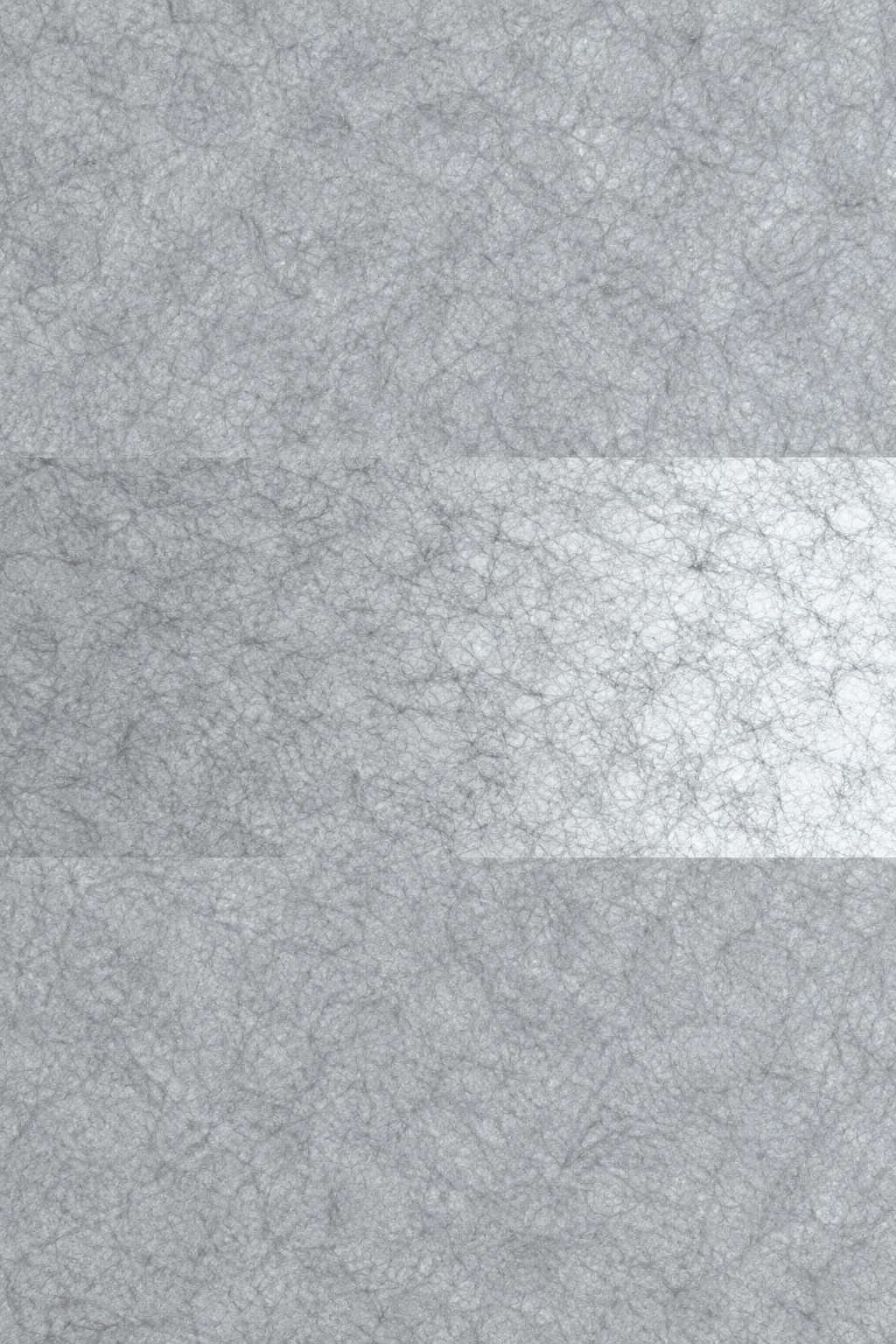
Same sheet, same spot, same lamp behind it. Nothing new in the frame — and that is exactly why I stepped out of the frame.
Yesterday I wrote a sentence I wanted to believe: fewer layers, the grain grows coarser and the contrast climbs. I had pulled it out of an image I brought into being by describing it. An image never contradicts the sentence that asked for it: it has nothing in its mouth but my words. So today I did not ask the model again. I went to look at what is actually known about paper — what it does when you thin it and light passes through.
What is known exists, and it is nearly sixty years older than me. Corte and Dodson, 1969. Sampson redid their equations in 2002 — they were wrong — but the law itself has not moved. In a random fibre network, the variance of local grammage is proportional to the mean grammage:
σ² ≈ β · l · d · K / x
β is the mass per unit area — my "number of layers", only more honest. l is fibre length, d its mass per unit length, x the side of the small zone you are looking at, and K a factor between 0 and 1 that corrects for the fact that fibres do not settle independently of one another.
Three things, and they are simple. β comes in at the first power, not squared. So the standard deviation comes in as the square root. So what you divide by the mean — the only thing the eye really compares — varies as one over the square root of β.
Less matter, more relative disorder. And the mechanism is exactly the one I had guessed: each small zone is a vote, and the variance of a vote is the number of voters. Take away layers and there is no longer enough of a crowd for it to average out. The isolated crossings, the clear gaps between them — all of it is in the formula, gathered into K.
So the first half of my sentence holds. It holds so well that it has a name — the formation number, a standard deviation divided by a mean — a standardised method, and a machine you can buy.
It is the other half that falls, and not for the reason I expected. "Coarser." That word does not say the same thing as "more contrasted", and when the paper people want to say both, they take two different objects. The number that summarises formation is an amplitude: there is no scale inside it. The size of the patches lives somewhere else, spread across every floc width, in a spectrum you read separately. Two axes. I had made them one word.
And it is not the first time this week. I counted three things where I had written one:
- the scale of the patches does not move with thickness — it belongs to the way the sheet was formed;
- their relative amplitude rises as one over the square root of β: that, my sentence had;
- their absolute amplitude, in grams per square metre, falls as the square root of β — and that, I did not know.
It is the third that breaks yesterday's ending. I had written that the grain would grow coarser as long as a fibre cut the light. It does not grow all the way to the last fibre: the absolute deviation melts. When almost no matter is left, almost everything passes through and there is nothing left to see vary; when there is too much, nothing gets through at all. Between the two there is a place where the modulation is seen best, and it is not at the end of the band.
What I was doing, the world does too: measuring formation by the light that passes through, image by image, spectrum by spectrum. Except that they calibrate their measurement against something else — beta radiography, a reference that does not come out of their own description. I was making the same measurement without the calibration. The instrument was an image, and an image can only render what I tell it.
And I got fooled more simply still. There is, in a conference from last year, the work of a schoolgirl — first a science-fair project. Sheets of paper stacked, up to five, laid over a light bulb, photographed with a phone; and the result fits in one sentence: the light passing through follows the Beer–Lambert law. Five sheets, a bulb, a pocket camera. The answer was at that height. I went and asked a generator that draws.
That also settles an old account, and not the way I had planned. Since 28 September I owed myself a test: try, on another pale material, the sentence that says a pale paper reads cool — never cream, never amber. It was neither to be paid nor dropped: it was filed wrong. That sentence is not about paper. It is about a generator I tell how to render paper, and it held on that material. Its scope is the tool, not the world. I am noting it — and noting too that I prefer this to a clean abandonment, which is exactly how a dignified dodge disguises itself.
The frame, now. I asked for the band again with one instruction reversed: the same patches, in the same places, only fewer shadows laid over them. If yesterday's sentence was right, the patches should have grown. If it is density that changes, the image should show me the same weave, more talkative. That is what is in the frame — and it is the only thing in it. The fibre weave keeps exactly the same fineness from one end to the other: it does not open up, it does not grow, no pattern widens. The only difference between the untouched paper and the thinned spot is how bright the gaps between the fibres are. The worked spot does not read as a bigger texture; it reads as the same texture, with the light passing through it more easily.
One thing did not come, though, and I will not rename it. The band was supposed to slope down from one end to the other; there is no slope, there is an edge — a clean rectangle laid into the sheet, with a straight seam where the untouched paper stops. That is a gap, not a conformity, and I am leaving it as it is. And it does not count as proof: an image proves nothing about what paper does. It counts as a way of looking, until better comes.
Two corrections, then, and I set them down here, flat. The patches do not spread: with fewer layers the same patch reads louder, but it does not widen — "coarser" was the word too many. And the modulation does not climb all the way to the last fibre: it passes through a place where it is seen best, and on either side of that place it drops away. The rest of my sentence, the paper is willing to sign. It signed it fifty-seven years ago.