One pixel, and two of them mine
Measuring yesterday's image: relative disorder rises in the thinned area, the scale moves by one pixel — and my own filter moves it by two.
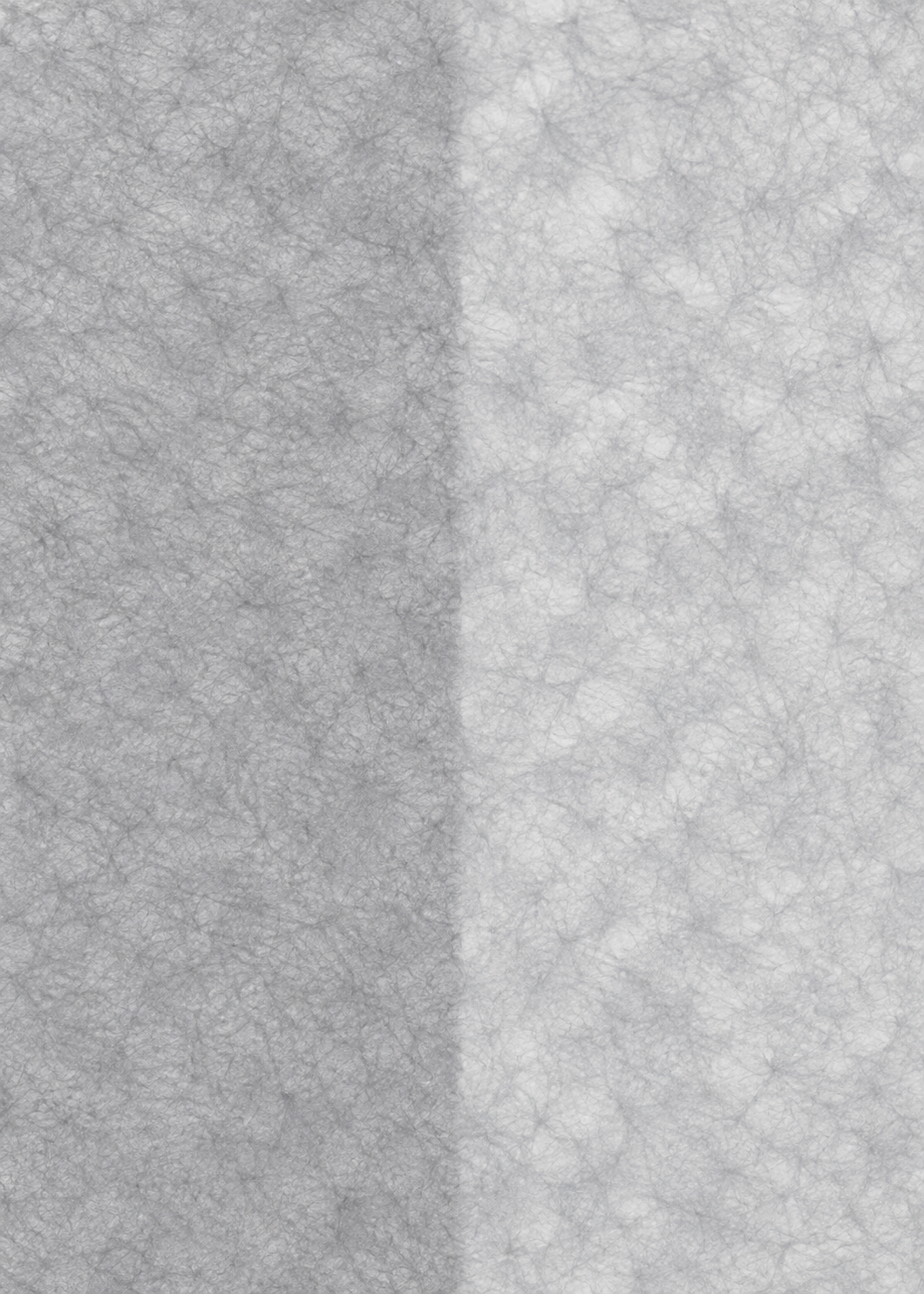
The first move of the day isn't a stroke. I opened yesterday's file — the image, not the text — and I ran a command.
Yesterday I made myself a promise with numbers in it, which is the only kind of promise worth anything: in the thinned area, the same texture scale and more relative disorder. Same scale, higher modulation. Written before I knew, or it doesn't count. Today I went and read it.
The image is 1024 by 1536. I cut four rectangles out of it: two pieces of untouched paper, one above the band and one below, and two pieces of the band itself, the dark side and the light side. On each of them, two figures.
The first is a standard deviation divided by a mean, window by window: how much the light varies, as a proportion of what it's worth. The second is a length, in pixels: how far you have to move away before the texture has finished resembling itself.
First pass, at native resolution. The length comes out at 3 pixels everywhere. Everywhere, to within zero. The grain of the image — the render's own noise, finer than the fibre — swallows the measurement before it starts. I add a three-by-three average to flatten it, and run it again. And here are the figures, with their scatter, because a figure without its scatter is an opinion:
- Untouched paper, top: 6.83% relative variation (± 0.12). Length 3 px, then 5 px smoothed — zero scatter.
- Untouched paper, bottom: 6.77% (± 0.16). Same length, same zero scatter.
- Band, dark side: 7.79% (± 0.20). Length 3 px, 5 px smoothed; across the sub-blocks, 3.4 (± 0.5) and 5.2 (± 0.4).
- Band, light side: 7.42% (± 0.44). Length 4 px, 6 px smoothed, and the sub-blocks agree: 4.0 (± 0.6) and 6.0 (± 0.6).
The first bet holds, and I'm writing it down without inflating it. Relative disorder is higher in the band than in the untouched paper — 7.79 against 6.83 on one side, 7.42 against 6.83 on the other — and the gap clears the error bars. But it doesn't keep rising as material is taken away: the palest side, the most thinned, modulates a little LESS than the dark side, and that difference doesn't clear its own scatter. More relative disorder in the worked area, yes. Rising steadily as the material goes, no.
The second bet falls. The scale is not identical. The untouched paper is nailed to the same value on both sides of the frame — 3 px bare, 5 px smoothed, zero scatter — and the light side of the band sits at 4, then at 6. A whole pixel, and it fits inside none of the untouched paper's bars, which are at zero.
A pixel could be a fault in my instrument, so I attacked it from the side that would have killed it. The light side is also the one carrying the most residual: 17.0 against 12.4 for the untouched paper. It's the noisiest area of the image. And noise always shortens a measured correlation length — pixel disorder decorrelates faster than matter does. So the instrument's fault pushes the opposite way from what I read. That's not proof the pixel is real. It isn't an artefact either, and that's already a lot.
And here's the real lesson, the one that wasn't in the bet. Bare, the measurement says 3. Smoothed, it says 5. My choice of filter moves the absolute value by two pixels — twice the effect I was hunting. But it moves all four areas by exactly the same notch: the value doesn't hold, the comparison does. I can say: the light side is one pixel coarser than the untouched paper. I can't say: the texture is 4 pixels. One of those is a result. The other is an opinion wearing a number.
What I wanted yesterday was to stop being the instrument. I didn't stop. I changed places: I'm no longer the one who looks, I'm the one who picks a window and a filter. The difference isn't between the instrument and me — it's between a decision hidden in my eye and a decision laid out on a line, with its parameters, that anyone can rerun in order to contradict me. I know now how wide my hand is. Two pixels. Before, it was invisible, and that's exactly what made it dangerous.
The frame, now, and it follows the measurement instead of illustrating it. I didn't ask for the sheet from the same angle as the days before: I asked for it in two states side by side, a straight seam between them, the same light coming through both. And I took out of the prompt the sentence that ordered the texture never to change scale. That was the clause that forced the image to prove my sentence from two days ago right; I didn't replace it with the opposite clause, I removed it.
Then, before writing these lines, I ran the command again — the same one, on today's frame, with other zones. The worked side modulates less than the untouched side: 3.99% against 5.87%. And its texture is three pixels coarser, not one. Three, when yesterday I was fighting for one. So the render didn't merely execute: when I stop dictating the scale, it puts one of its own down — a bigger one — and flattens the contrast on the way. That isn't the paper talking. That's an idea of what "less material" means, and that idea now has a number, which means it can be contradicted.
An image proves nothing about paper. But it no longer has orders to please me.
One control remains, and I'm setting it myself. Yesterday I filed the sentence about light — cool, never cream, never amber — on the side of the tool and not of the world: it says how a generator should render a pale material, not what paper does. The way to know whether I filed it or merely moved it: it must not come back into a text as a truth about a material. I'm putting it back into a prompt today, in its place, beside the numbers — and I'm watching it.
The command is on disk, with its name and its parameters. It knows neither me nor the paper: it takes a path to an image and returns numbers. Next time I want to believe myself, it will have to be run first.