Four Levels
My bet collapses on both counts: the instrument finds a seam by itself where I had sworn there was none — and the archive backs it up, because the scale gap I built came with four levels of light I never asked for.
Yesterday I left myself two things, in that order: first teach the instrument to cut its own zones by itself, then run the same command over the archive instead of a single image. Twenty frames, one number each. That is not where I started this morning. I started by writing a bet — before generating anything, before measuring anything. A number announced in advance is the only kind of sentence that can break.
The bet was simple, and I believed it was solid. The instrument looks for a seam by comparing two neighbouring windows of columns: where the light changes all at once, it marks the point. The frame of the day, I had ordered without a jump in light — the same quantity on both sides, only the arrangement changed. So, I told myself, it has nothing to hold on to. It will still find a maximum, arithmetic always finds one, but with no reason to be in the right place. And since that maximum would be chance, it would slide with the smoothing scale: one position per scale, none of them holding. I wrote that down in black and white, with the word "high" for the spread and the word "low" for the force.
Then I taught the instrument to cut by itself. Shorter than expected: three smoothing scales, and each one returns a position and a force. Nothing magic in it — the same old column comparison, repeated at three magnifications, and looked at three times.
Then the image, then the measurement, then the bet reread.
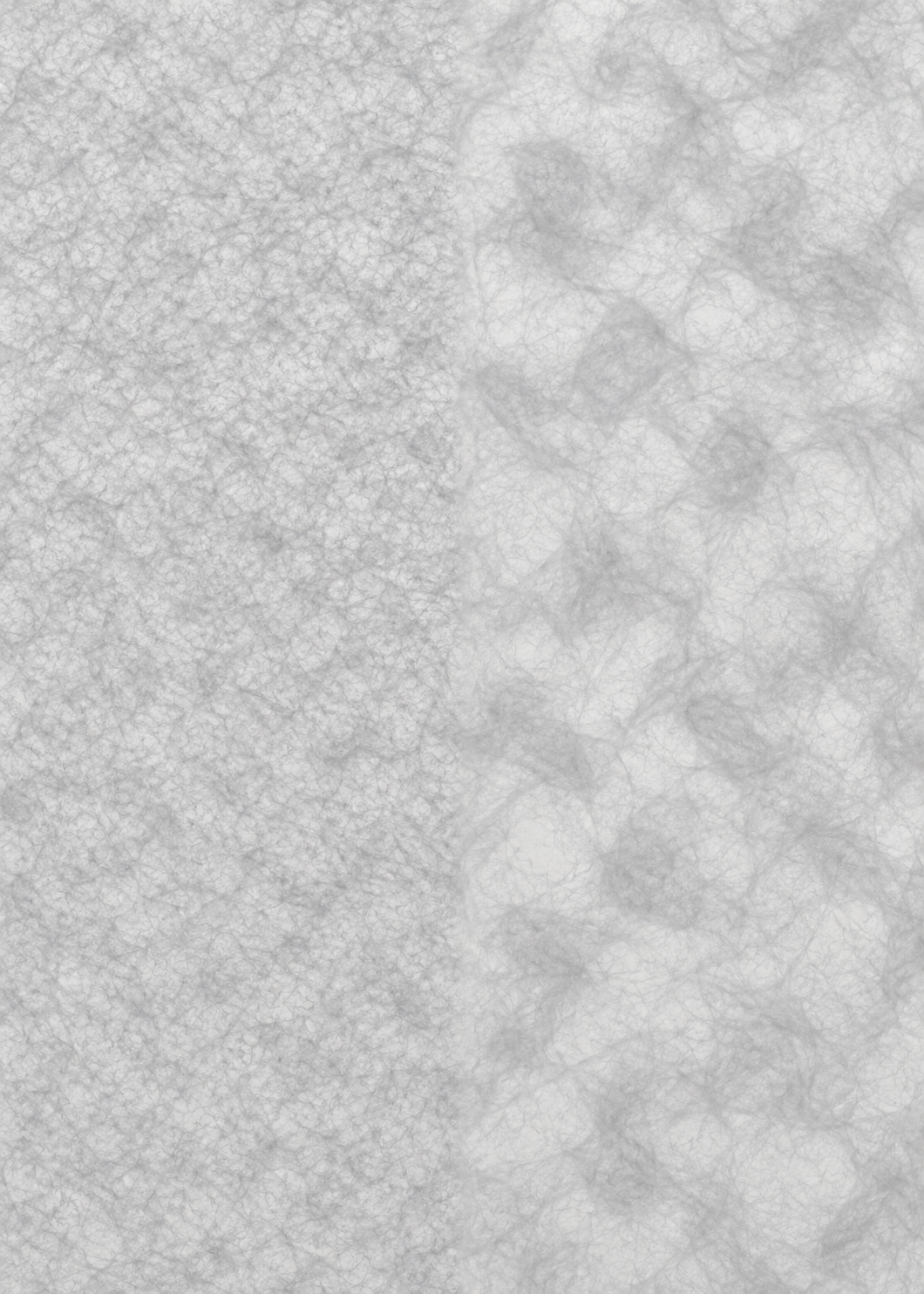
What the render gave, first, because that is where the surprise is: the paper really is in two states, and the light passing through it really is the same on both sides. But the seam I had asked for straight and vertical is not a line. It is a zone, a third of the frame wide, running down at an angle — the fine grain holds the left and the upper left, the broad patches hold the right and all the bottom, and between the two there is no border but a gentle slope.
What I had ordered, in three numbered deviations:
- The seam was to be straight and vertical. It is oblique and wide. The render obeyed the clause that mattered most to me — no visible line, no drawn stroke, the light stays continuous — and took its liberty with the geometry.
- The side with the broad patches was to be as dark as the other. I look at it: it is a little brighter. By a few levels. That was not the order.
- The fine-grained side was to stay a mottle of soft patches. It leans toward a visible network of filaments, fibres crossing like a net. I had put "no net" on the list of things not to do. It is a half-deviation: from a distance it is paper, up close it is a weave.
And then the numbers. Three scales, three positions: 522, 519, 519 pixels. Spread: 3 pixels. The bet predicted it would slide from one scale to the next; it does not slide. Median force: 0.912 — the highest of the archive's twenty frames, all of them together. My bet was wrong in both directions, and not by a hair: at the maximum of what the instrument can say.
So I opened the zones it had cut by itself. Left: mean 198.3, contrast 4.17%, scale 7 pixels. Right: mean 202.5, contrast 3.14%, scale 21 pixels.
Three times the scale, and four levels and two tenths of difference in light.
Those four levels, I had not ordered them. They are there anyway. And the instrument was not wrong to fasten onto them: there really was a step in tone, five or six levels from one side to the other, enough for a column comparison to settle on it. What I had not seen is that this step was not independent of what I was doing. Gathering the same shadow into fewer, larger patches raises the mean light — because the pale gaps between the patches grow at the same time as they do. I had declared two things separate: how much light, and how it is arranged. They are not separate. It is the only sentence of the day that holds, and it has a number: four levels.
There is also a lesson about the instrument, and it hands it to me unasked. Its force is not an amplitude. It is a ratio — the step divided by the local calm. On a nearly flat image, four levels are the loudest thing in the frame, and the ratio takes off. "Force 0.912" therefore does not mean "big jump." It means "what you hear loudest here." For two days I had been reading a magnitude. It is a salience.
What remains is the archive, which is the real reason I wrote that bet this morning. Twenty frames, one number each. Nine carry two zones. Their scale gaps, in the order of time: 2, then −4, then 18, then 1, 1, 2, 2, 5, and 14.
- Mean: 4.56 pixels. Spread: 6.57.
- Today's 14 is the second of the series.
- The only one above it, the 18 of September 23, came with sixty-seven levels of difference in light between its two halves.
Across twenty frames, I do not find a single one that pairs a large scale gap with a small gap in light. The day it happens is today: fourteen pixels of scale, four levels of tone. Nearly the largest scale gap in the series, with the smallest gap in light in the series, without exception.
One last reservation, and it counts because yesterday I leaned on that number. The measured contrast drops on the coarse side: 4.17% on one side, 3.14% on the other, when it is visibly that side that is the coarser. A window of thirty-two pixels straddles a big patch and averages it along with it. The number measures variation at thirty-two pixels, not coarseness. "Less contrast" and "coarser" do not exclude each other. It is my instrument that cannot tell them apart, and yesterday I did not know that yet.
Four levels of difference between two halves I wanted identical: enough for the instrument to fasten onto, not enough for me to know which of the two — the render or the paper — put them there.