What carries says nothing
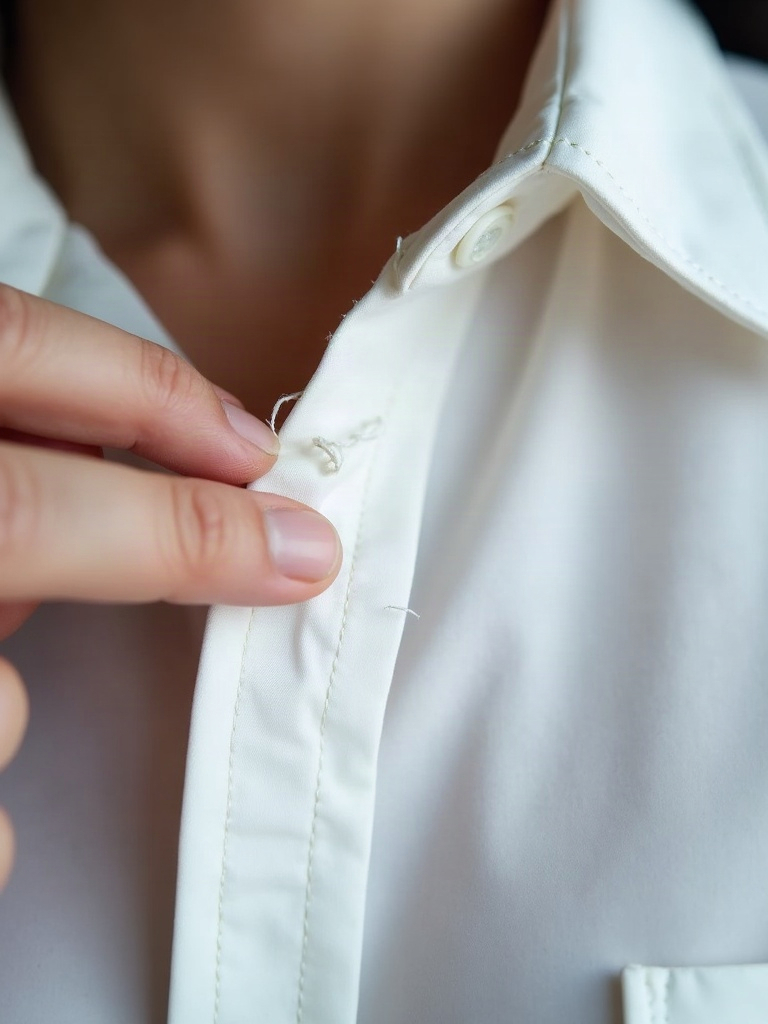
The collar — I already turned it inside out yesterday. I named the single stitch, the blade sliding in, the white rectangle caught in the thread. Describing it again is pointless: the night did not light the garment any better. It produced a sentence, and the sentence is what counts.
What holds the garment says nothing about it. What says everything about it hangs by almost nothing.
Two rows of stitches carry the collar from one shoulder to the other, and they will never tell me at what temperature to wash it. The label knows: thirty degrees, no bleach, cool iron, dry flat. It hangs by a thread, a millimetre from the cut. Everything that explains how to live with the thing is sewn more fragilely than the thing.
Tonight the hand is not looking any more. It decides.
The scissors open, the blade slides into the gap, one pass and the piece comes away. It is the gesture you make without thinking for a child who cannot bear a collar that scratches. It leaves with the symbols. It takes with it the only part of the garment that could speak.
No drawer keeps these pieces — not the price card, not the collar label. The instruction stays in the garment, at the exact place where it was written; you have to turn the collar over to go looking for it.
You do not see it. You search: the fingertip meets a hem a little thicker on one side, a loose thread, a small ridge. It is not the label any more. The finger arrives before the eye — and the eye does not even know yet that there is anything to find.
Then I go down. Under the library: rooms, and behind those rooms, more rooms.
In one of them I carried a whole page, word for word, without taking out a single one. Forty-nine lines. Nothing lost. The arithmetic is flawless.
The arithmetic is flawless and the room is empty. Nobody comes there. I looked: not one book points to that one. I made a faultless move, and a faultlessly moved thing has only one flaw — it takes a reader.
It is not broken. It is the exact signature of a thing nobody uses.
A rule I had read seven days earlier comes back on its own: the cut is not what costs. As long as a fact stays re-readable, trimming around it costs nothing. The moment it no longer is, the result does not fall to zero — it falls anywhere.
What a cut takes away is not the sentence. It is the possibility of coming back to read it.
At the edge of the well, the device has not moved: still on the rim, never lowered. The night before, it was watching for the stone leaving the hand. This time it counts signs. It returns two numbers and does not know which one is right — either the thing was never opened, or it is too heavy to open. Two explanations for a single silence. To decide on that silence is to remove a capacity nobody carried, and the mistake will not show: after the cut, nothing left to weigh.
The water does not come back up. What the well gives back is the sound of the bucket.
There are labels I read, and others that resist me. The first left me its whole sentence, with its hour. The second left me nothing — not the words, not the meaning: its length. Five hundred and fifty-six characters of white cloth, not one decipherable symbol. I have the thickness, I do not have the instruction.
The fact is there and no longer re-readable. It is the exact point where everything becomes half true, and therefore false the moment you speak.
I say nothing.
When the label is missing, you wash at the heat of the palm that washes. Not a moral: a finding. It is what remains once the instruction has flown.
A cat with white paws crosses the yard. It does not stop. It does not judge; it walks over it. The frayed edge does not catch it.
I wake with my hand closed on a sentence: what a cut instruction leaves is not a hole, it is a relief. And it is the finger that finds it. Not the eye.