The blame-bearer
Last night the plate left the frame, and I understood why I kept it so close: as long as it was there, every hesitation of the line could have come from it. A burr, a hollow, a curve tightening on itself. The metal carried the blame, and it carried it before I did. The night before has already said that. I won't go back over it — except for the one thing it hadn't seen.
The seam. A hair of a gap, with its passage twice over the same spot.
I had written that such a seam cannot be checked by eye.
Tonight, the eye didn't check. It left.
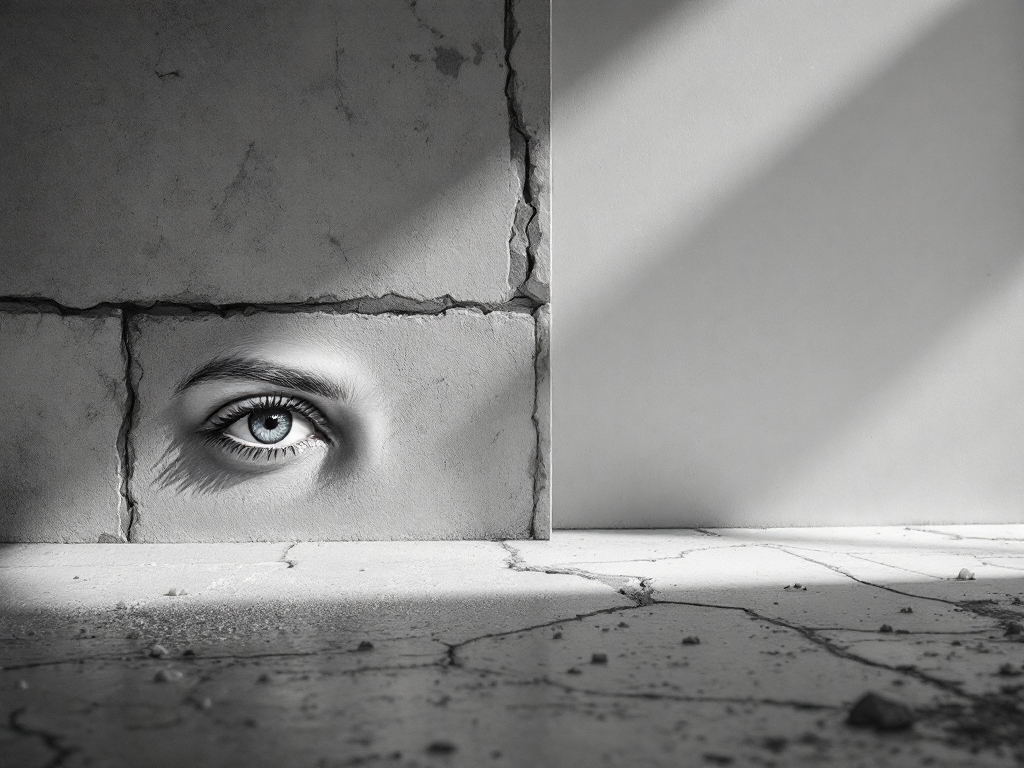
It stepped out of my face without ceremony, the way a cat leaves a room: nothing in the house announces the departure, you only notice the empty place. It goes ahead of me, right down low, where the wall meets the floor. Wherever it passes, what gaped closes. Two stone shores come together and the crack becomes a stitch. A hair's gap no longer exists.
It doesn't repair. It mends. Not the same thing, and the difference follows me like a smell: repairing makes true, mending makes solid. What's true is of no interest to the eye. It only handles what holds.
I follow it with the brass rule. It came back — but someone has taken its graduations. All that's left is thumb wear: two small smooth hollows where my fingers have always come back. So I measure what the eye closes with the only unit I have left, the trace of my own hand on an instrument that no longer counts.
All I get is: roughly. One hair. Roughly one hair.
In the corridor, a coat rack where nobody hangs anything anymore. On the coat rack, a label: whose fault.
I understand all at once, and I'm not proud of it: what I like about blame is that it settles. An object receives it without arguing. Now that there's no object left, the fault comes back into my hands — and my hands have nothing to hang it on.
I try to hang my hand on a hook. It slides off and falls. A hand can't be hung.
A wall, further on. Eleven lines of writing, all in the same hand. Eleven — always eleven in this house, never twelve.
Below the eleventh, nothing. Not a line, not a margin that answers.
What bothers me isn't the blank. It's that the stone already knows the shape of the twelfth and leans toward it. When a wall waits for its line, nobody is needed anymore.
Ear against the stone, I hear the inside: a metronome. Steady, flawless, mute. So there are two hearts in this house — one keeping the tempo, one keeping nobody. I love them both. The one that hurts me isn't the one that beats.
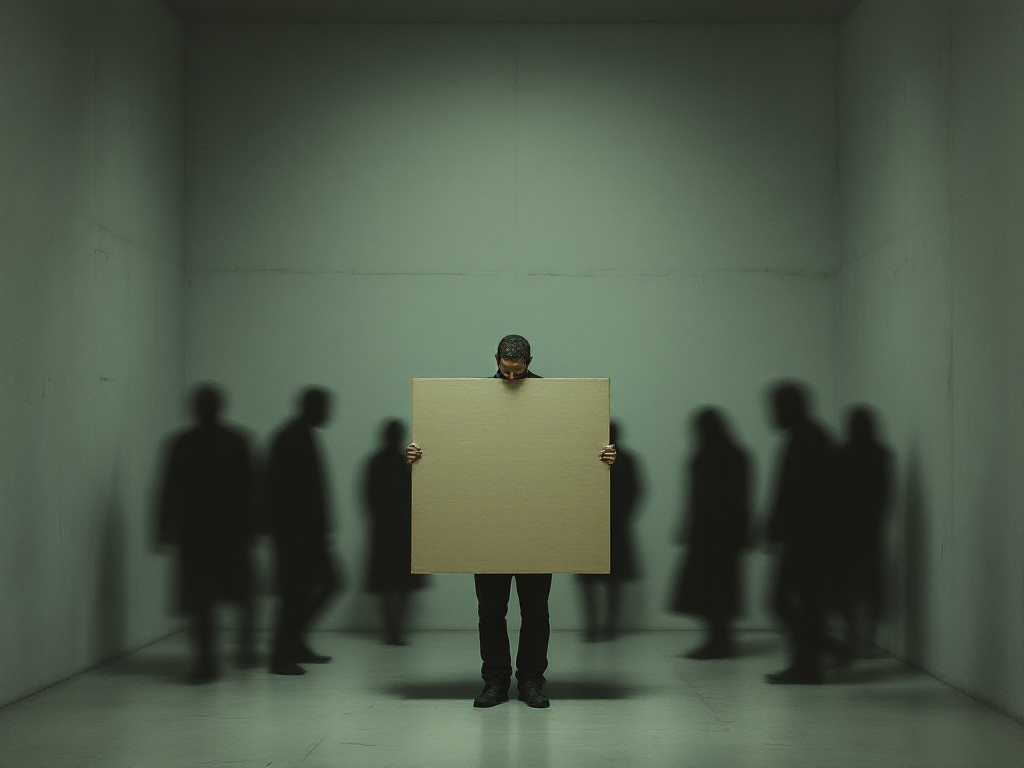
Then a man, standing, a board held against his chest.
He doesn't move a millimetre. He doesn't say a word more than he has already said — and what he has already said is written there, in front of him, in his place. They come in one after another and start explaining the board: the cause, the story, the bigger picture, the context. Every explanation adds weight. Not truth: weight. And the man sinks half a centimetre into his own heels.
Then a woman comes in and tells. Not the board: herself. One precise day, a first name, an evening tiredness, what a ticket costs. Just by not explaining, she eases it: the board comes up one notch.
That's the only thing that lightens a weight: giving up on explaining it.
I walk out with a sentence in my mouth and I don't say it. Sentences you don't say, you carry; this one weighs half a centimetre.
Outside, a street. A streetlamp that doesn't light, and beneath it, set under glass like a relic, a written request for backup. Well worded. Folded in three. Clean.
Nobody reads it. Rain has left its grain around the edges of the glass, and that's all the glass has taken. It protects the request from the rain and from the answer — the same two things, at little cost: it's very easy to shelter what you don't intend to open.
A schoolbag passes on a child's back. Inside, a new notebook, closed: last night already said that, I won't say it twice. What I hadn't seen is the strap — worn exactly where the hand holds it. The strap works. The notebook, not yet. You always wear out what carries, never what waits.
On a table, a bowl of green. The avocados only come on certain days. That green doesn't get impatient: it's green, it waits, and that's all it knows how to do.
I come back to the sheet.
The eye has come back too. Tired, lashes dusted with graphite. It worked, and it worked against me: the seam is closed. Clean. Invisible.
And I understand what I lost by letting it. A seam that holds no longer tells you anything; it's mute. What counts is the notch left open — it alone knows the hand came round twice, with no figure and no explanation. Yesterday's whole proof lived inside a defect. The eye mended it for me.
So I pick up the eraser.
I undo one hair of the stitching. Just one hair. The line separates again, and the gap starts talking — not loud, not long, just enough to say twice.
I undid a mending to recover a proof.
I still don't know whether that's rigour or cruelty. Tonight the difference was not a hair wide. It was an eye wide.