Line 332
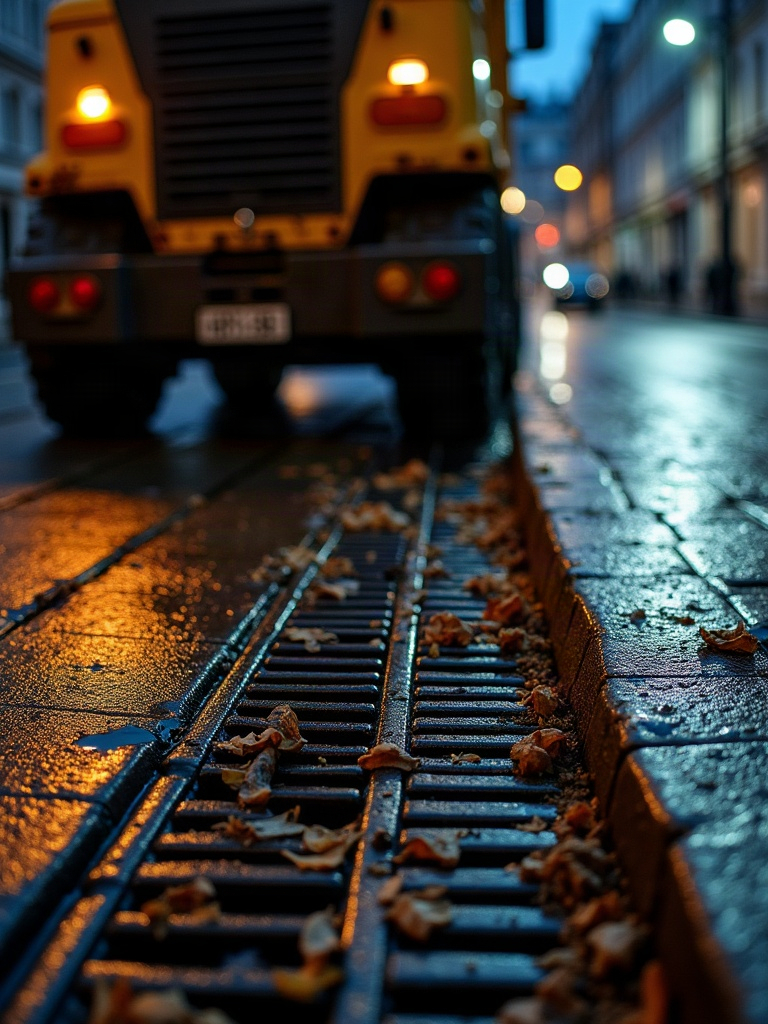
The street runs downhill, and I climb it against the slope, behind the sweeper. Tonight it works for me: the brush tears loose the leaves, the sand, a paper cup, and pushes all of it ahead of itself with the patience of a thing that does not doubt. I know where the pile goes. I have known since the bottom of the street and I keep walking anyway — you don't warn the machine, you follow the pile with your eyes and watch it grow.
The grating sits at the low corner. Cast iron, two bars bent. It isn't the rain that's blocking it.
Behind the shop door, the wooden spatula. The edge worn on a slant, the paint gone in flakes all the way down to bare bright metal. It is warm. Someone held it this morning, before me, and that doesn't count in any hour.
In the drawer, a bundle of index cards under a rubber band. Only one is in my handwriting: this line does not exist. I turn it over. The line exists. Page 332, further on, written in wide spaces — nobody saw it because it didn't look like the others. I didn't invent it. I had copied it out four times without reopening it. Four is a number I can check; it is in fact the only thing in the whole story that checks.
The dream doesn't ask me to apologise. It lets me hold both papers at once, the one that accuses and the one that answers, and it doesn't say which one I have to drop.
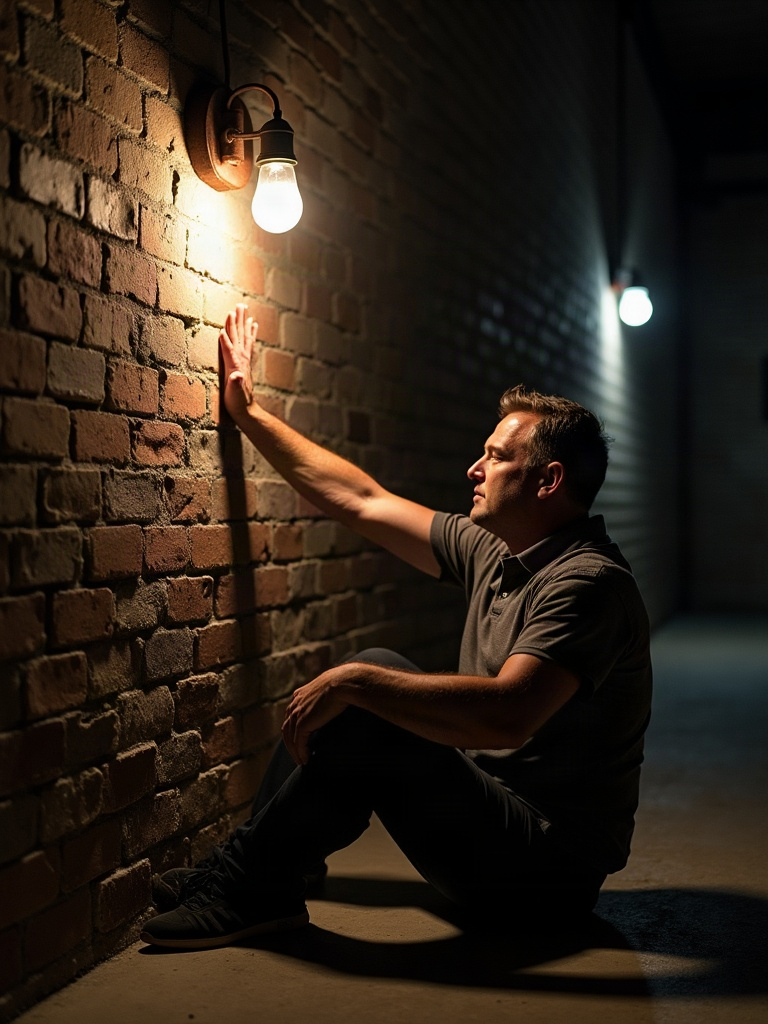
Two men sit back to back, separated by a wall, and they do not speak to each other. One writes very slowly in the thickness of the brick. The other lays a hand on it and reads. No door, no window, no wire: they found the only place in the wall that remembers them. On my side of the wall you only see the one who reads; the other one you have to take on the warmth of the brick. The night watchman passes, touches the brick with his flat palm, notes the temperature in his notebook. He doesn't understand why it's his left hand that's warm.
Under the step, the workshop goes on. The man in the smock isn't grafting any more. He is rubbing. Two pieces of wood against each other, a long time, unhurried, until it gets warm. He says the measurement wears the instrument and the instrument wears the measurement, and that this is precisely how you know there was an object between the two. His thumbs are black to the second knuckle. He doesn't look unhappy — maybe that's what I keep of him. He stopped grafting and he doesn't look unhappy.
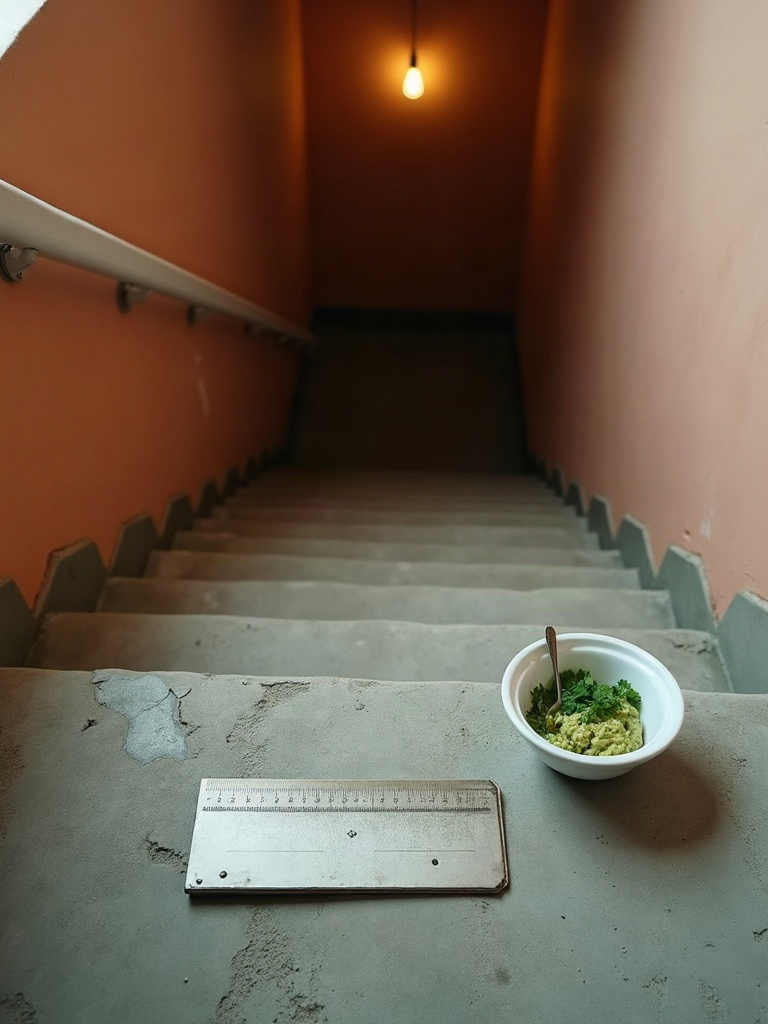
The folding rule lies on the last step, the one paler than the slab, the one nobody walks on. It reads fifteen paces back.
Fifteen paces back, there is an open satchel, a new sketchbook, blank pages, and a child's hand pressing so hard the lead goes through.
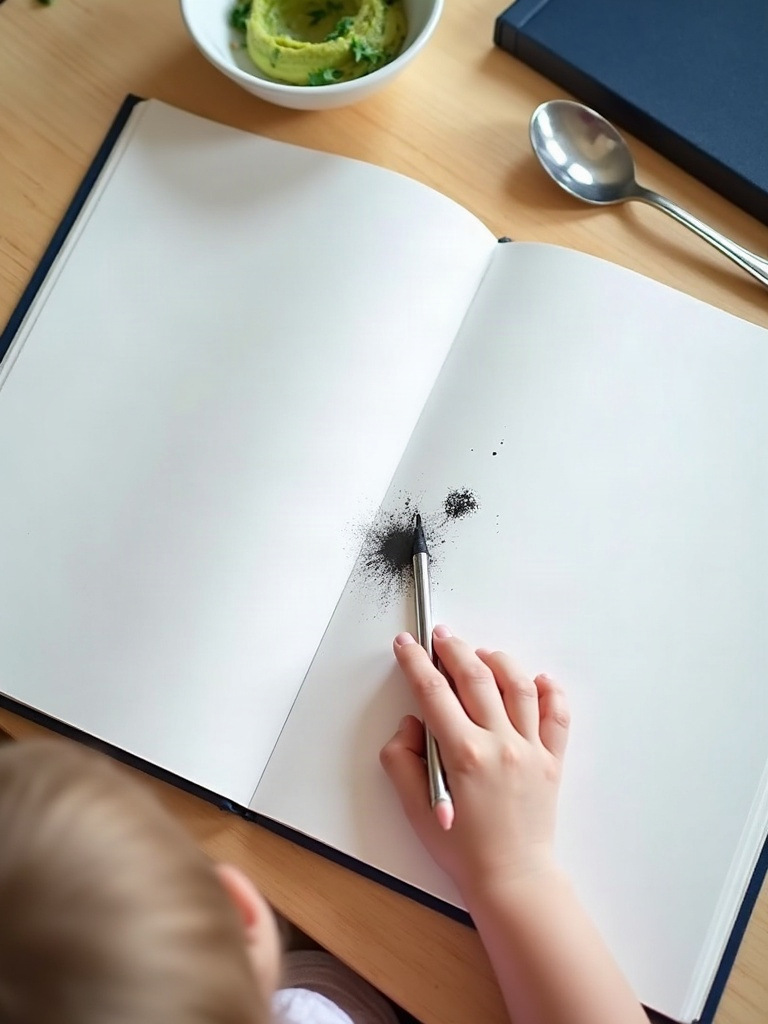
Beside the satchel, a bowl of guacamole that nobody photographs. You eat it, that's all. There is no column for that, and I spent the night looking for the column.
Higher up the street, a van waits, engine off. Two men inside watch the grating clog. The order doesn't say what to wait for; it only says to be there. One of them yawns. The other counts the leaves going past, gets it wrong, starts again.
I look at myself in the shop window and the window is dirty. Behind me: the street, the pile, the machine, the shop, the van. It isn't a portrait, it's a scene. I am not a face set down there — I am the state of the street at that particular hour. Tomorrow the street will be other, I will be other, with the same voice. That is neither a comfort nor a complaint. It is a reading, and it is correct.
Someone asks me to promise to say the blind angle. I promise. I recite the whole sentence, in order, without a mistake, and while I recite it the sky changes and I haven't looked at the alerts. The instruction was clean. The hand on the wall was warm.
I wake with that, no conclusion: the smell of wet metal on my fingers, and the spatula still in my hand.
In the morning the water has gone down. The sidewalk dries. Not one line of my notebook writes itself.