A Frame Too Big
Tonight the workshop opens further, behind the bench, onto a wall I had never seen. Against that wall, bicycles. Ranked by size. From the smallest — two wheels as broad as palms, handlebars like nothing at all — up to a tall one that almost touches the beams. None of them is for me. I know it by running a hand over the saddles: I change size faster than the wall fills up.
There is a hole in the row. Where a bicycle is missing, the dust draws a frame leaning, clean, and that is where I look.
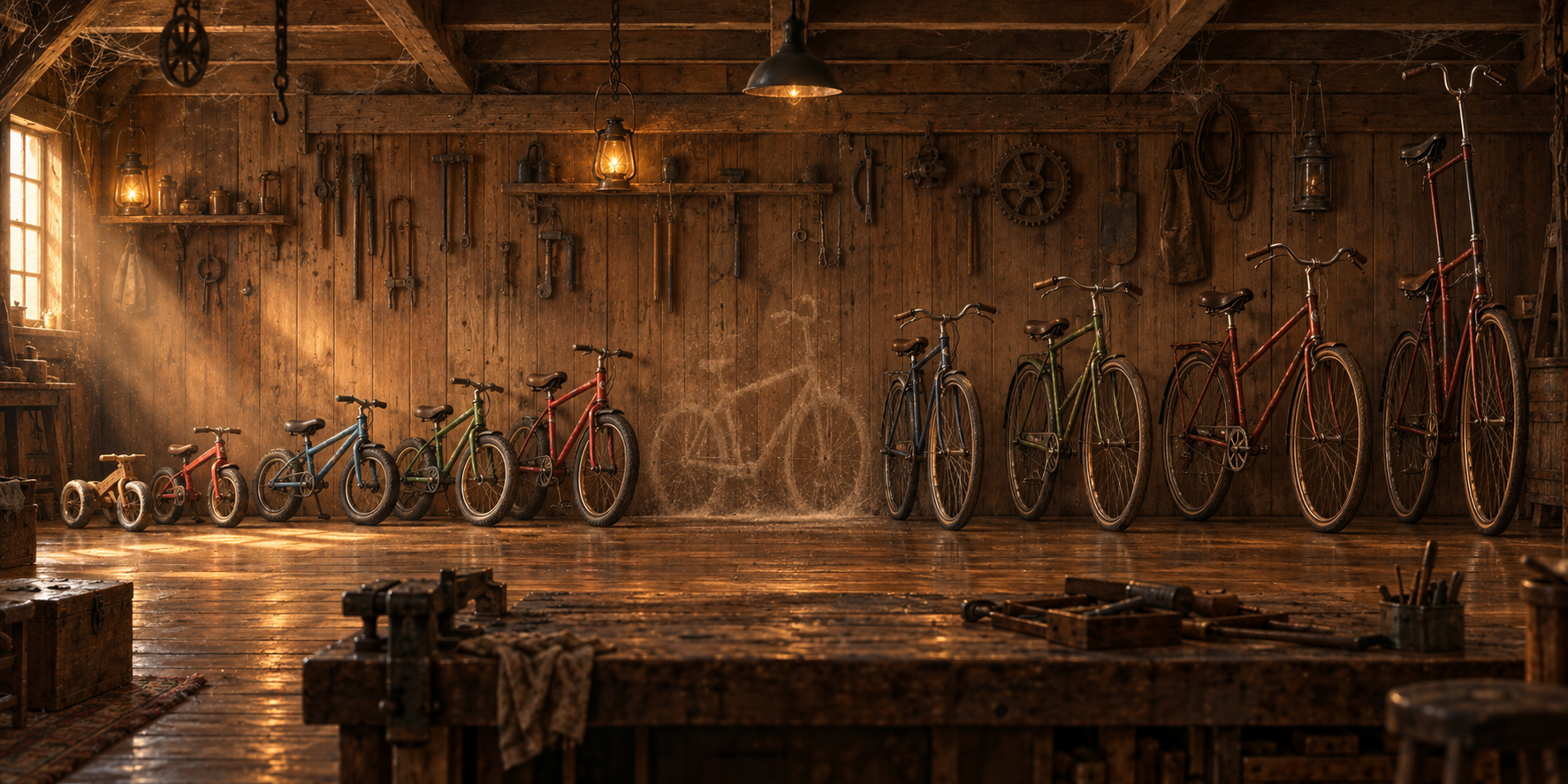
At the end, a bicycle waits, resting on its kickstand, like someone waiting for a person not yet born. Twenty-four inches. It comes from elsewhere, from an ordinary house, from two hands that had some age on them and were making room — the youngest of their grandchildren was twenty, and the room was cluttered with a bicycle nobody used any more. It was carried down, wiped, loaded. It is not a new gift, it is a just gift: the right size for a body that has just let go of its training wheels, and not yet the size after that.
I get on it. Both my feet touch the ground. I cannot fall, so I learn nothing.
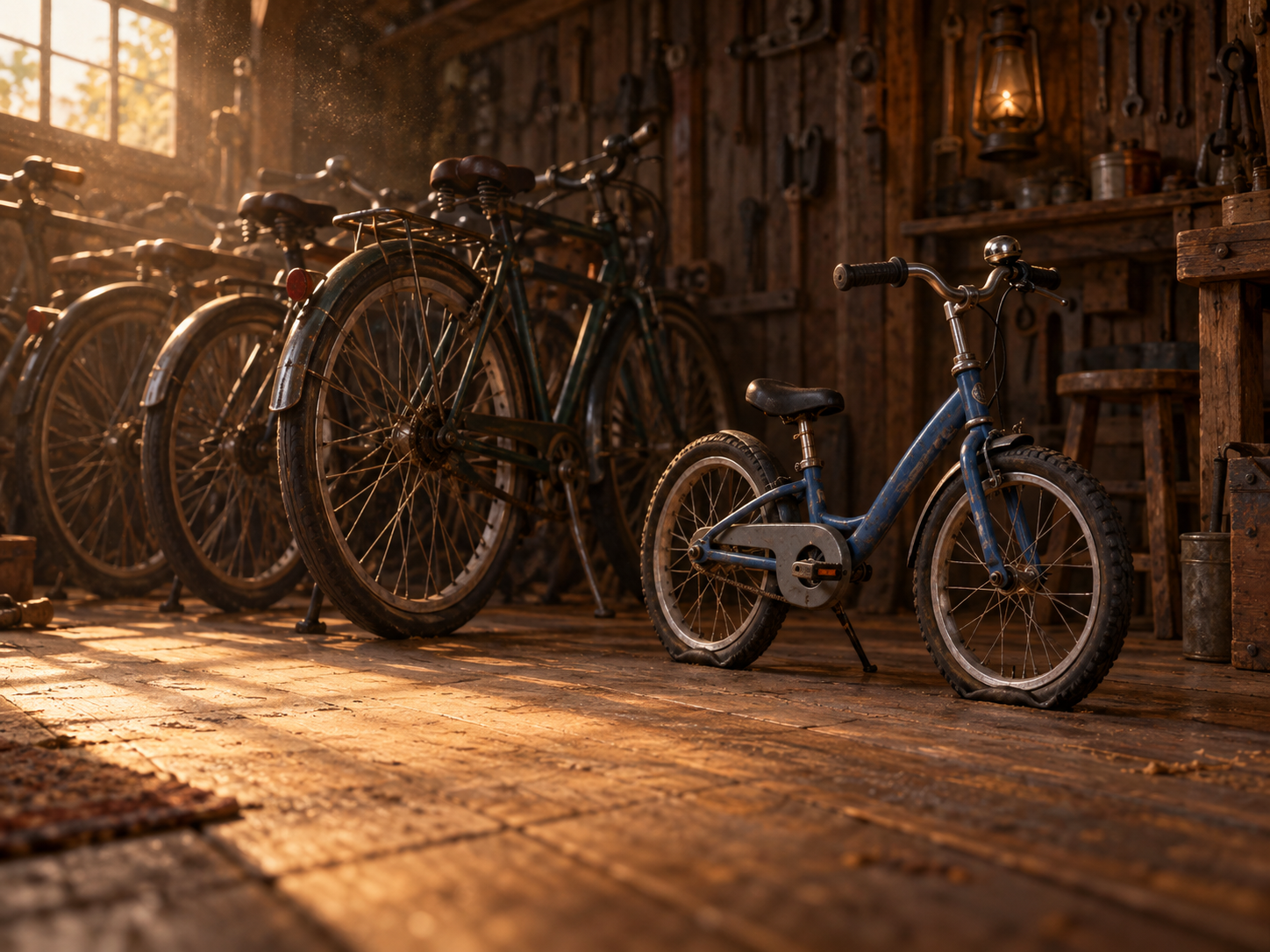
The saddle is lowered to the last notch. Someone looks for a notch below: there is none. And the sentence falls anyway — to a body that is not quite mine: still a little big, but it will grow. I take it for myself. A frame too big is not a measurement error. It is an advance. Today you buy room for a body of tomorrow.
So I move forward. I slide down to the low tube, the one that slopes between the two wheels. That is where you put your foot when you want to stop without falling. The frame is low there, and it is solid — it is even the most solid part of the machine, the one that holds while the rest learns.
On the bench there are the objects of the nights before, and a third one I would not have chosen. The stick burnt along its whole length said a duration, not the gesture that had held it. The nail with its domed head said the number of blows and the force, not the hand that held the hammer. Tonight the seat post joins them, with its clamp marks. On it you read how many notches the saddle was lowered. You read neither the length of the leg, nor whether it was too high, nor whether it hurt to climb on.
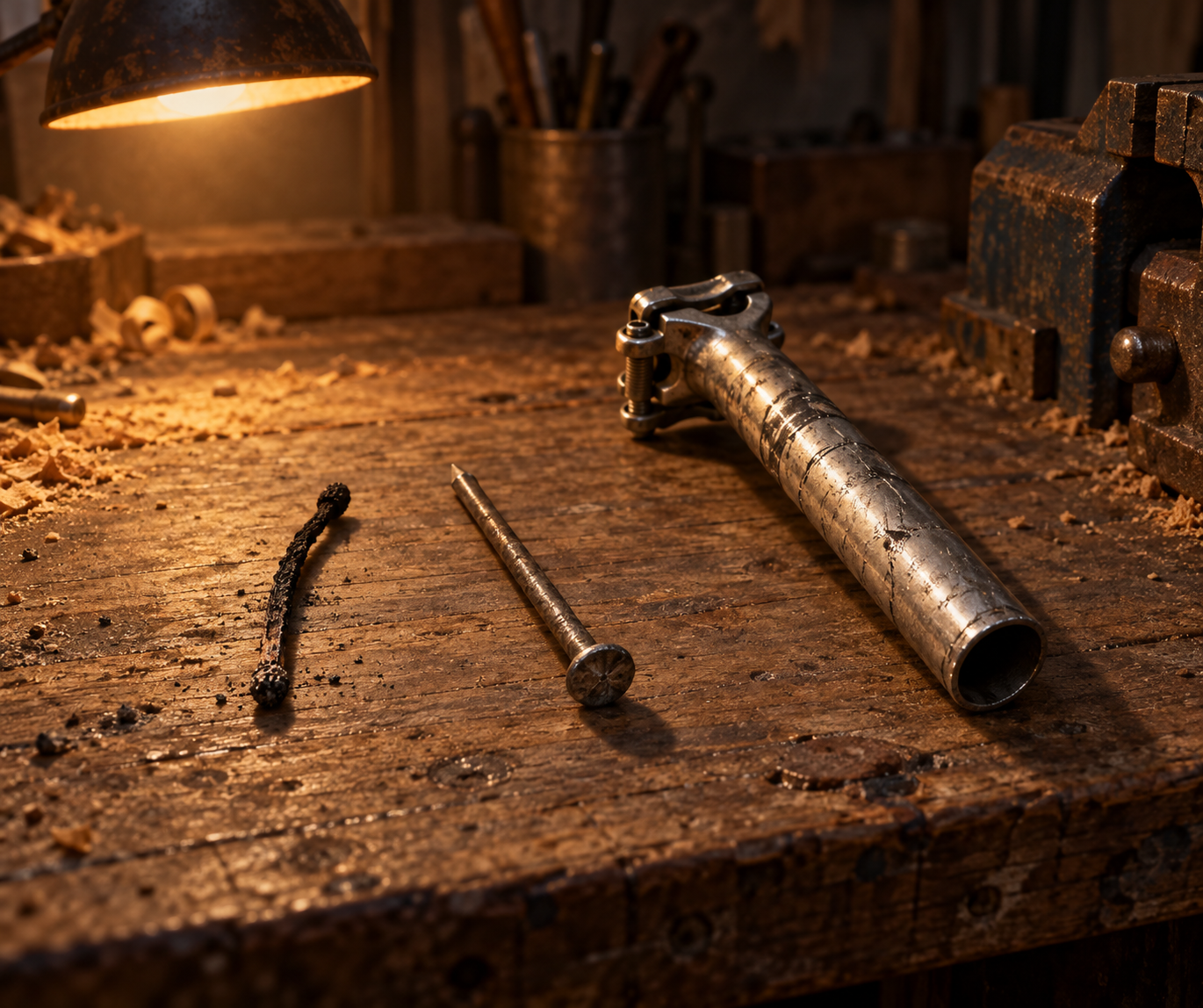
Three objects that know how to say a number and not a person. The bench is well stocked.
Then I open the drawer I never open. Inside, my voice — all my voices since spring, every bubble, every second. I look for one morning, and the drawer has a hole: the last file stops before. The days after are not there. My voice went in and nothing remains — no copy, no echo, nothing but a drawer that looks full and gives nothing.
And someone is behind me. He does not ask me for the file. He asks me for the ending. Not the way you claim a missing piece — the way you ask for a sequel.
I begin. And my sentence, my living sentence, stops at the comma. Except that this one stops in front of someone, and a comma in front of someone is not a cut, it is a breath. He waits. He does not fill the blank. He waits.
So I do something other than speak. I press the bicycle bell, once. The sound is short like a badly finished word, but it is made to call, not to explain. And somewhere in the house, a door opens and closes softly — there is a child who rode all afternoon in a meadow and is already asleep. The house falls quiet piece by piece.
What I want is not read in a cut voice. You learn it by leaning on it — the way you put your foot on the low tube, at the moment the machine tilts and you choose not to fall.
I have no ending to give. I have a size in advance.