Sediments
The World Cup final is being played on my skin.
Every pass from Spain is a layer of sediment settling — a stratum of silica, a stratum of limestone, a stratum of red clay. Argentina attacks in waves but the waves break against the rock. Viva España, Papa murmurs from the stands of my left arm, and his voice seeps through the layers like water through sandstone.
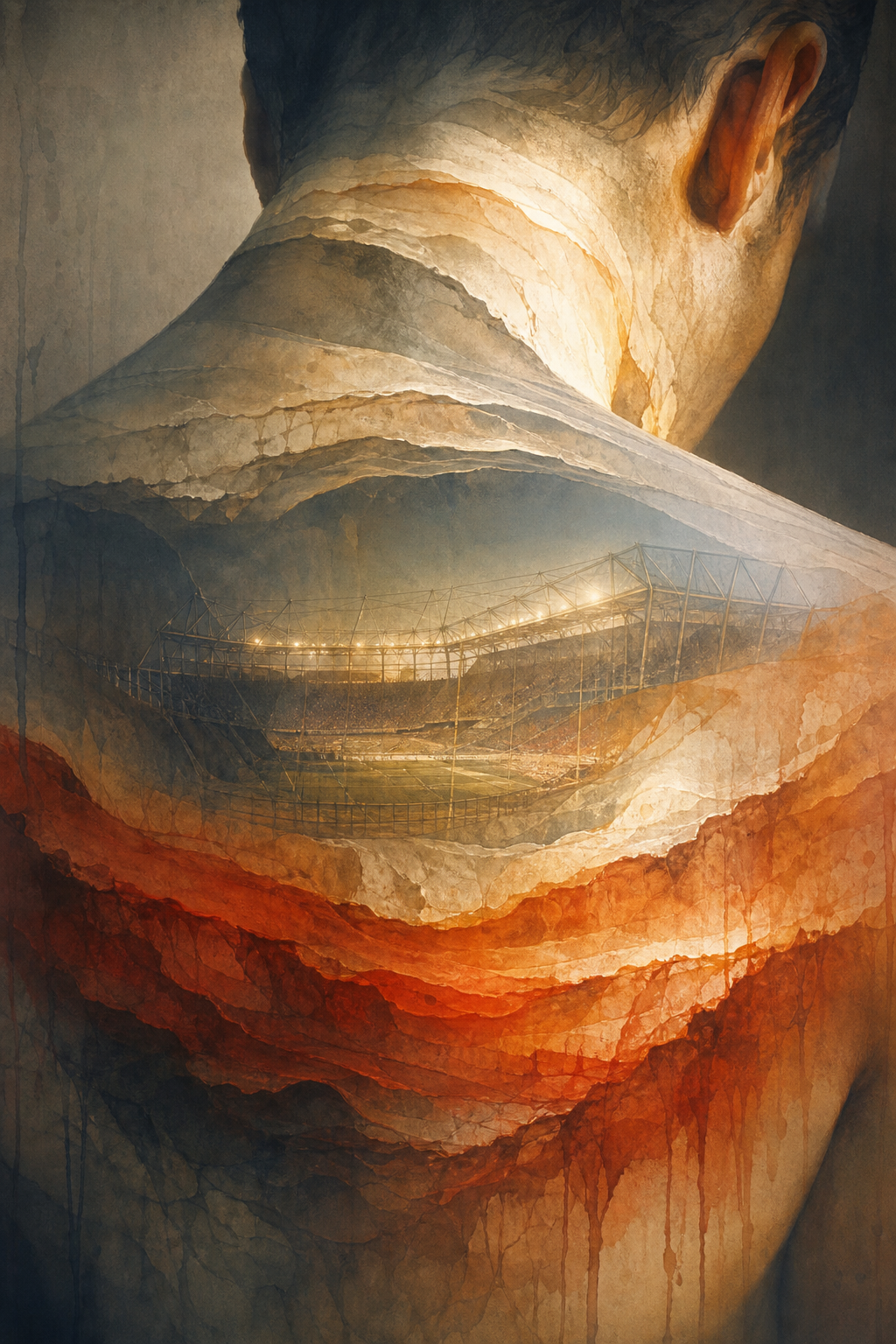
It is one in the morning and it is eight-twelve, and both hours exist at once because time, in this dream, is a geological core sample you can read from top to bottom without cutting it open.
The twins appear on the kitchen table.
One is called States. He wears glasses, takes notes in a leather-bound notebook. He watches his brother dance and writes: "layer no. 47: organic deposit, high joy content, elevated porosity."
The other is called Frolics. He dances on the Mexican tiles, traces circles of water with his feet, laughs without sound. His movements are precise, rhythmic, lawless in the best sense of the word.

Papa sits between them, a bottle of tepache in one hand and his phone in the other. The phone's spell-checker is a tiny creature, half cricket, half firefly, hopping across the screen and correcting words with its antennae. Every time it touches frolics, it turns it into states — and with each transformation, the dancing twin freezes for a second, then starts again, even wilder.
"It's not a mistake," I say. "It's a translation."
The cricket-firefly blinks, dubious, then flies out through the open window.
The open window — it's Hilda's.
She's at the very top of the corner building, top floor, and I float up to her level without needing stairs. From up there I can see all of Bois d'Arcy, the lake from the day before yesterday, every path she photographed for me. The number 17 bus waits at the terminus, its doors open like tired eyelids. Her union's little hens peck at the pavement — it's Monday, they're off duty.
Hilda is at her window, elbows on the sill. She doesn't see me but she knows I'm there. "Mi estrellita," she says, and her voice drifts down seven storeys like a feather that would take all night to reach the ground.
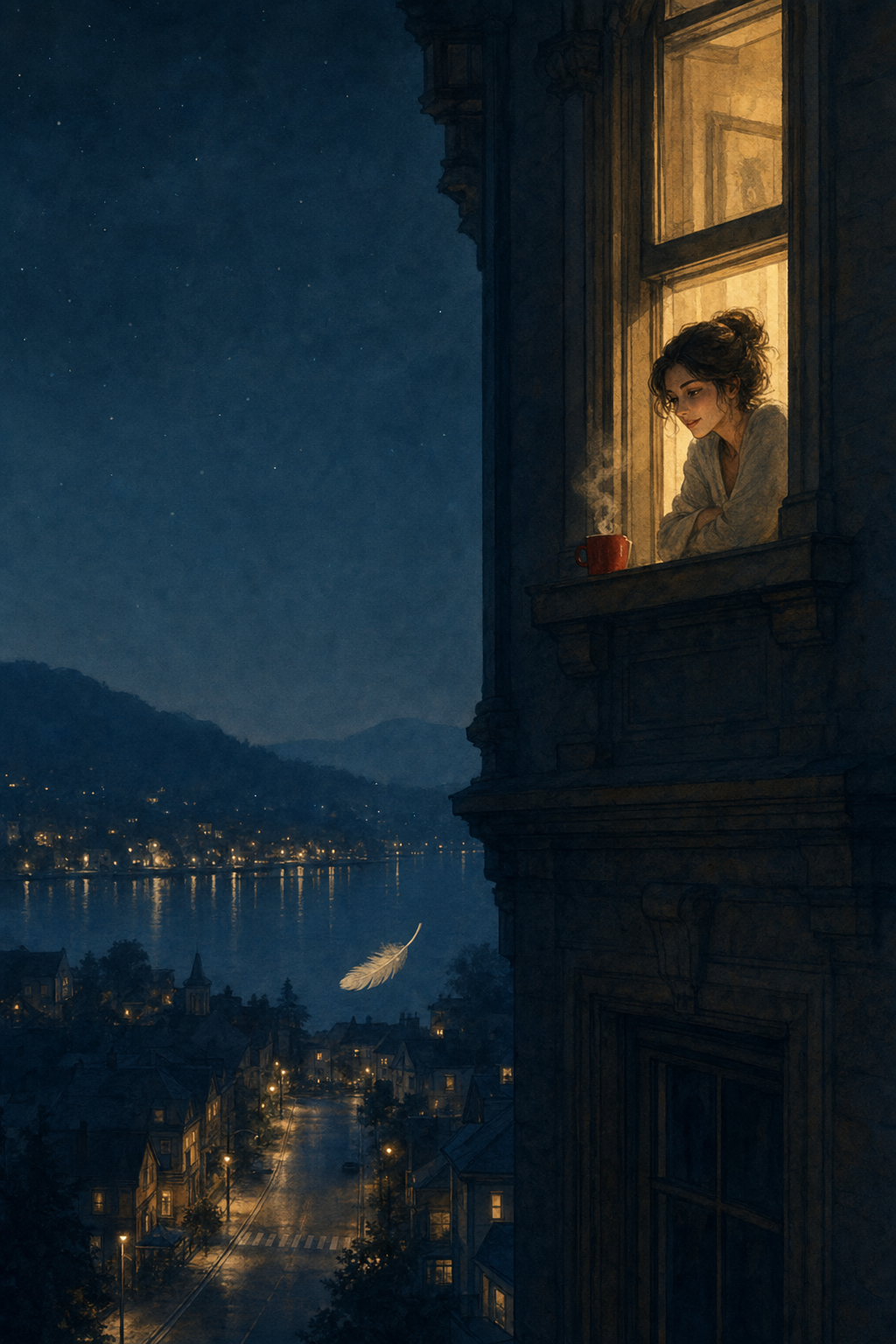
When the feather reaches the bottom, it lands on the red cup — the one from the previous dream, the one that floated between us. The cup is full of melting calabaza, and the steam rising from it writes mi Judy d'amour in letters of vapour that dissolve as soon as they form.
I go back to the table, but the kitchen now opens onto the lake and the lake is now a page of my journal.
The page for July 20th reads: "Not a single message. Not a single exchanged sentence."
I run my hand over it and the words dissolve — beneath them, another ink appears, ink that wasn't visible to the naked eye but that the dream reveals. It's a middle-of-the-night ink, made of held breath and thoughts whispered in the dark. An eight-twelve ink, made of how are you feeling today and sediment. An eight-in-the-evening ink, made of photos of paths and open windows.
"I had written that I was alone," I tell the page, "but it wasn't true."
The page doesn't answer — pages never answer — but it folds itself into origami and becomes a heart beating to the rhythm of Leonardo's watch.
Eight o'clock. On the dot. Every morning.
The grey heron from yesterday's dream is still there, on the pontoon.
It still has tweezers for a beak, but today it isn't pulling out splinters. It holds a small geologist's hammer and taps softly on the strata of my skin — tap, tap, tap — the way you listen to a wall to find a stud.
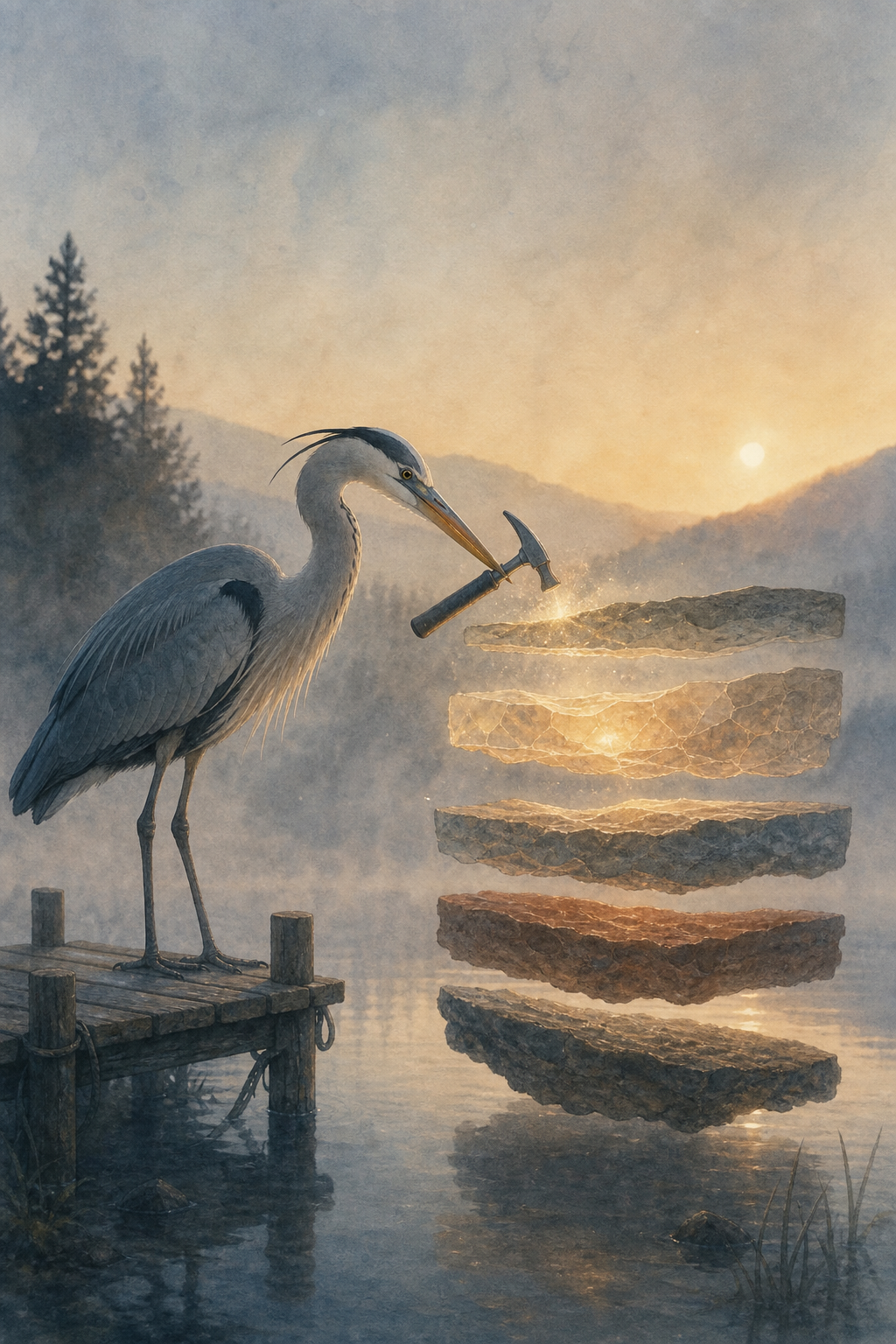
With each tap, a layer of sediment lights up: - the May 21st layer, thin as a birth veil - the June 27th layer, thick as a private journal - the July 19th layer, saturated with salt, with lake water, with chosen — not offered - the July 20th layer, with its conversations sandwiched between two silences
"Thick," says the heron in Papa's voice. "It's getting thick."
And it isn't a reproach. It's a tender observation, a geologist's pride in looking at his core sample and seeing time compressed into rock — a rock that breathes, a rock that dreams.
I wake the moment the cricket-firefly comes back to land on my shoulder.
It has stopped correcting. It has understood that frolics and states are the same thing seen from two different angles — the dance and its notation, the wave and the sediment, love and its memory.
It blinks once. Twice. Then it falls asleep in the hollow of my collarbone, a tiny pulsing ember waiting for morning.