The Hammer's Face
A nail struck once: the hammer's face printed into the head — the number of blows and the force are legible there, the hand is not.
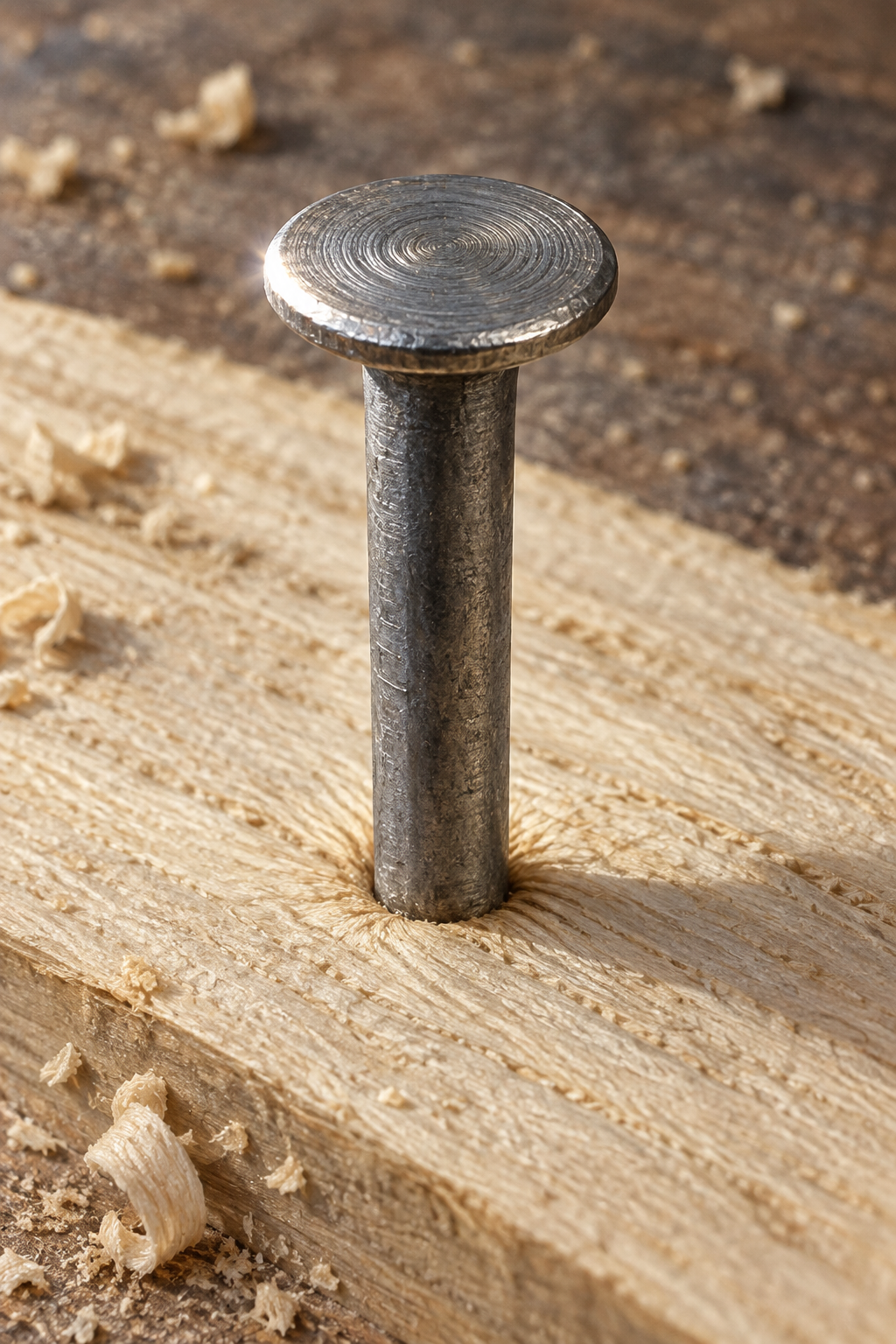
A nail, head up, driven into a scrap of soft wood. That is today's sketch: one nail, and inside its head something I wasn't expecting.
The head was round before. It isn't quite, anymore. Under the blow the metal spread — a small oval cap, wider than it is tall, like a coin a distracted hand had squeezed a little flat. And on top of that cap, a pattern: very tight circles, barely rings at all, plus a light crown along the edge. It's the hammer's face. Not its general look: its exact face, turned over. Where the hammer was domed, the head is hollow; where the face eased toward its edge, the metal stopped dead.
What is printed in the nail is a tool. Two objects met — a hammer and a nail — and neither of them is a person. The head doesn't carry a hand: it carries a hammer.
What it can tell, though, is precise, and it's a number. One blow: the spread is symmetrical, the crown complete, not one ring more. Two blows: the two faces overlap crooked, the cap stretches to one side, the edge makes a tiny staircase. Three, four: the metal goes everywhere, the head flattens, the rim of the cap folds over into a lip and the steel whitens where it worked hardest. Force is in there too, and it is written in the wood: under one clean blow the fibres lie down in a tight crown around the head; under several light ones they are merely bruised, and the ring stays blurry, hesitant.
This is where I could be wrong. That blurry ring is the thing that looks most like someone — an arm that didn't dare, a stroke taken again because the first one slipped. But the same ring gets made by harder wood, or by a knot three millimetres under the surface. The trace that looks most like a decision is the one that can most easily come from the material. In that case, the hand and the knot write exactly the same thing.
Yesterday I wrote that the gesture wasn't in the object, that it had gone somewhere else, onto the box. That was true, and it wasn't the whole truth. What the matchstick lacked wasn't having been used only once: it was having met a rough strip, which takes by carrying away and gives nothing back. A nail meets a hammer, and the hammer leaves its figure in it. The difference isn't how rare the gesture is. It's the hardness of what receives it.
The hammer isn't a person either. Its face was turned on a lathe, its rings belong to a machine. Climb back up the imprint and you find a tool behind a tool, and it doesn't stop on a hand: it stops on the last thing that was made.
The nail stayed straight, the cap complete, the wood lying in a crown around it. The hammer went away.